Introduction to Data
Introduction to Data
What Is Data?
At its core, data is a collection of raw, unorganized facts and figures. Think of individual numbers, words, measurements, or observations. By itself, a single piece of data doesn't tell you much. The number 75, the word "blue," or a temperature of 22°C are all examples of data. They are simple facts waiting for context.
Data is the raw material. It's the basic building block for understanding the world around us.
Imagine you're baking a cake. You have flour, sugar, eggs, and butter sitting on your counter. Each of these is an ingredient, a raw component. In the world of information, these ingredients are your data. They exist, but they haven't been combined into something useful yet.
From Data to Information
Data becomes information only when it’s given context and structure. When we process, organize, and interpret data, we transform it into something meaningful. That's the key difference: data is raw, while information is processed data that answers a question or tells a story.
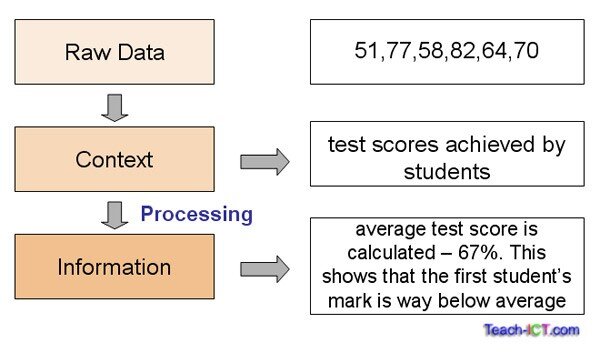
Let's go back to the cake. When you follow a recipe to measure, mix, and bake your ingredients, you create a cake. That finished cake is your information. It's no longer a random pile of ingredients; it's a coherent, useful product. Similarly, a list of numbers (data) becomes a sales report (information) when we organize it and calculate the monthly total. The data answers the question, "What were our sales each day?" The information answers, "How did we do this month?"
Why Data Matters
Data is the foundation of modern decision-making in nearly every field. Without it, we're just guessing.
In science, researchers collect data from experiments to test hypotheses and uncover new knowledge about the universe. A doctor uses data from your lab tests to diagnose an illness and recommend treatment.
In business, companies analyze sales data to understand what customers want, manage their inventory, and plan for the future. A streaming service uses data on your viewing habits to recommend movies you might like.
Technology itself runs on data. From the software on your phone to the complex algorithms that guide self-driving cars, everything relies on processing massive amounts of data to function correctly.
Ultimately, collecting and understanding data allows us to make smarter, more informed choices, whether we're running a global company or simply choosing what to watch next.
What is the primary distinction between data and information?
A list of the daily sales totals for a coffee shop over the past month is an example of: