Introduction to CUDA Programming
CUDA Overview
More Than Just Graphics
For a long time, Graphics Processing Units (GPUs) had one main job: rendering the visuals for your video games and applications. They were highly specialized, built to quickly perform the millions of calculations needed to draw pixels on a screen. But developers realized this hardware was incredibly powerful, capable of much more than just graphics.
The problem was that tapping into this power was difficult. It required clever workarounds and deep knowledge of graphics programming. That all changed in 2007 when NVIDIA released CUDA.
CUDA
noun
Stands for Compute Unified Device Architecture. It is a parallel computing platform and programming model that allows software developers to use a CUDA-enabled GPU for general-purpose processing.
In simple terms, CUDA is a bridge. It gives developers a straightforward way to instruct the GPU to perform a wide range of computational tasks, not just graphics-related ones. This unlocked the massive parallel processing power of GPUs for a whole new world of applications.
CPU vs GPU
To understand why CUDA is so significant, it helps to know how GPUs and Central Processing Units (CPUs) are different. They're designed for fundamentally different types of work.
A CPU is like a master chef. It has a handful of very powerful, versatile cores. Each core can execute a wide variety of complex instructions one after another, very quickly. It's perfect for managing the diverse, sequential tasks required to run your operating system and most everyday software.
A GPU, on the other hand, is like an army of prep cooks. It has thousands of smaller, simpler cores. Each core isn't as capable as a CPU core, but there are a huge number of them. They excel at doing the same, relatively simple task over and over again, all at the same time.
This architectural difference is key. A CPU is optimized for low latency on serial tasks. A GPU is optimized for high throughput on parallel tasks. CUDA lets programmers explicitly assign the high-throughput, parallel parts of their code to the GPU, while the rest runs on the CPU.
The art of CUDA programming lies in efficiently partitioning tasks and managing data transfers between the CPU (the host) and the GPU (the device).
Powering Modern Computing
The ability to harness GPU power has been revolutionary. Many of the biggest advances in technology over the past decade rely heavily on the kind of parallel computing that CUDA enables.
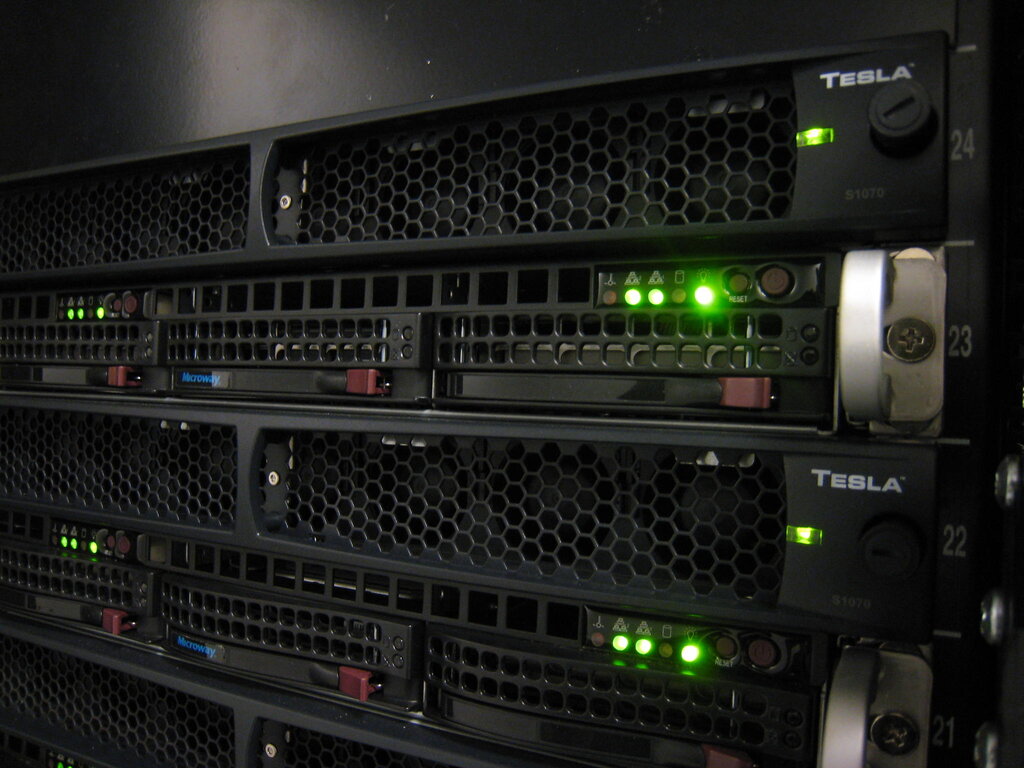
Here are just a few areas where CUDA has made a massive impact:
-
Artificial Intelligence and Machine Learning: Training deep learning models involves performing millions of matrix multiplications. This is a perfectly parallel task, making GPUs ideal. Nearly all modern AI development relies on GPU acceleration.
-
Scientific Research: Scientists use CUDA to run complex simulations for everything from weather prediction and climate modeling to drug discovery and astrophysics.
-
Data Science: Analyzing massive datasets often involves applying the same operation to every data point. GPUs can do this far faster than CPUs, speeding up data processing and analytics.
-
Computer Graphics and Video: Beyond gaming, CUDA is used in professional video editing, special effects rendering, and real-time ray tracing, delivering faster results and more realistic visuals.
By providing a standardized platform, CUDA turned a specialized piece of graphics hardware into a general-purpose supercomputer, fundamentally changing the landscape of high-performance computing.
What is the primary architectural difference between a CPU and a GPU?
Which of the following tasks is best suited for acceleration with a GPU using CUDA?