Introduction to Conic Sections
Geometric Definitions
Slicing a Cone
Conic sections are the curves you get when you slice a cone with a flat plane. But it’s not just any cone. Imagine two identical ice cream cones placed tip-to-tip. This shape is called a double-napped cone.
The shape of the slice, or “section,” depends entirely on the angle of the plane that cuts through the cone. Depending on how you slice it, you can create four distinct types of curves.
The Four Curves
Circle: If you slice the cone with a plane that is perpendicular to the cone's axis, the intersection is a perfect circle. Think of it like cutting a carrot straight across. This is the simplest type of conic section.
A circle is formed when the plane is horizontal and cuts through one nappe.
Ellipse: When you tilt the plane slightly, so it’s no longer perpendicular to the axis but still cuts through only one nappe, the resulting shape is an ellipse. It’s an elongated circle. Most planetary orbits, for example, are ellipses, not perfect circles.
An ellipse is formed when the plane is tilted but still cuts completely through one nappe.
Parabola: Tilt the plane even more, until its angle is exactly parallel to the side of the cone. Now, the plane intersects only one nappe, but it doesn't close back on itself. The curve goes on forever. This open curve is a parabola. The path of a thrown ball is a classic example of a parabola.
A parabola is formed when the plane is parallel to the side of the cone.
Hyperbola: If you tilt the plane so much that it becomes steeper than the side of the cone, it will slice through both the top and bottom nappes. This creates two separate, open curves that mirror each other. Together, these two curves form a hyperbola.
A hyperbola is formed when the plane cuts through both nappes.
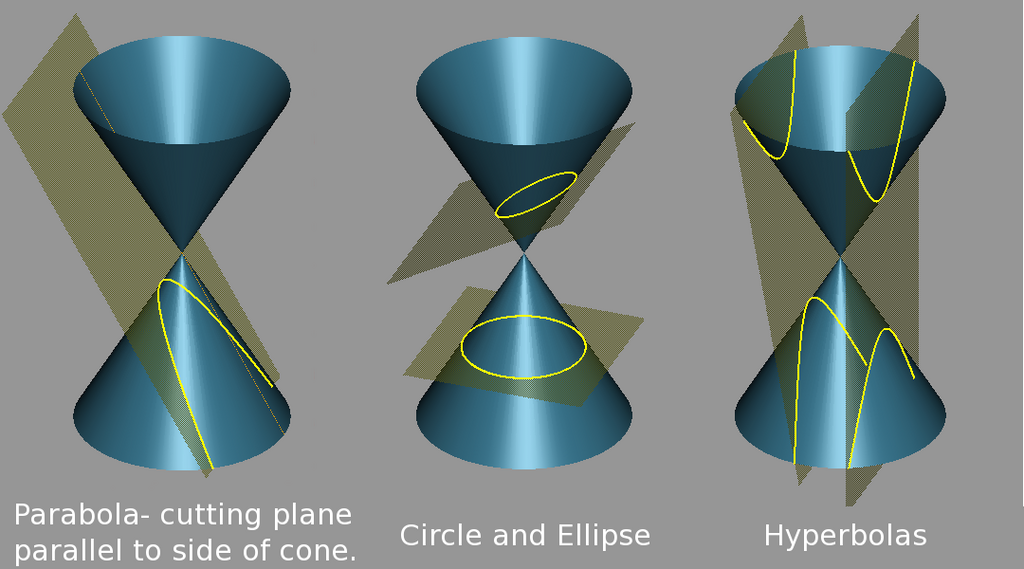
Let's review these fundamental shapes.
Now, test your understanding of how these curves are formed.
Which conic section is formed when a plane intersects a single nappe of a cone at an angle that is NOT perpendicular to the axis, creating a closed curve?
Imagine you slice a cone with a plane that is steeper than the side of the cone itself. What is the result?
Understanding how these four shapes come from slicing a single object is the first step in exploring their unique properties.