Introduction to Computer Servers
Introduction to Servers
What Exactly Is a Server?
Think of a server like a librarian. You (the client) go to the library and ask the librarian for a specific book. The librarian finds the book on the shelves and brings it to you. In the digital world, a server does a similar job. It's a computer program or device that provides a service to another computer program and its user, also known as the client.
When you browse a website, stream a movie, or check your email, you're interacting with a server. Your computer, phone, or tablet is the client. It sends a request over a network, like the internet, to a server. The server receives that request, finds the information you asked for, and sends it back to your device.
A server's main job is to listen for requests from clients, process them, and send back a response.
The Client-Server Model
This relationship between your device and the server is called the client-server model. It's the fundamental structure that makes the internet work. The client initiates the conversation by making a request, and the server responds with the requested data or service. This is a two-way street, but the client always starts the conversation.
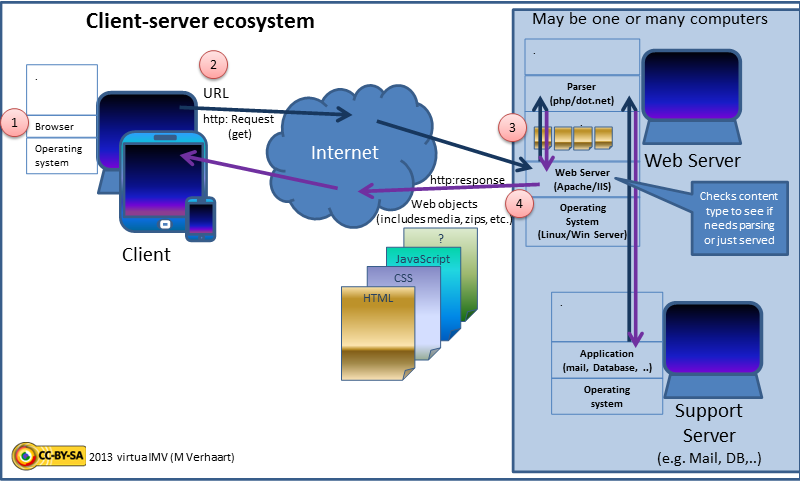
For example, when you type a web address into your browser:
- Your browser (the client) sends an HTTP request to the web server that hosts the website.
- The server receives the request, finds the files for that webpage (HTML, CSS, images).
- The server sends those files back to your browser as an HTTP response.
- Your browser assembles the files and displays the webpage for you to see.
The Purpose of Servers
Why not just connect all computers directly to each other? The primary purpose of servers is to manage shared network resources. Instead of every computer storing its own massive library of data or running powerful applications, a central server can do it for everyone. This is much more efficient.
Servers provide centralized services like:
- Data Storage: Services like Google Drive or Dropbox use servers to store your files, so you can access them from any device.
- Processing Power: Complex calculations or running large applications can happen on a powerful server, so your local computer doesn't have to do all the heavy lifting.
- Communication: Email servers, for example, manage the sending, receiving, and storing of messages for many users.
By centralizing resources, servers make it easier to manage, update, and secure data and applications for many users at once.
Basic Server Components
Under the hood, a server is still a computer, so it has many of the same components as your desktop or laptop. However, server components are typically more powerful and durable because they are designed to run 24/7 and handle requests from many clients simultaneously. A server is made up of both hardware and software.
| Component | Type | Purpose in a Server |
|---|---|---|
| CPU | Hardware | The 'brain' of the server, executing instructions to process client requests. Servers often have multiple powerful CPUs. |
| Memory (RAM) | Hardware | Temporarily stores data for quick access. More RAM allows a server to handle more requests at the same time. |
| Storage | Hardware | Permanently stores files and data (e.g., website files, databases). Often uses fast, reliable Solid-State Drives (SSDs). |
| Network Interface | Hardware | The physical connection to the network (like an Ethernet port) that allows the server to send and receive data. |
| Operating System | Software | Manages the server's hardware and software resources. Examples include Linux Server or Windows Server. |
| Server Application | Software | The specific program that provides the service, such as Apache for a web server or MySQL for a database server. |
These components work together to ensure the server can reliably and efficiently respond to all the clients that depend on it.
In the client-server model, which part is responsible for initiating a request for information or a service?
Imagine you are watching a movie on a streaming service. Your computer or smart TV is acting as the ______.
Now that you understand the role and basic makeup of a server, you're ready to explore the different types of servers and the specific jobs they do.