Introduction to Computer Science
Introduction to Computer Science
What is a Computer?
At its heart, a computer is a machine that follows instructions. It takes input, processes it, and produces an output. This simple idea has roots stretching back further than you might think. Mechanical calculators existed for centuries, but the concept of a programmable machine truly began with Charles Babbage and his Analytical Engine in the 19th century. Ada Lovelace, a mathematician working with Babbage, wrote what is considered the first algorithm intended for a machine, making her the first computer programmer.
Of course, these early mechanical devices were a far cry from the electronic computers that emerged in the 20th century. The invention of the transistor and the integrated circuit made computers smaller, faster, and more powerful, paving the way for the personal computers and smartphones we use every day.
Hardware vs. Software
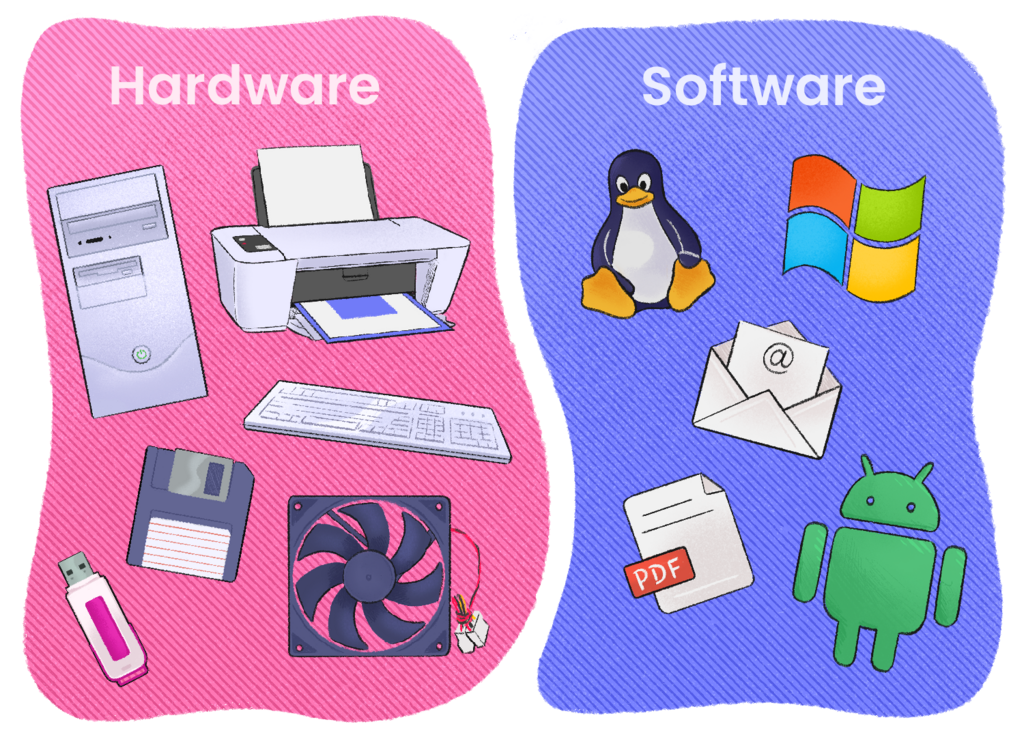
Every computer system is made of two fundamental parts: hardware and software. The distinction is simple.
Hardware is any physical part of the computer you can touch. This includes the screen, keyboard, mouse, and the internal components like the processor and memory chips.
Software is the set of instructions that tells the hardware what to do. You can't touch software. It includes everything from the operating system (like Windows or macOS) that manages the computer's resources to the applications you use, such as a web browser or a game.
Think of it like a book. The paper, ink, and binding are the hardware. The story, chapters, and words on the pages are the software. One is useless without the other.
Inside the Machine
So how does the hardware actually run the software? A few key components work together to process information. While a modern computer has many parts, we can focus on three core pieces to understand the basics.
-
CPU (Central Processing Unit): This is the brain of the computer. Its job is to read and execute instructions from the software. Everything you do on a computer, from moving the mouse to watching a video, involves the CPU processing billions of instructions per second.
-
RAM (Random Access Memory): This is the computer's short-term memory. When you open an application, it gets loaded from long-term storage into RAM so the CPU can access it quickly. Think of RAM as your desk space. It holds what you're currently working on. The more RAM you have, the more things you can work on at once without slowing down.
-
Storage (Hard Drive or SSD): This is the computer's long-term memory. It's where your files, applications, and operating system are stored permanently, even when the computer is turned off. Continuing the desk analogy, storage is like your filing cabinet. You pull files from the cabinet (storage) to place on your desk (RAM) when you need them.
These parts constantly communicate. When you want to open a document, you provide input (a double-click). The CPU gets this instruction, finds the document in storage, loads a copy of it into RAM, and then displays it on the output screen.
Instructions and Organization
Computer science isn't just about hardware; it's about solving problems. To solve a problem with a computer, we need two things: a set of instructions and a way to organize the information the instructions will use. These are known as algorithms and data structures.
algorithm
noun
A finite sequence of well-defined, computer-implementable instructions, typically to solve a class of specific problems or to perform a computation.
An algorithm is simply a step-by-step recipe for accomplishing a task. If you've ever followed a recipe to bake a cake, you've used an algorithm. It gives you a clear, ordered set of steps to get from your ingredients (input) to a finished cake (output).
A data structure is how we organize information. In our cake recipe, you might have your dry ingredients in one bowl and your wet ingredients in another. This organization, or structure, makes it easier to follow the recipe. In computer science, we use data structures like lists, arrays, and trees to store data in ways that make our algorithms efficient. The way data is structured has a huge impact on how quickly and easily an algorithm can work with it.
These two concepts, algorithms and data structures, are the foundational building blocks of all software. Every application on your phone or computer is built from complex algorithms operating on well-organized data.
Which of the following is an example of computer software?
Who is credited with writing the first algorithm intended for a machine, making them the first computer programmer?
Understanding these core ideas, from the physical hardware to the abstract logic of an algorithm, is the first step into the world of computer science.