Introduction to Computational Fluid Dynamics
Introduction to Fluid Mechanics
What Makes a Fluid?
Think about the difference between a block of wood and a cup of water. You can pick up the wood, and it keeps its shape. Water, on the other hand, takes the shape of its container. If you spill it, it spreads out. This ability to flow and change shape is the defining feature of a fluid.
Fluids include both liquids and gases. While a solid resists being deformed, a fluid continuously deforms when a force is applied. It can't hold a fixed shape on its own. To understand how fluids behave, whether they're sitting still or rushing through a pipe, we need to look at a few of their basic properties.
Fluid
noun
A substance that has no fixed shape and yields easily to external pressure; a gas or a liquid.
Three of the most important properties are density, pressure, and viscosity.
Density is how much "stuff" is packed into a given space. It's the mass of the fluid per unit of volume. A bucket of water is much heavier than a bucket of air because water is far denser.
Pressure is the force a fluid exerts on a surface, spread out over the area of that surface. If you dive into a pool, you can feel the water pressure increasing on your ears as you go deeper. This pressure acts in all directions at once.
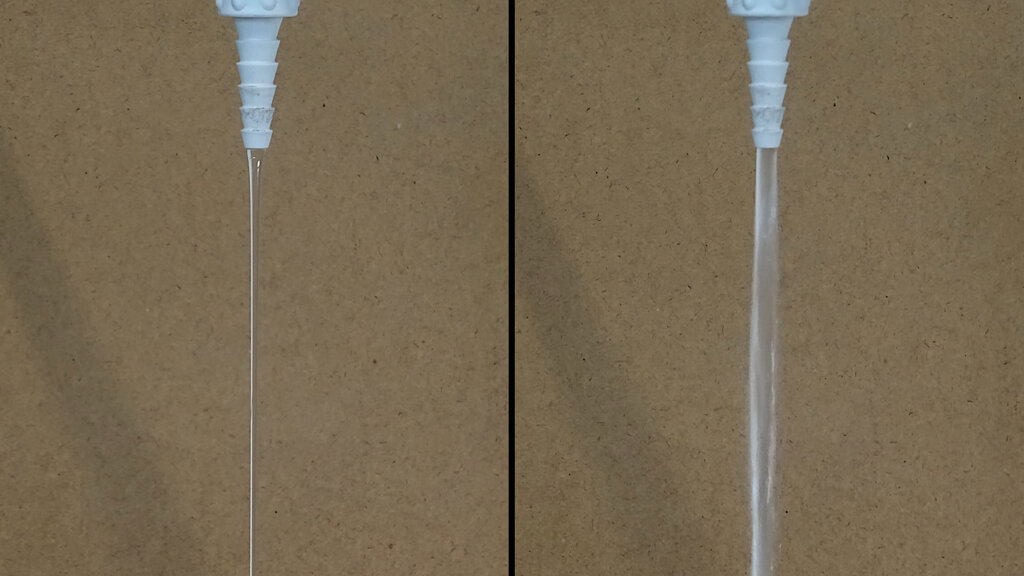
Viscosity is a fluid's resistance to flowing. Honey is highly viscous; it pours slowly and thickly. Water has low viscosity and flows easily. This property is like a kind of internal friction within the fluid.
Fluids at Rest
When fluids aren't moving, they're in a state of equilibrium. The study of this is called fluid statics. The most important principle here is that pressure increases with depth. This is known as hydrostatic pressure.
In a static fluid, the pressure at any given point is the same in all directions.
The pressure at a certain depth depends on the density of the fluid (), the acceleration due to gravity (), and the depth ().
This principle is the reason dams must be built much thicker at the bottom than at the top. The immense pressure from the water at the base requires a stronger structure to hold it back.
Another key concept in fluid statics is buoyancy. This is the upward force exerted by a fluid that opposes the weight of an immersed object. It's why ships float and why you feel lighter in a swimming pool. The buoyant force is equal to the weight of the fluid that the object displaces. This is Archimedes' principle.
Principles of Fluid Motion
When fluids start moving, things get more interesting. This is the realm of fluid dynamics. The most fundamental idea governing fluid motion is the principle of conservation of mass.
This principle states that mass cannot be created or destroyed. For a fluid, this means that the amount of fluid entering a section of a pipe must equal the amount leaving it, assuming there are no leaks. This is expressed through the continuity equation.
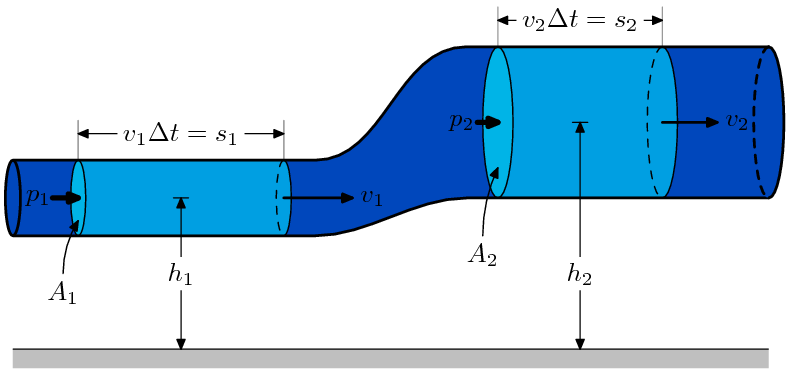
Imagine a river that flows from a wide channel into a narrow gorge. To get the same amount of water through the smaller space in the same amount of time, the water must speed up. This is a direct consequence of mass conservation.
For an incompressible fluid (one whose density doesn't change), the continuity equation relates the cross-sectional area of the flow () to its velocity ().
Another core concept is momentum conservation, which comes from Newton's second law (). For a fluid, this means a net force is required to change its velocity. This force could come from pressure differences, gravity, or friction (viscosity).
Finally, the principle of energy conservation applies to fluids as well. The total energy of a fluid in motion, which includes its pressure energy, kinetic energy (from motion), and potential energy (from height), remains constant along its path, provided there's no friction. This is the essence of Bernoulli's principle, a cornerstone of fluid dynamics.
Bernoulli's principle states that where the speed of a fluid is higher, its pressure is lower.
This relationship explains how airplane wings generate lift. The curved top surface of a wing forces air to travel faster than the air moving along the flat bottom surface. This speed difference creates lower pressure above the wing and higher pressure below it, resulting in an upward force.
These foundational ideas are the building blocks for understanding the complex world of fluid flows.
What is the primary characteristic that defines a substance as a fluid?
If you have two identical buckets, one filled with water and one filled with air, the bucket of water is much heavier. This is because water has a higher ______.