Introduction to Computational Fluid Dynamics
Fluid Mechanics Basics
What Makes a Fluid?
A fluid is any substance that can flow. This includes liquids like water and gases like air. Unlike solids, fluids don't have a fixed shape; they take the shape of their container. To understand how they behave, we need to look at a few key properties.
Density
noun
The amount of mass packed into a given volume.
Mathematically, we write density (represented by the Greek letter , or rho) as mass () divided by volume (): . It's a fundamental measure of how compact a substance is.
Viscosity
noun
A fluid's resistance to flow. It's a measure of its internal friction.
Think of viscosity as how “thick” a fluid is. A fluid with high viscosity resists motion because its molecules create a lot of internal friction. This property is crucial for everything from lubricating engine parts to understanding how blood flows through your veins.
How Fluids Flow
Fluid flow isn't always the same. Watching a calm river is very different from watching a raging waterfall. We can classify these different behaviors to better predict how a fluid will act.
The two main types of flow are laminar and turbulent.
Laminar flow is smooth and orderly. The fluid moves in parallel layers with little to no mixing between them. Imagine slowly pouring syrup onto pancakes; it flows in a steady, predictable stream. This type of flow typically happens at low speeds or in highly viscous fluids.
Turbulent flow is chaotic and irregular. Instead of smooth layers, you see swirls, eddies, and vortices. Think of the smoke rising from a candle, which starts smooth (laminar) but quickly becomes a swirling, unpredictable mess (turbulent). This is common at high speeds or in less viscous fluids.
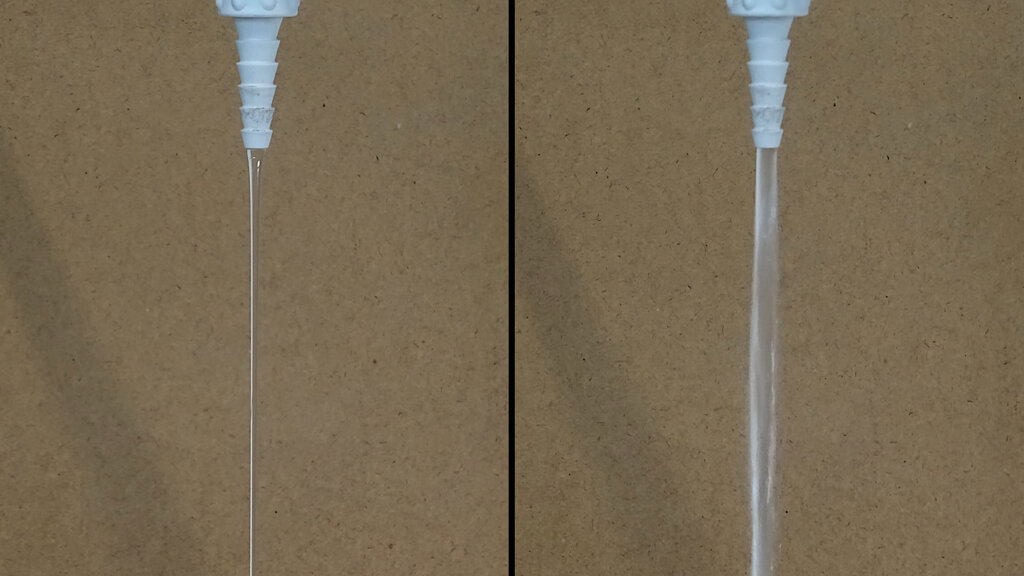
Another important distinction is whether a flow is compressible or incompressible.
Incompressible flow is a flow where the fluid's density remains constant. This is a very good approximation for most liquids, like water. Even if you squeeze water, its volume doesn't change much.
Compressible flow is a flow where the density changes significantly. This is common for gases, especially when they are moving at high speeds. For example, the air flowing over an airplane's wing is compressed and expanded, and these density changes are critical for generating lift.
The Rules of Motion
To predict fluid motion, we use a set of fundamental equations. These aren't new laws of physics; they are simply the application of principles you might already know—conservation of mass, momentum, and energy—to fluids. They form the mathematical foundation of all fluid dynamics.
The fundamental principles of Computational Fluid Dynamics (CFD) include the conservation of mass, momentum, and energy, which are derived from the Navier-Stokes equations.
Let's look at what each conservation principle means for a fluid.
A simple way to think about this is a garden hose. If you put your thumb over the end, you narrow the opening. The same amount of water still needs to get out, so it speeds up. Mass is conserved.
These equations, often called the Navier-Stokes equations, are notoriously difficult to solve. They capture the complex interplay between inertia, pressure, viscosity, and external forces that dictates how a fluid moves.
This equation is especially important in problems involving heat transfer, such as analyzing the cooling of electronics or the aerodynamics of a high-speed vehicle.
What is the defining characteristic of a fluid?
Which of the following correctly represents the formula for density (ρ), given mass (m) and volume (V)?
Together, these properties, classifications, and governing equations provide the framework needed to analyze and predict the behavior of fluids in almost any situation.