Introduction to Computational Fluid Dynamics
Introduction to CFD
What Is Computational Fluid Dynamics?
Computational Fluid Dynamics, or CFD, is a way to simulate the movement of fluids like air and water using computers. Think of it as a virtual laboratory. Instead of building a physical prototype of a car and putting it in a real wind tunnel, engineers can build a digital model and test it on a computer. This saves time and money, and allows for countless design tweaks to be tested quickly.
CFD helps us understand and predict how fluids flow, how heat moves through them, and how they interact with surfaces. This is crucial in many fields. Aerospace engineers use it to design more efficient airplane wings. Civil engineers use it to analyze wind patterns around skyscrapers. Even doctors use it to study blood flow through arteries.
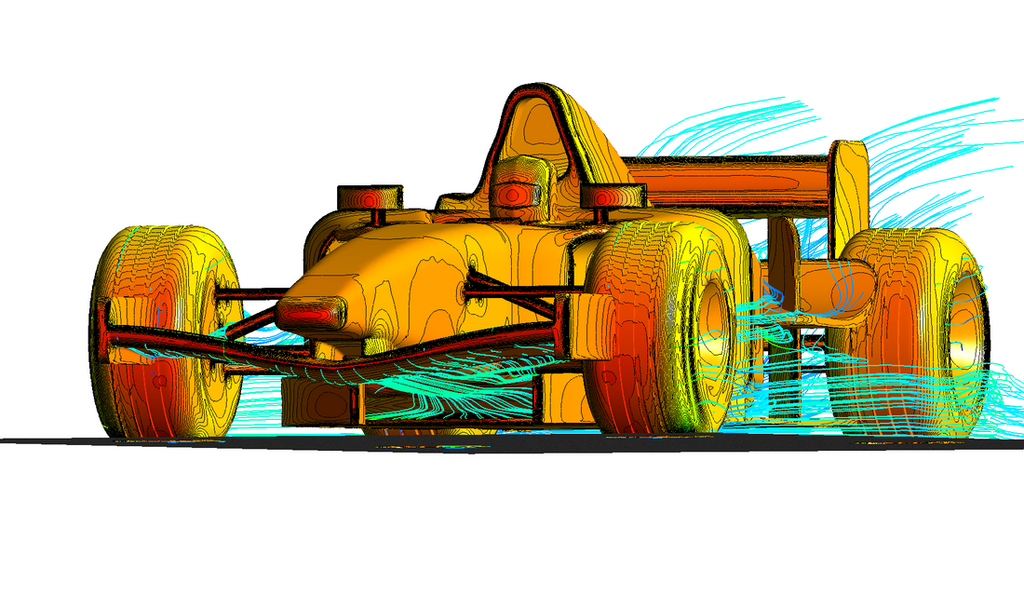
The core idea is to break down a complex fluid flow problem into millions of smaller, simpler calculations that a computer can solve. By piecing together the results, we get a detailed picture of the entire system.
Essentially, CFD provides a window into the invisible world of fluid motion, making it possible to see things like turbulence, pressure zones, and temperature gradients that would be difficult or impossible to measure directly.
Governing Equations of Flow
The behavior of fluids isn't random. It's governed by a set of fundamental physical principles, which can be expressed as mathematical equations. The most important of these are the Navier-Stokes equations. They are a set of partial differential equations that describe how a fluid's velocity, pressure, temperature, and density are related.
These equations are based on the conservation of mass, momentum, and energy.
The Navier-Stokes equations capture in a few succinct terms one of the most ubiquitous features of the physical world: the flow of fluids.
Here is a simplified form of the Navier-Stokes equation for an incompressible fluid, representing the conservation of momentum:
Let's break that down:
- is the fluid velocity.
- is time.
- is the fluid density.
- is the pressure.
- is the kinematic viscosity (a measure of the fluid's resistance to flow).
The left side describes the acceleration of a small parcel of fluid. The right side describes the forces acting on it: pressure forces and viscous forces.
These equations are notoriously difficult to solve analytically for most real-world scenarios. In fact, proving that smooth, non-turbulent solutions always exist is one of the biggest unsolved problems in mathematics. This is where computers come in.
From Equations to Simulation
Since we can't solve the Navier-Stokes equations with a pen and paper for complex shapes like an airplane, we need another approach. CFD solves them numerically through a process called discretization.
Discretization means breaking a continuous problem down into a finite number of smaller, manageable parts. Imagine trying to find the exact area under a curve. You could approximate it by drawing a series of thin rectangles under the curve and adding up their areas. The more rectangles you use, the closer you get to the true area. CFD does something similar, but for fluid dynamics.
The fluid-filled space is divided into a grid, or mesh, of small cells or volumes. The governing equations are then applied to each individual cell. There are several common ways to do this:
- Finite Difference Method (FDM): This is one of the oldest methods. It approximates derivatives in the equations by using the values at neighboring grid points. It's straightforward but works best for simple, structured grids.
- Finite Volume Method (FVM): This is the most common approach in modern CFD. The equations are integrated over each control volume (cell) in the mesh. This method is excellent at conserving quantities like mass and momentum, which is critical for accuracy. It's also flexible enough to handle complex geometries and unstructured meshes.
- Finite Element Method (FEM): This method divides the domain into smaller elements (like tiny triangles or pyramids) and uses simpler functions to approximate the solution over each element. FEM is very powerful for problems involving complex shapes and is widely used in structural analysis as well as fluid dynamics.
By solving these approximated equations for every cell in the mesh, the computer builds a complete picture of the fluid flow. The result is a massive dataset of pressure, velocity, and temperature values at thousands or even millions of points throughout the domain, which can then be turned into insightful visualizations.
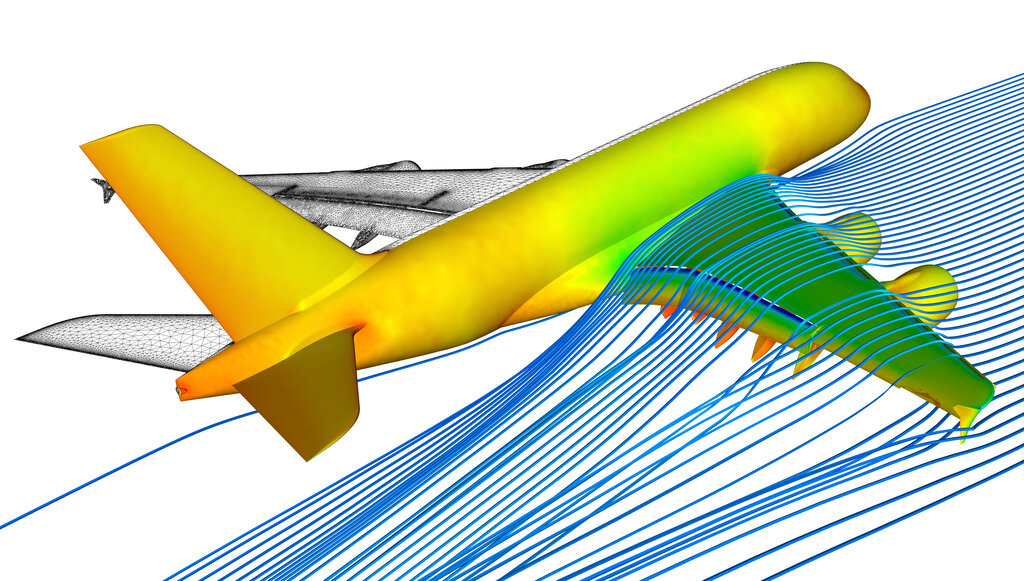
CFD began in the 1960s and 70s, driven by the needs of the aerospace industry and the increasing availability of powerful computers. Early simulations were simple and took a long time to run. Today, with immense computational power, CFD has become an indispensable tool in science and engineering, transforming how we design and analyze systems involving fluid flow.
What is the primary purpose of Computational Fluid Dynamics (CFD)?
The core mathematical principles governing fluid motion, based on the conservation of mass, momentum, and energy, are known as the ______ equations.