Introduction to Complexity Theory
Introduction to Complexity Theory
Beyond the Sum of its Parts
Some things are more than just a collection of their components. A single bird isn't a flock. One person isn't a city. A neuron isn't a thought. In each case, the whole behaves in ways you could never guess by just studying one of its pieces. This is the world of complex systems.
Complex System
noun
A system composed of numerous interconnected and interacting parts whose collective behavior is not easily predicted from the behavior of the individual parts.
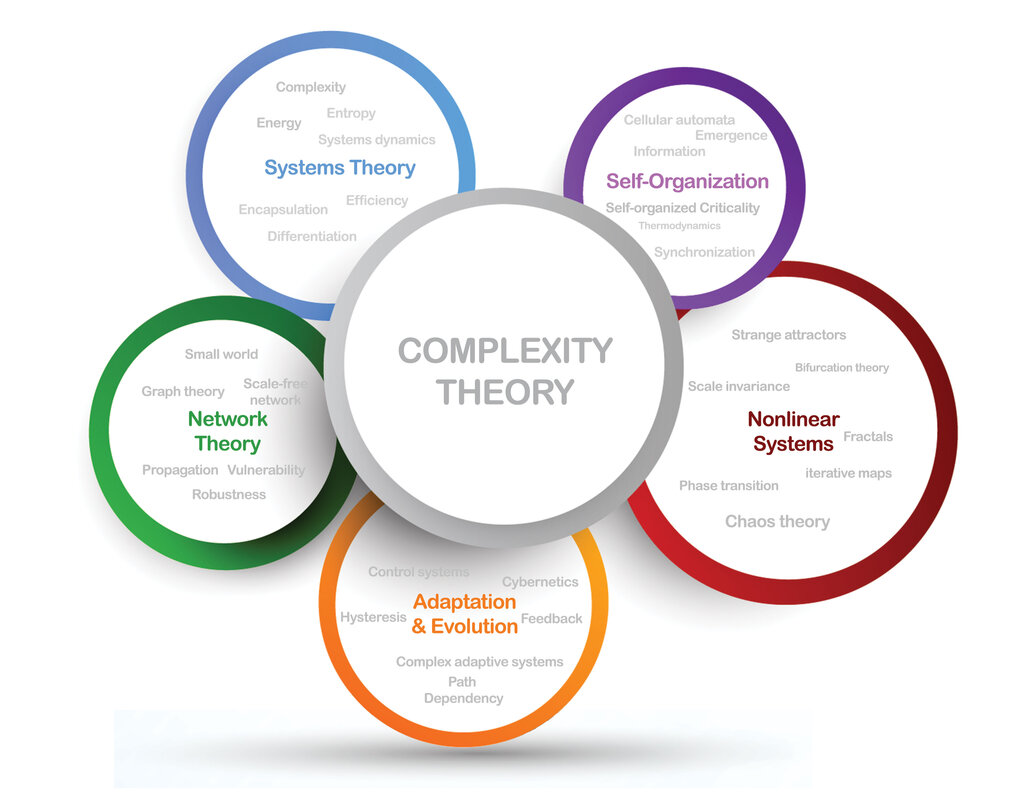
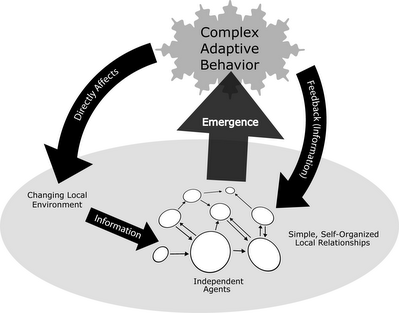
These systems have a few key traits. They are made of many agents—whether they're birds, people, or cells—and these agents interact with each other based on local information. There's no central conductor telling everyone what to do. The intricate, system-wide patterns we see, like a traffic jam or a stock market trend, arise from these local interactions.
Complex vs. Complicated
It's easy to mix up what's complex with what's merely complicated. A jet engine is incredibly complicated. It has thousands of parts, all precisely engineered. But if you have the blueprint, you can understand it completely. You can take it apart and put it back together, and it will work the same way every time. Its behavior is predictable.
A pond ecosystem, on the other hand, is complex. It might have fewer "parts" than a jet engine, but the interactions between the fish, frogs, insects, plants, and water create unpredictable behavior. You can't perfectly predict how the pond will change if you add a new species of fish. The system adapts and changes in ways the blueprint can't show.
| System Type | Description | Example |
|---|---|---|
| Simple | Few parts, predictable behavior. | A light switch |
| Complicated | Many parts, but operate in predictable ways. | A jumbo jet |
| Complex | Many interacting parts, unpredictable behavior. | A rainforest |
This also separates complexity from chaos. Chaos theory often deals with systems that are highly sensitive to their starting conditions. Think of the famous "butterfly effect," where a tiny change at the start can lead to a huge difference later on. Chaotic systems can be deterministic, but they are fundamentally unpredictable over the long term because we can never know the starting conditions perfectly.
Complexity isn't just about unpredictability. It’s about how systems composed of many independent agents can produce large-scale, structured patterns.
A complicated system is a machine. A complex system is an organism.
Why It Matters
Understanding complexity helps us make sense of the world. So many of the systems we care about are complex: economies, cities, immune systems, the internet, and social networks. Traditional science often works by breaking things down into their smallest parts to understand them. This is called reductionism, and it's incredibly powerful.
But for complex systems, reductionism isn't enough. Studying a single driver won't explain a traffic jam. Analyzing one trader won't explain a market crash. Complexity theory gives us the tools to look at the system as a whole. It helps us understand how global patterns can arise from local rules and how these systems adapt and evolve over time.
By studying the principles of complexity, we can gain insights into some of the biggest challenges we face, from managing pandemics to building resilient supply chains and understanding climate change. It's a way of thinking that embraces uncertainty and focuses on the connections between things, rather than just the things themselves.
Which of the following best distinguishes a complex system from a complicated one?
A traffic jam, where individual drivers following simple rules create a large-scale slowdown, is an example of __________.