Introduction to Complexity Theory
Introduction to Complexity Theory
Beyond Simple Parts
Some things are complicated, but predictable. Think of a watch. It has many tiny gears and springs, but if you understand each part, you understand the whole. Its behavior is the sum of its parts.
Now, think of a traffic jam. It also has many parts—individual drivers making individual choices. But you can't understand the traffic jam just by interviewing one driver. The jam has a life of its own. It's a complex system, and understanding these kinds of systems is what complexity theory is all about.
Complexity theory studies how systems with many interacting components create collective behaviors that are more than the sum of their parts.
The Core Principles
Complex systems don't follow simple, linear rules. Instead, they operate on a few key principles that, when combined, produce surprising and intricate results.
Nonlinearity
noun
A property of a system where cause and effect are not proportional. A small change in input can lead to a massive, unpredictable change in output.
In a linear system, if you push something twice as hard, it moves twice as far. Simple. In a nonlinear system, pushing twice as hard might make it move a hundred times farther, or not at all. Think of a single spark that starts a massive forest fire, or the last grain of sand that causes an entire sandpile to collapse. The final input was tiny, but the outcome was huge.
Next is adaptation. The components of a complex system—whether they're drivers, ants, or neurons—are not static. They react to their environment and to each other, changing their behavior based on new information. A driver hears a traffic report and takes a different route. A stock trader sees a price dip and decides to sell. The system is constantly learning and evolving.
This leads to self-organization. Complex systems often create order and structure without any central command or master plan. No one tells a flock of starlings how to create its swirling, hypnotic patterns. Each bird follows a few simple rules, like matching speed with its neighbors and not bumping into them. From these local interactions, a stunning global pattern emerges.
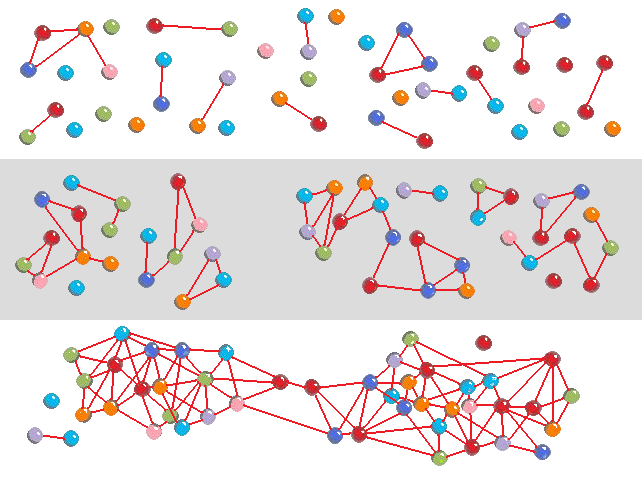
And that brings us to the most magical-seeming principle: emergence.
Emergent phenomena are governed by macroscale rules that seem self-contained, without heed to what the component parts are doing.
Emergence is the new, unpredictable behavior that arises from all these interactions. Individual water molecules aren't wet, but put enough of them together and you get wetness. A single neuron isn't conscious, but the interactions of billions of neurons in your brain give rise to consciousness. These emergent properties cannot be found by studying the individual parts in isolation.
Complexity in the Wild
Once you start looking, you see complex systems everywhere. An ant colony is a classic example. There is no "queen ant" giving orders. Each ant operates on simple chemical cues, but together they achieve incredible feats of engineering, farming, and defense. The colony's intelligence is an emergent property of the interactions between thousands of less-intelligent individuals.
Ecosystems are another example. Predators, prey, plants, and weather all interact in a dynamic, adaptive dance. The health and stability of the entire forest or coral reef is a property of the system as a whole, not just one species.
Even our economies are complex systems. Millions of people making billions of buying and selling decisions create patterns like market trends, economic booms, and recessions. No single person or agency is in control; the overall behavior emerges from the countless local interactions.
Understanding these principles helps us see the world differently. It shows us that intricate patterns and intelligent behaviors can arise from simple rules, and that sometimes, the most important properties of a system can't be found by taking it apart.
According to complexity theory, what is the primary difference between a complicated system like a watch and a complex system like a traffic jam?
The principle that a single spark can start a massive forest fire is a classic example of what characteristic of complex systems?