Introduction to Complexity Theory
Introduction to Complexity Theory
Beyond Complicated
Think about the difference between a high-end watch and a flock of birds. The watch has hundreds of tiny, intricate parts, all working together perfectly. If you study its blueprints, you can understand exactly how it works. It’s a complicated system. A flock of birds, on the other hand, operates on a different level. There are no blueprints, no leader bird choreographing the group’s every swoop and turn. Yet, the flock moves as a single, fluid entity, creating breathtaking patterns in the sky. This is a complex system.
Complexity theory is the study of these systems. It isn’t about how many parts a system has, but about how those parts interact. In a complex system, the richness comes from the connections. Simple, individual actions snowball into large-scale, often surprising, behaviors.
Hallmarks of a Complex System
Complex systems share a few key characteristics, whether we're talking about an ant colony, a city's traffic flow, or the global economy.
First, they consist of many individual components or “agents” that interact with one another. These agents could be ants, drivers, neurons, or companies.
Second, these agents follow simple, local rules. A single ant isn't thinking about building a massive, ventilated nest. It’s just following basic instincts like “follow the pheromone trail” or “if you find food, bring it back.” It has no awareness of the colony's grand design.
Crucially, there is no central control. No one is in charge. The order we see arises from the bottom up, through the countless interactions between agents. This self-organization is a defining feature.
The Magic of Emergence
When these ingredients mix, something remarkable happens: emergence. Emergent behavior is the sophisticated, large-scale pattern that arises from all the simple, local interactions. It’s a property of the system as a whole, which could never be predicted by studying a single agent in isolation.
The world is full of such emergent phenomena: large-scale patterns and organization arising from innumerable interactions between component parts.
A traffic jam is a classic example. No single driver intends to create a jam. Each person is just reacting to the car in front of them: braking, accelerating, changing lanes. But the collective result is a slow-moving wave of congestion that can feel like a solid object, independent of the individual cars flowing through it.
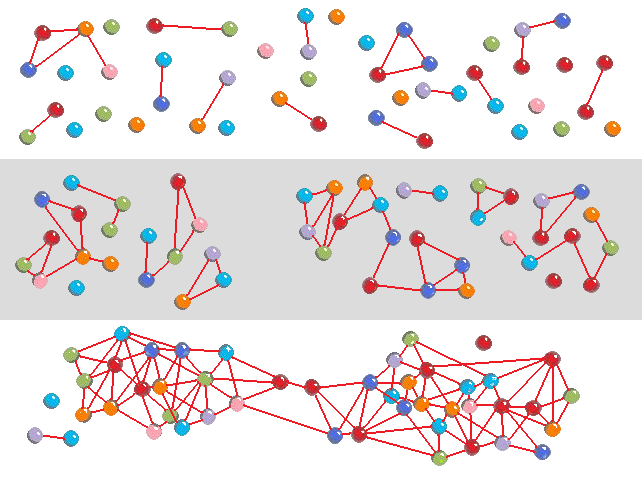
Similarly, consciousness is an emergent property of the brain. A single neuron isn’t conscious. But the interactions of billions of neurons, each following simple electrochemical rules, give rise to thoughts, feelings, and self-awareness. The whole truly becomes greater than the sum of its parts.
Why It Matters
Understanding complexity helps us see the world differently. It shifts our focus from individual components to the relationships between them. Many of the world’s most pressing challenges and fascinating phenomena are rooted in complex systems: climate change, financial markets, the spread of ideas, the evolution of life.
These systems can't be understood by taking them apart. You can’t understand a traffic jam by putting a single car under a microscope. You have to study the interactions. By grasping the fundamentals of complexity, we gain a more powerful lens for making sense of our interconnected world.
Which of the following best describes the core difference between a complicated system and a complex system?
The sophisticated, large-scale patterns that arise from many simple, local interactions within a system are known as __________.