Introduction to Complexity Theory
Introduction to Complexity Theory
Beyond Complicated
Some things are complicated, like the inside of a watch. They have many parts, but they work in a predictable, linear way. Take one gear out, and the watch stops. Put it back, and it starts again. Complexity theory isn't about things that are merely complicated. It's about systems where the individual parts interact in ways that create surprising, unpredictable patterns.
Complexity theory studies how a system's collective behavior arises from the interactions of its individual components.
Think of a traffic jam. There's no central controller telling every car to slow down. Each driver just reacts to the cars immediately around them. A small tap of the brakes by one driver can ripple backward, creating a massive slowdown miles behind. That's a complex system in action. The overall behavior—the traffic jam—can't be understood by just looking at a single car and driver.
Characteristics of Complex Systems
Complex systems, whether they're cities, economies, or ecosystems, share a few key traits.
-
Many Interacting Components: They consist of numerous individual agents, like birds in a flock or traders in a stock market. These agents act independently.
-
Simple Local Rules: Each agent follows a simple set of rules based only on its local environment. A bird doesn't know the flight plan for the whole flock; it just tries to stay close to its neighbors without crashing.
-
No Central Control: There is no single leader or blueprint coordinating the actions of all the agents.
-
Feedback Loops: The actions of agents affect the environment, which in turn affects the future actions of the agents. A successful trading strategy might attract more traders, changing the market dynamics for everyone.
These characteristics mean that the system is constantly adapting and evolving. It's dynamic, not static like the parts in a watch.
More Than the Sum of Its Parts
The most fascinating aspect of complex systems is emergence. This is when the system as a whole displays properties that its individual components do not have. These new behaviors literally 'emerge' from the interactions between the parts.
Emergence
noun
The arising of novel and coherent structures, patterns, and properties during the process of self-organization in complex systems.
A single neuron isn't conscious. But billions of neurons interacting in the brain give rise to consciousness. A single ant is simple, but an ant colony can solve complex problems like finding the shortest path to a food source. The intelligence of the colony is an emergent property.
Emergence is a fundamental property of complex systems and can be thought of as a new property or behavior, which appears due to non–linear interactions within the system; emergence may be considered the ‘product’ or by–product of the system.
This is why you can't predict the behavior of a complex system by taking it apart. Studying one water molecule won't tell you about the power of a tsunami. The whole is truly different than the sum of its parts.
A Science of Connections
Because complexity is a feature of so many different kinds of systems, complexity theory isn't just one field of science. It's an interdisciplinary framework that connects ideas from biology, economics, physics, sociology, and computer science.
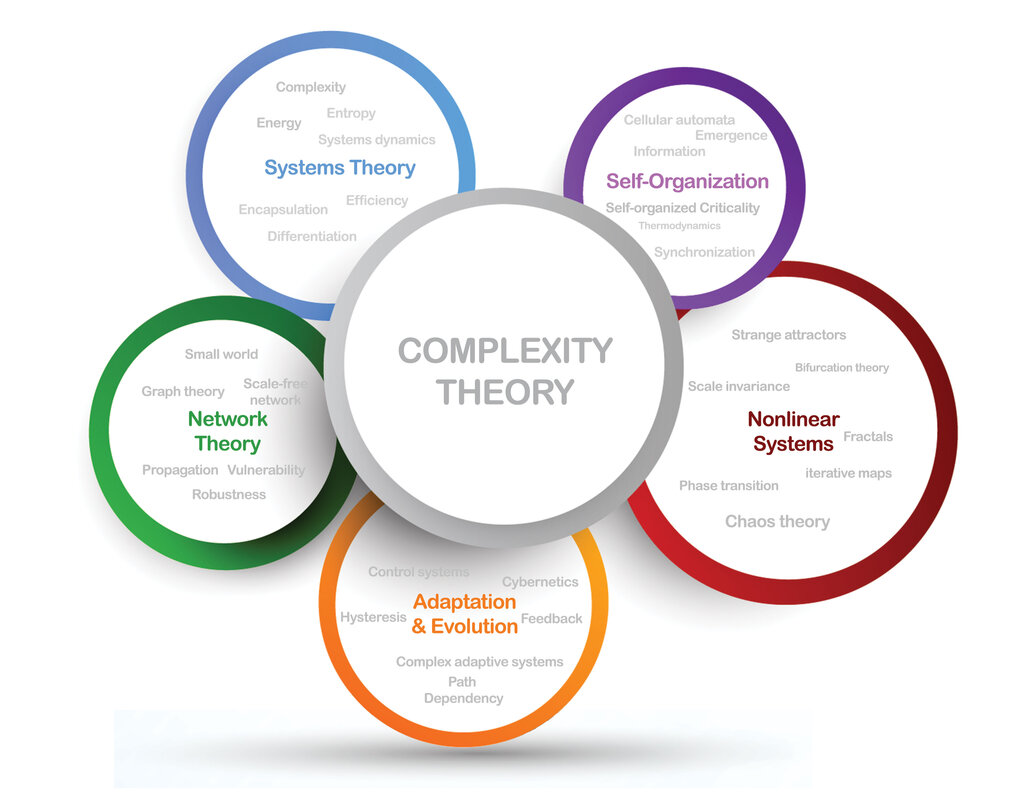
Scientists use its principles to understand everything from how cities grow and how diseases spread to how innovations take hold in an economy. It's a way of thinking that focuses less on individual components and more on the rich, dynamic, and often surprising patterns that arise from their connections.
Ready to check your understanding?
What is the key difference between a 'complicated' system, like a watch, and a 'complex' system, like a traffic jam?
The phenomenon where a system as a whole displays properties that its individual components do not have is known as:
Understanding these foundational ideas is the first step toward seeing the world through the lens of complexity.