Introduction to Coding Fundamentals
Introduction to Programming
What is Programming?
At its core, programming is simply giving instructions to a computer. Think about how you'd give a friend directions to your house. You'd provide a series of clear, step-by-step commands: "Walk to the corner, turn left on Main Street, and walk two blocks." A computer needs instructions just like that, but it can't understand conversational language. It takes everything you say literally and requires absolute precision.
Programming is the art of breaking down a problem into tiny, logical steps and then writing those steps in a language the computer can understand. Whether it's a complex video game or a simple calculator app, every piece of software is built on these foundational instructions.
Programming
noun
The process of writing instructions for a computer to perform a specific task.
Speaking the Computer's Language
Since we can't just talk to a computer in English or Spanish, we use special languages called programming languages. They act as a bridge between human ideas and the computer's electronic circuits. A programming language provides a set of rules and keywords that allow us to write our instructions in a structured way.
There are hundreds of programming languages, each with its own strengths and weaknesses. Some, like Python, are praised for being easy to learn. Others, like C++, are known for their speed and are often used to build high-performance applications like games. Think of them as different tools in a toolbox. You wouldn't use a hammer to turn a screw, and you wouldn't choose the same programming language for every single project.
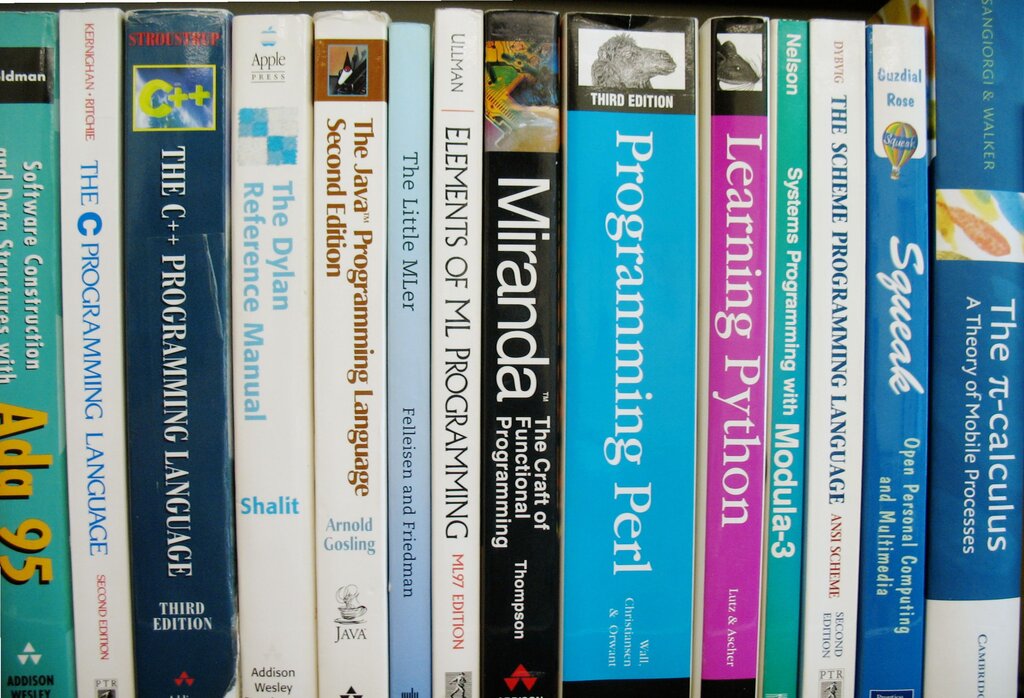
Don't worry about the sheer number of them. The good news is that most languages are built on the same fundamental principles. Once you learn the core logic of programming in one language, picking up another becomes much easier.
The Anatomy of a Program
So what do these instructions actually look like? Most programs, at their simplest, are just text files. These files contain lines of code written according to the rules of a specific programming language. The computer executes these instructions in order, usually from top to bottom, just like you would read a recipe.
Let's look at a classic first program. For decades, a common tradition for new programmers is to write a program that simply displays the phrase "Hello, World!" on the screen. It's a simple goal, but it shows you the basic syntax needed to make a computer do something.
A program is a sequence of instructions that specifies how to perform a computation.
Here is what "Hello, World!" looks like in the C programming language. Don't worry about understanding every single character right now. The key takeaway is to see what a small, complete set of instructions looks like.
// This is a comment. The computer ignores it.
#include <stdio.h>

// All C programs start inside the 'main' function.
int main(void) {
    // This line prints the text to the screen.
    printf("Hello, World!\n");

    // This tells the computer the program finished successfully.
    return 0;
}
This small program has a clear beginning (main), a specific command (printf), and a clear end (return 0). Every program you write, no matter how complex, will be built from small, understandable pieces like this.