Introduction to Coding Concepts
Introduction to Programming
What Is Programming?
At its core, programming is simply telling a computer what to do. Think of it like writing a recipe. You provide a list of precise, step-by-step instructions. The computer, like a chef, follows these instructions exactly to achieve a final result, whether that's displaying a website, calculating a budget, or running a game.
The key word here is precise. A computer doesn't understand nuance or intent. If a recipe says "add a pinch of salt," a human chef uses judgment. A computer would need to be told exactly how many grams of salt to add. Every instruction must be clear, unambiguous, and logical. The art of programming is breaking down a large task into these tiny, literal steps.
The Language of Computers
We can't write instructions for a computer in English or Spanish. Computers operate on a much more basic level, using electrical signals that represent ones and zeros. This is called machine code or binary. Trying to write a program in binary would be incredibly difficult and slow.
This is where programming languages come in. They act as a translator, allowing us to write instructions in a way that is readable for humans. Special programs called compilers or interpreters then convert our code into the binary instructions the computer's processor can understand and execute.
There are hundreds of programming languages, each with its own strengths. Some, like Python, are praised for their simple, clean syntax, making them great for beginners. Others, like C++, offer more direct control over the computer's hardware, making them powerful for high-performance applications like video games.
The Anatomy of a Program
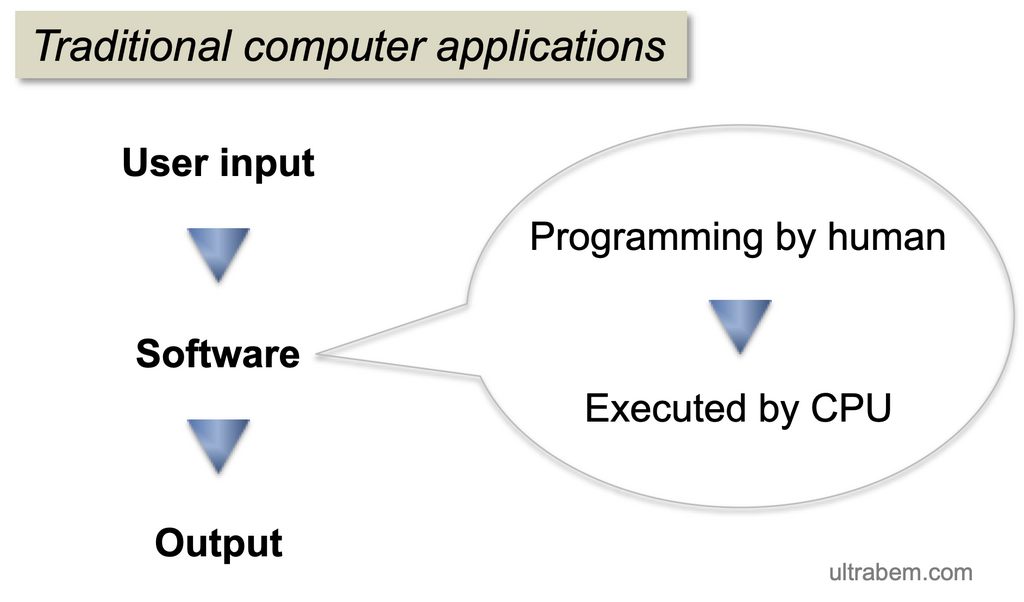
Despite the variety of languages, most programs follow a fundamental structure. They take some information, do something with it, and then produce a result. This can be broken down into three main parts:
Input: The program receives data. This could be a user typing on a keyboard, a file being read, or information from a sensor.
Processing: The program manipulates the data according to its instructions. It might perform a mathematical calculation, sort a list, or change some text.
Output: The program displays the result of its processing. This could be text shown on the screen, a new file being saved, or a light turning on.
Even the most complex software in the world is built on this simple Input-Process-Output model, just with millions of steps layered on top of each other.
Your First Program
A long-standing tradition for new programmers is to write a program that simply displays the message "Hello, World!" on the screen. It's a simple task that confirms your programming environment is set up correctly and introduces you to the basic syntax of a language.
In a conceptual, language-agnostic form called pseudocode, the instruction is as simple as it gets:
PRINT "Hello, World!"
This single line covers the Processing and Output steps. The processing is preparing the text string "Hello, World!", and the output is displaying it. Let's see how this looks in C, one of the most influential programming languages.
// This line includes a library for input/output functions.
#include <stdio.h>

// The main function is the entry point of every C program.
int main() {
    // printf is a function that prints text to the screen.
    printf("Hello, World!\n");

    // Return 0 to indicate the program ran successfully.
    return 0;
}
Don't worry about understanding every piece of this code right now. The key takeaway is seeing how a simple idea, PRINT "Hello, World!", is translated into the specific structure and rules—the syntax—that a particular programming language requires. Writing this code into a file and then using a compiler to run it is the first step on any programming journey.
What is the primary role of a programming language?
Why must instructions given to a computer be extremely precise?
With these basics, you now have a framework for what programming is and how it works. It's less about magic and more about logic and structure.