Introduction to Coding
Introduction to Programming
What Is Programming?
At its heart, programming is simply telling a computer what to do. Think of it like writing a very detailed recipe. If you want to bake a cake, the recipe gives you a list of ingredients and a sequence of steps to follow. Miss a step or add the wrong ingredient, and you won't get a cake.
Computers are the same way, but they're even more literal than the most pedantic baker. They need a precise, step-by-step set of instructions to accomplish any task, from displaying a button on a screen to calculating the trajectory of a rocket. These instructions, written in a special language, form a program.
Program
noun
A sequence of instructions written to perform a specified task with a computer.
The Programmer's Role
A programmer is a problem-solver and a translator. They take a human idea—like "let's build an app to share photos"—and figure out how to break it down into tiny, logical steps that a computer can execute. They then write these steps in a programming language, acting as a bridge between the human world and the digital one.
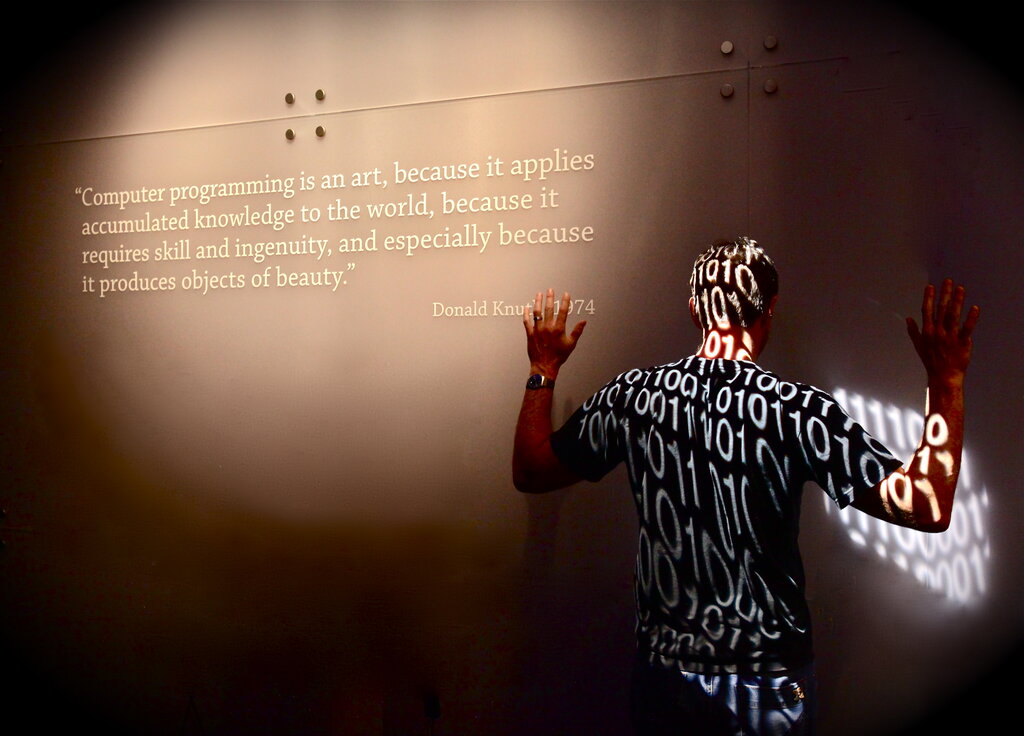
This process involves more than just writing code. A programmer must first understand the problem thoroughly, design a solution, write the instructions, and then test the program to make sure it works correctly. It’s a cycle of thinking, creating, and refining.
From Human Ideas to Machine Actions
So how does text written by a human become something a computer can run? Computers don't understand English or any other human language. They operate on a fundamental level using binary code: millions of ones and zeros that represent electrical signals being on or off.
To bridge this gap, we use special programs called compilers or interpreters. A programmer writes code in a human-readable language like Python or Java. The compiler or interpreter then translates this source code into the binary machine code that the computer's central processing unit (CPU) can understand and execute.
Every program you use, from your web browser to the operating system on your phone, has gone through this translation process.
The Basic Structure of a Program
While every programming language has its own unique rules, or syntax, most programs share a common structure. They take some data as input, process it, and then produce an output.
- Input: This is the data a program receives. It could be a user typing on a keyboard, a file being read, or information from a sensor.
- Processing: This is the core of the program. It involves logic, calculations, and decisions. The program follows its instructions to manipulate the input data. For example, it might sort a list of names or calculate the total cost of items in a shopping cart.
- Output: This is the result of the processing. It could be text displayed on a screen, a new file being saved, or a command sent to a robot's motor.
Think of a simple calculator app. The input is the numbers and the operation you enter. The processing is the calculation itself. The output is the answer displayed on the screen.
Understanding this Input-Process-Output model is a key first step. It’s the fundamental pattern that all programs, simple or complex, are built upon.
What is the primary role of a programmer?
Computers operate on binary code (1s and 0s). How is human-readable code, like Java, made understandable to a computer's processor?
Learning to program is like learning a new way to think. It's about breaking down problems and building solutions with logic and creativity.