Introduction to Classical Physics
Introduction to Classical Mechanics
Describing Movement
Before we can understand why things move, we first need a clear way to describe how they move. This is the job of kinematics. It’s all about position, speed, and changes in speed.
Everything starts with displacement. This isn't just how far something traveled, but how far it is from its starting point and in what direction. If you walk 5 meters east and then 5 meters west, your total distance traveled is 10 meters, but your displacement is zero because you ended up exactly where you started.
Velocity is how fast an object's displacement is changing. It's not just speed; it includes direction. A car traveling at 60 miles per hour north has a different velocity than a car traveling 60 miles per hour south.
When velocity changes, we call it acceleration. You experience acceleration when you press the gas pedal in a car (speeding up), hit the brakes (slowing down), or turn the steering wheel (changing direction). In all three cases, your velocity is changing.
The Laws of Motion
Objects don't just start, stop, or turn on their own. Their motion changes because of forces. A force is simply a push or a pull. The other key ingredient is mass, which is a measure of how much “stuff” an object is made of. Critically, mass is also a measure of inertia—an object’s resistance to changes in its motion.
This brings us to Newton's First Law of Motion, the law of inertia. It states that an object will keep doing what it's already doing unless a force acts on it. If it's at rest, it stays at rest. If it's moving, it will continue moving in a straight line at a constant speed.
An object in motion stays in motion, and an object at rest stays at rest, unless acted upon by an external force.
Think about a hockey puck gliding across the ice. It keeps moving in a straight line until it hits the wall or friction from the ice slows it down. Those are the external forces that change its motion.
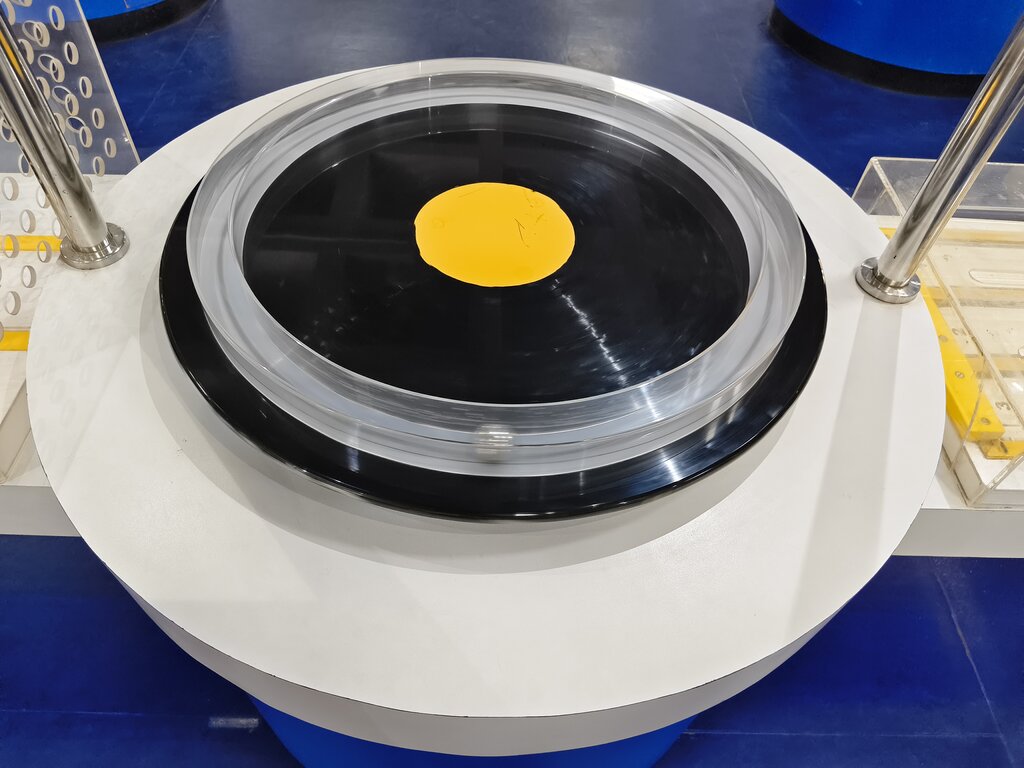
Force, Mass, and Acceleration
So, what happens when a force does act on an object? Newton's Second Law gives us the answer. It provides a precise, mathematical relationship between force, mass, and the acceleration that results.
This simple equation says that the force () required to move an object is equal to its mass () multiplied by its acceleration ().
This makes intuitive sense. If you push a small grocery cart and a heavy one with the same amount of force, the small one will accelerate more quickly. More mass means less acceleration for a given force. Likewise, if you want to make the heavy cart accelerate faster, you have to push it with more force.
The formula can also be rearranged as . This shows that acceleration is directly proportional to the net force and inversely proportional to the mass. It's the cornerstone of how we calculate the motion of almost everything in our everyday world.
Forces Come in Pairs
Forces never exist in isolation. Whenever one object exerts a force on a second object, the second object exerts an equal and opposite force back on the first. This is Newton's Third Law of Motion.
It’s often called the “action-reaction” law. If you press your finger against a wall, the wall is pressing back on your finger with the same amount of force. You feel the wall's force.

A rocket provides a great example. It doesn't push against the ground to fly. It pushes hot gas out of its engines (the action). In response, the gas pushes the rocket forward (the reaction). This is true even in the vacuum of space, where there's nothing to “push against.” The two forces are equal in strength but opposite in direction.
Putting It All Together
With these three laws, we can analyze complex movements, like the arc of a thrown baseball or a satellite orbiting the Earth.
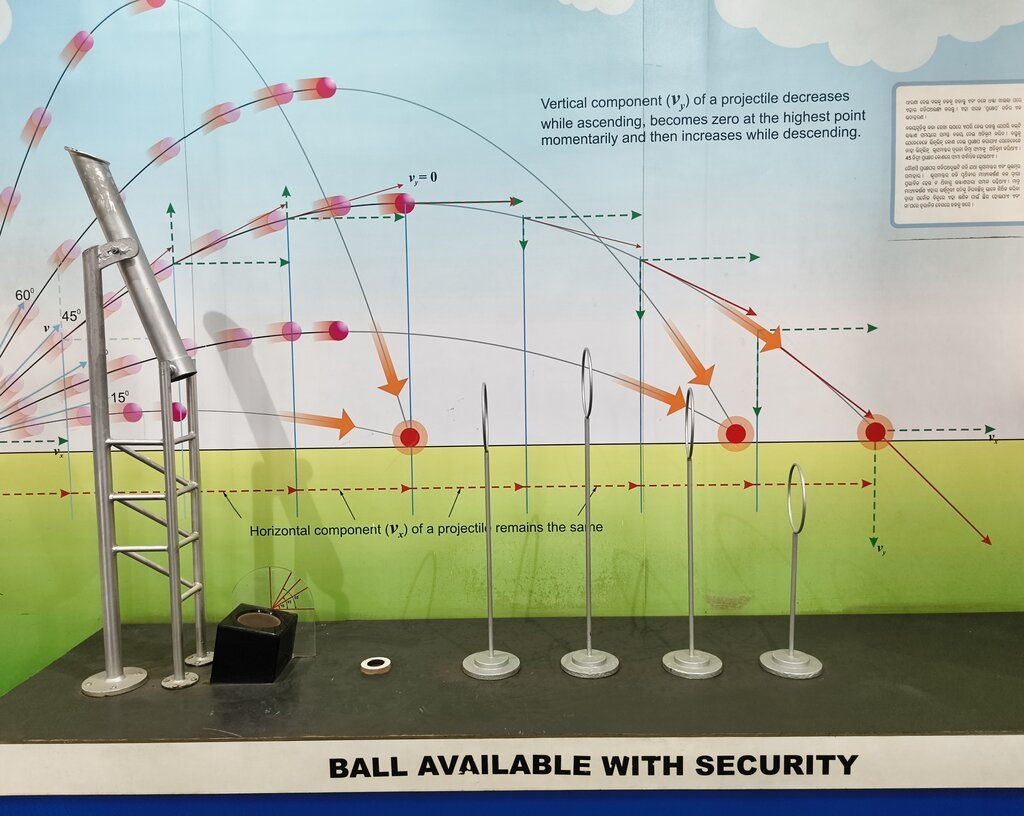
Projectile motion is a classic example. When you throw a ball, the only significant force acting on it is gravity, which pulls it downward. This causes a constant vertical acceleration (Newton's 2nd Law). Horizontally, however, there's no force (ignoring air resistance), so the ball maintains a constant horizontal velocity (Newton's 1st Law). The combination of these two motions creates the familiar parabolic arc.
Uniform circular motion is another application. An object moving in a circle at a constant speed is still accelerating because its direction—and therefore its velocity—is constantly changing. According to Newton's Second Law, an acceleration requires a force. For circular motion, this is a centripetal force, one that always points toward the center of the circle. If you swing a ball on a string, the tension in the string provides the centripetal force that keeps the ball from flying off in a straight line.
These fundamental principles form the bedrock of classical mechanics, allowing us to predict and understand the motion of the world around us.
A runner completes exactly one lap around a 400-meter circular track, ending precisely where they started. What is their total displacement?
An astronaut in deep space, far from any significant gravitational pull, throws a wrench. What path will the wrench follow after it leaves her hand?