Introduction to Cisco
Cisco Systems Overview
The Stanford Connection
In the early 1980s, Stanford University was a maze of different computer networks. Departments had their own systems, but they couldn't talk to each other. It was like having a dozen different postal services that refused to deliver each other's mail. Two Stanford computer staff members, Leonard Bosack and Sandy Lerner, decided to solve this problem.
Working from their living room, they developed the first multi-protocol router. This device was a game-changer. It acted as a universal translator, allowing different types of networks to communicate seamlessly. In 1984, they founded Cisco Systems to commercialize their invention, forever changing the landscape of networking.

Building the Internet's Plumbing
Cisco's routers became the essential plumbing for the growing internet. Before Cisco, connecting networks was a complex, custom job. Their routers made it a standardized, scalable process. This reliability and scalability were crucial for the internet to expand from a small academic project into a global communication system.
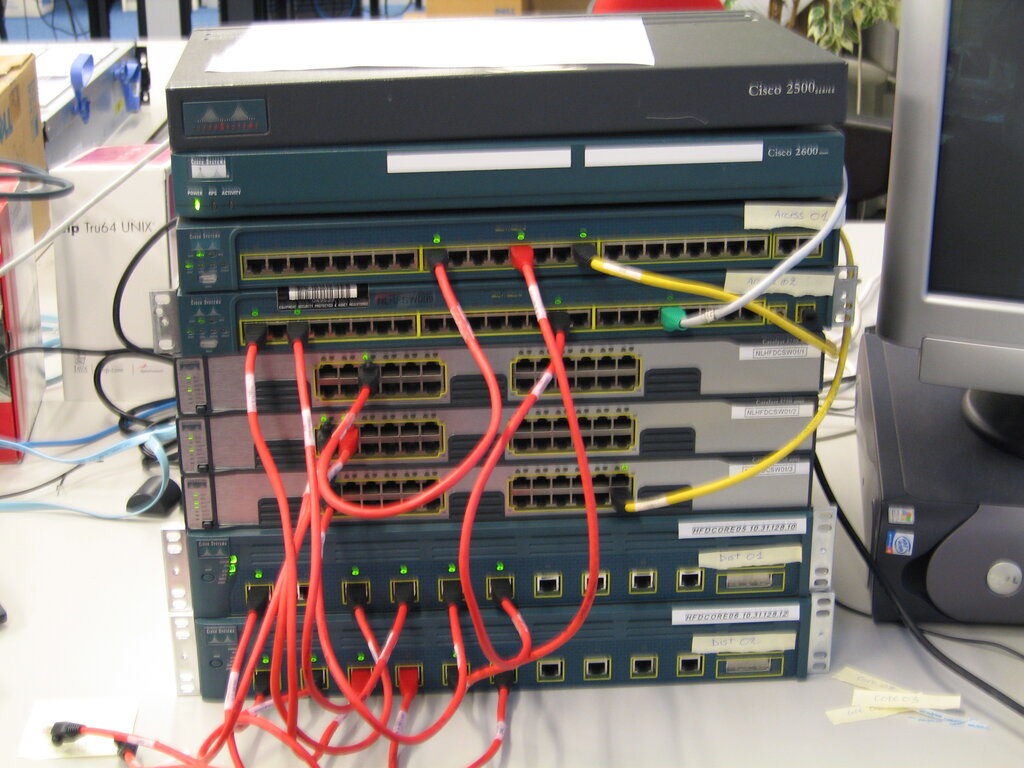
As networks grew within organizations, another piece of hardware became critical: the switch. While a router connects different networks, a switch connects devices within the same network, like computers and printers in an office. Cisco didn't invent the switch, but they perfected and popularized Ethernet switching, making it faster, more affordable, and the standard for local area networks (LANs).
Growth Through Acquisition
A key part of Cisco's strategy has been acquiring innovative companies to expand its technology portfolio. One of the most significant early acquisitions was Kalpana in 1994. Kalpana had pioneered the first multiport Ethernet switch, and bringing this technology in-house allowed Cisco to quickly dominate the burgeoning market for LAN switching.
Another landmark purchase was WebEx Communications in 2007. This acquisition signaled a major shift for Cisco, moving it beyond hardware and into the world of software and collaboration services. It positioned the company to compete in the growing market for online meetings and remote work tools, a move that proved incredibly prescient.
Through decades of innovation and strategic acquisitions, Cisco has built a product line that addresses nearly every aspect of networking. Its influence extends from small businesses to the core of the internet itself.
The Cisco Networking portfolio has the breadth and depth to serve the broadest range of networking needs across industries and segments.
Today, Cisco remains a dominant force in the networking industry. Beyond its hardware and software, the company plays a huge role in shaping network professionals through its certification programs. Certifications like the CCNA (Cisco Certified Network Associate) and CCNP (Cisco Certified Network Professional) have become industry standards, defining the skills required to build and manage modern networks.
Ready to check your understanding of Cisco's journey?
What core problem at Stanford University led Leonard Bosack and Sandy Lerner to develop the first multi-protocol router?
What is the fundamental difference between the function of a router and a switch?
Cisco's history is intertwined with the history of the internet itself, from solving a local problem at Stanford to building the global infrastructure we rely on today.