Introduction to Chordates
Introduction to Chordates
What Makes a Chordate?
In the vast animal kingdom, scientists group animals into different categories based on shared body plans. One of the major groups is a phylum, and the phylum Chordata includes a huge range of animals, from tiny sea creatures to humans. You might be surprised what you have in common with a fish or a sea squirt.
All chordates share a set of specific features at some point in their lives, whether it's just for a few days as an embryo or for their entire life.
Animals in the phylum Chordata share four key features that appear at some stage during their development: a notochord, a dorsal hollow nerve cord, pharyngeal slits, and a post-anal tail.
Let's break down what each of these features actually is.
The Four Key Features
notochord
noun
A flexible, rod-like structure made of cartilage that provides skeletal support.
The notochord is the first of the four signature traits. It runs along the body, providing a stiff but flexible axis for muscles to pull against. In many chordates, including all vertebrates, the notochord is only present during embryonic development. It plays a crucial role in signaling and organizing the developing body plan before being replaced by a bony or cartilaginous spine, also known as the vertebral column.
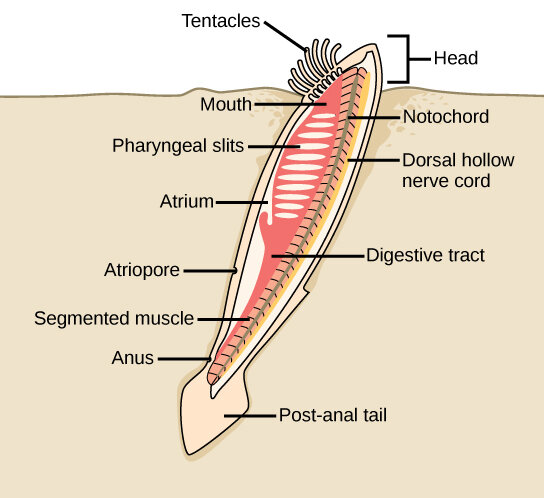
Second is the dorsal hollow nerve cord. This is a tube of nerve tissue located along the back (dorsal side) of the animal, just above the notochord. It develops into the central nervous system: the brain and spinal cord. This is different from many other animal phyla, which have solid nerve cords located on their front (ventral) side.
Third are the pharyngeal slits. These are openings in the pharynx, the part of the throat behind the mouth. In aquatic chordates like fish, these slits develop into gills for breathing. In land-dwelling chordates, including humans, they are typically only visible during early embryonic stages and later develop into parts of the ear, head, and neck.
Finally, all chordates have a post-anal tail at some stage. This is an extension of the body that runs past the end of the digestive tract. In many aquatic species, this tail is used for propulsion through the water. In other species, like humans, the tail is greatly reduced to a vestigial structure, the coccyx or tailbone.
The Three Subphyla
The phylum Chordata is divided into three major groups, or subphyla. While all share the core features we just discussed, they exhibit them in different ways.
| Subphylum | Common Name(s) | Key Characteristic |
|---|---|---|
| Vertebrata | Vertebrates | Notochord is replaced by a backbone of vertebrae. |
| Tunicata | Tunicates, Sea Squirts | Larvae have all four chordate features, but adults are often stationary filter-feeders. |
| Cephalochordata | Lancelets, Amphioxus | Retain all four chordate features throughout their entire life. |
Vertebrates are the group we're most familiar with—it includes fish, amphibians, reptiles, birds, and mammals. The other two groups, Tunicata and Cephalochordata, are small, exclusively marine organisms that provide a glimpse into the earlier forms of chordates.
Which of the following lists the four key features that all chordates possess at some stage of their life?
In terrestrial vertebrates, including humans, what is the developmental fate of the pharyngeal slits that are present in the embryo?