Introduction to Chinese Language
Chinese Phonetics
The Sound of Mandarin
Before diving into Chinese characters, you need to understand how the language sounds. Mandarin Chinese uses a system called Pinyin to write out its sounds using the familiar Latin alphabet. Think of it as a pronunciation guide. Mastering Pinyin is the first and most important step to speaking and understanding Mandarin correctly.
Pinyin is the Romanization system for Chinese characters and is crucial for beginners to learn pronunciation and tones accurately.
The Building Blocks
Every syllable in Mandarin is like a small recipe with up to three ingredients: an initial, a final, and a tone. The initial is the starting consonant sound, and the final is the vowel sound that follows.
Initial
noun
The consonant sound that begins a syllable.
Most syllables start with an initial, but some just have a final.
Final
noun
The vowel sound that follows the initial. It can be a single vowel or a combination of vowels.
Together, initials and finals create the basic sound of a syllable. But there's one more crucial element that gives the word its meaning: the tone.
The Music of the Language
Mandarin is a tonal language. This means the pitch of your voice when you say a syllable changes its meaning completely. There are four main tones, plus a fifth neutral tone.
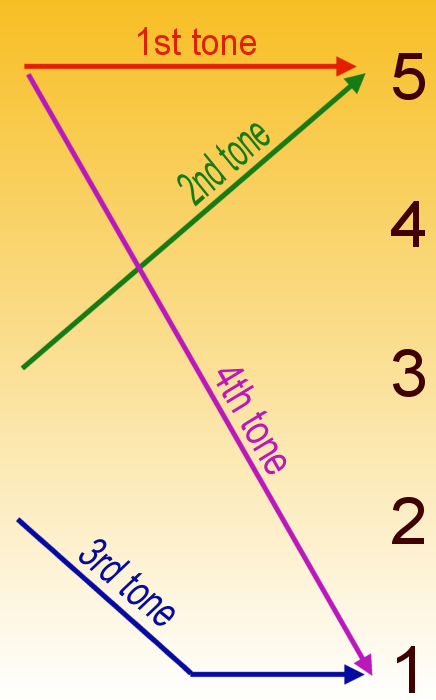
Let's look at how this works with the syllable ma.
- First Tone (mā): High and flat. Keep your voice steady and high, like you're holding a single musical note.
- Second Tone (má): Rising. Your voice starts in the middle and goes up, like you're asking a question.
- Third Tone (mǎ): Dipping. Your voice goes down, then back up. It's the longest and most complex tone.
- Fourth Tone (mà): Falling. Your voice starts high and drops sharply, like you're giving a command.
There is also a Neutral Tone (ma), which is short, light, and has no specific pitch contour. It's usually found at the end of words or in grammatical particles.
Changing the tone changes the word. This is why paying close attention to tones is essential from the very beginning.
| Pinyin | Tone | Meaning |
|---|---|---|
| mā | First (high) | mother (妈) |
| má | Second (rising) | hemp (麻) |
| mǎ | Third (dipping) | horse (马) |
| mà | Fourth (falling) | to scold (骂) |
| ma | Neutral | question particle (吗) |
As you can see, saying mǎ when you mean mā could lead to some confusion. Learning to hear and produce these tones accurately is a foundational skill in learning Mandarin.
What is the primary purpose of the Pinyin system in learning Mandarin Chinese?
A Mandarin syllable's basic sound is typically formed by what two components?
Pinyin is your map to navigating the sounds of Mandarin. By focusing on initials, finals, and especially tones, you'll build a strong foundation for speaking clearly and confidently.