Introduction to Chess Strategy
Chess Basics
The Board and the Battlefield
Chess is played on a square board with 64 squares, arranged in an eight-by-eight grid of alternating light and dark colors. It doesn't matter what the specific colors are, as long as they contrast. Each player starts with an army of 16 pieces.
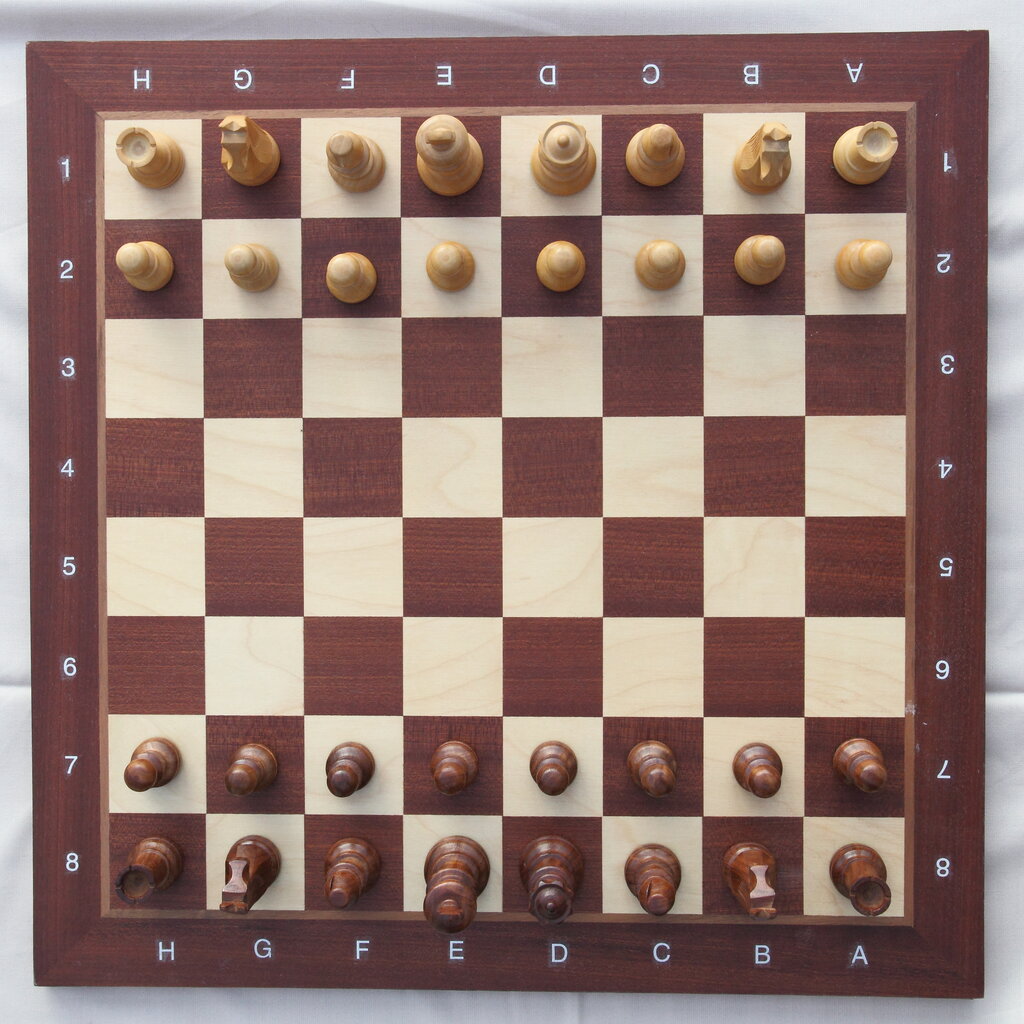
To talk about where the pieces are, we use coordinates. The vertical columns are called files and are labeled with letters 'a' through 'h'. The horizontal rows are called ranks and are numbered 1 through 8.
This gives every square a unique name. For White, the board starts on rank 1 and 2. For Black, it's ranks 8 and 7. The square in the bottom-left corner from White's perspective is 'a1'.
How the Pieces Move
Each piece has its own unique way of moving and capturing. When a piece captures an opponent's piece, it moves to that square and the opposing piece is removed from the board.
The Rook: Moves any number of squares horizontally or vertically, in a straight line. It can't jump over other pieces.
The Bishop: Moves any number of squares diagonally. A bishop always stays on the same color of squares it started on.
The Queen: The most powerful piece. It combines the moves of the rook and the bishop, moving any number of squares in any straight line—horizontally, vertically, or diagonally.
The King: The most important piece, but also one of the weakest. It can move one square in any direction: horizontally, vertically, or diagonally.
The Knight: This piece has a unique L-shaped move. It moves two squares in one direction (horizontally or vertically) and then one square perpendicular to that. The knight is the only piece that can jump over other pieces.
The Pawn: Pawns are the foot soldiers of chess. They can only move forward. From its starting square, a pawn can move either one or two squares forward. After that, it can only move one square forward at a time. Pawns capture differently than they move: they capture one square diagonally forward. A pawn cannot capture a piece directly in front of it.
The Goal of the Game
The object of chess is not just to capture pieces. It's to trap the opponent's king. This is called checkmate.
check
noun
A situation where a king is under direct attack by an opponent's piece. The king must get out of check on the next move.
If a king is in check, it must be moved out of danger immediately. There are three ways to get out of check:
- Move the king to a safe square.
- Block the check with another piece.
- Capture the piece that is giving check.
If none of these are possible, the king is in checkmate, and the game is over.
checkmate
noun
A position in which a player's king is in check and there is no legal move to escape. Checkmate wins the game.
It's also possible for the game to end in a draw. One common way is through stalemate. This happens when a player is not in check, but has no legal moves to make. In this case, neither player wins.
Three Special Moves
Besides the standard moves, there are three special rules you need to know.
Pawn Promotion: If a pawn reaches the opposite end of the board (the 8th rank for White, or the 1st rank for Black), it gets a promotion! It can be transformed into a queen, rook, bishop, or knight of the same color. You can't choose to keep it as a pawn or turn it into a king. Most players choose a queen, as it's the most powerful piece.
Castling: This is the only move in chess where you can move two pieces at once. Castling is a defensive move designed to protect your king and connect your rooks. You can castle if:
- Neither the king nor the chosen rook has moved yet.
- There are no pieces between the king and the rook.
- The king is not in check, does not pass through a square that is under attack, and does not end up in check.
To castle, you move the king two squares toward the rook, and then move the rook to the square the king just crossed over.
En Passant: This French term means "in passing." It's a special pawn capture that can only occur immediately after a pawn makes a two-square move from its starting square. If an opponent's pawn could have captured it had it only moved one square, that pawn has the option to capture it "in passing" on the very next turn. If they don't do it right away, the chance is lost.
This is the most confusing rule for new players, but you'll get the hang of it with practice.
Now that you know the rules, you're ready to play. Let's test what you've learned.
The vertical columns on a chessboard are called ______, and are labeled with ______.
Which piece moves in an 'L' shape and is the only one that can jump over other pieces?
Understanding these fundamental rules is the first and most important step to becoming a chess player. Every strategy and tactic you'll ever learn is built on this foundation.