Introduction to Chess
Chessboard and Pieces
The Battlefield
Every game of chess unfolds on an 8x8 grid of 64 squares, alternating between light and dark. This is the chessboard. Think of it as a map with its own coordinate system. The vertical columns are called files and are labeled with letters from 'a' to 'h'. The horizontal rows are called ranks and are numbered 1 through 8.
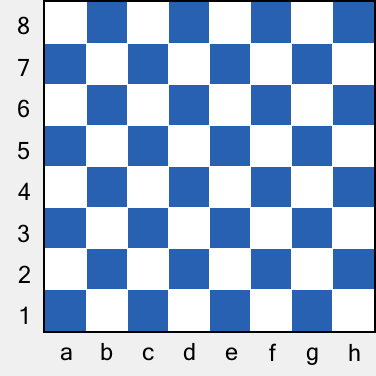
Every square has a unique name, combining its file and rank. For example, the bottom-left corner square is 'a1', and the top-right is 'h8'. A helpful rule to remember when setting up the board is "white on the right." This means each player should have a light-colored square in their bottom-right corner (h1 for White, a8 for Black).
Meet the Army
Two armies, White and Black, face each other across the board. Each army has 16 pieces, and each piece moves in a specific way. The goal is to capture the opponent's most important piece: the King. Let's meet the cast.
The Pawn Pawns are the foot soldiers. They are the most numerous but also the weakest pieces. They can only move forward, never backward.
From its starting square, a pawn can move either one or two squares forward. After that, it can only move one square forward at a time. Pawns capture differently than they move: they attack one square diagonally forward. If a pawn reaches the other side of the board, it gets a promotion and can become any other piece (except a king), usually a queen.
The Rook The rook is a powerful piece that moves in straight lines. It can go as many squares as it wants horizontally or vertically, as long as its path isn't blocked by another piece. Rooks are especially strong on open files where their long-range power can be fully used.
The Knight The knight moves in a unique L-shape: two squares in one direction (horizontally or vertically) and then one square at a 90-degree angle. The knight is the only piece that can jump over other pieces, making it tricky and unpredictable.
The Bishop The bishop moves diagonally, as many squares as it wants, unless blocked. Each player starts with two bishops: one that moves on the light squares and one that moves on the dark squares. They can never switch colors.
The Queen The queen is the most powerful piece on the board. She combines the moves of the rook and the bishop, meaning she can move any number of squares in any straight line: horizontally, vertically, or diagonally.
The King The king is the most important piece, but it's not the most powerful. It can move one square in any direction. The entire game revolves around protecting your king while trying to trap your opponent's. The king can never move to a square where it would be under attack (in "check").
Setting Up the Board
Now that you know the pieces, let's place them in their starting positions. The setup is always the same.
- Rooks go on the corners.
- Knights go next to the rooks.
- Bishops go next to the knights.
- The Queen goes on her own color. The white queen starts on a light square (d1), and the black queen starts on a dark square (d8).
- The King takes the remaining square next to the queen.
- Finally, all eight Pawns are placed in a line on the rank in front of the other pieces.
With the board set and the pieces in place, you're ready to make your first move. Understanding how the board is laid out and how each piece moves is the first and most critical step to playing the game.