Introduction to Chess
Chessboard and Pieces
The Battlefield
Every game of chess unfolds on an 8x8 grid of 64 squares, alternating between light and dark. This is the chessboard. The board has a coordinate system to help players describe where pieces are. The vertical columns are called files and are labeled 'a' through 'h'. The horizontal rows are called ranks and are numbered 1 through 8.
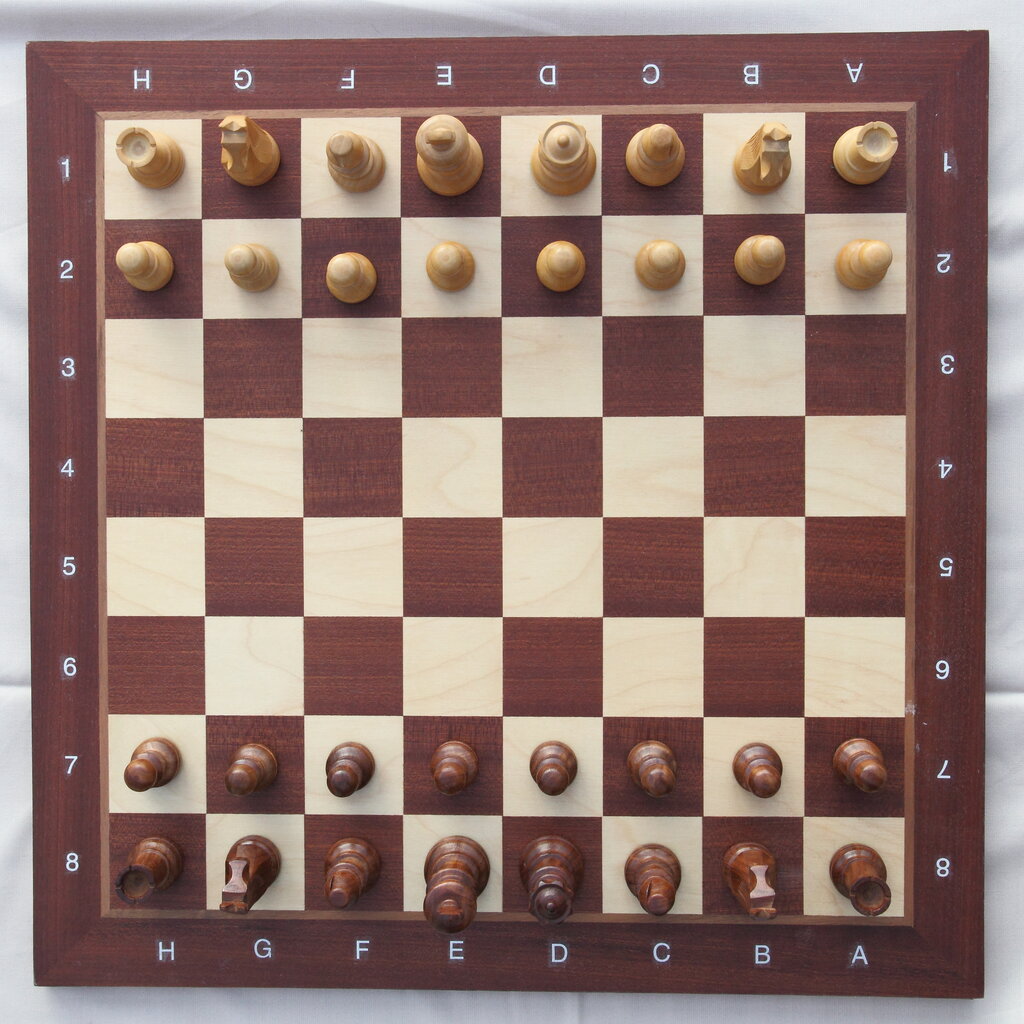
To set up the board correctly, make sure each player has a light-colored square in their bottom-right corner. It's a simple but crucial first step. The pieces for one player, called White, occupy ranks 1 and 2. The other player, Black, uses ranks 7 and 8. White always makes the first move.
The Army
Each player starts with an army of 16 pieces. While they might look different, both armies are identical in strength and function. Let's meet the soldiers.
Pawn
noun
The most numerous piece in chess. It has the most complex rules of movement.
You start with eight pawns. On its first move, a pawn can advance either one or two squares forward. After that, it can only move one square forward at a time. Pawns have a unique way of capturing; they attack one square diagonally forward. A pawn can't move forward if a piece is directly in its way.
Next up is the Rook. You have two of them, and they sit in the corners. Rooks move any number of squares horizontally or vertically, as long as their path isn't blocked by another piece.
The Knight is the trickiest piece. You have two, positioned next to the rooks. It moves in an 'L' shape: two squares in one direction (horizontally or vertically) and then one square at a 90-degree turn. The knight is the only piece that can jump over other pieces.
You also start with two Bishops, one on a light square and one on a dark square. A bishop moves any number of squares diagonally. Because of this, a bishop will always remain on the color of the square it started on.
The Queen is the most powerful piece on the board. You get one queen. She combines the powers of the rook and the bishop, meaning she can move any number of squares in any straight line: horizontally, vertically, or diagonally.
Finally, we have the King. The king is the most important piece, but not the most powerful. The goal of the game is to trap the opponent's king. The king can move one square in any direction: horizontally, vertically, or diagonally.
Special Moves
Beyond the basic movements, there are three special rules you need to know.
Pawn Promotion If a pawn successfully marches all the way to the other side of the board (rank 8 for White, rank 1 for Black), it gets a promotion! You can replace it with a queen, rook, bishop, or knight of the same color. Most players choose a queen because she is the most powerful.
Castling is a defensive move that involves both the king and one rook. It's the only time you can move two pieces in a single turn. The king moves two squares towards a rook, and that rook jumps to the square on the other side of the king. You can castle under these conditions:
- Neither the king nor the chosen rook has moved yet.
- There are no pieces between the king and the rook.
- The king is not currently in check.
- The king does not pass through or land on a square that is under attack by an enemy piece.
The last special move is called En Passant, which is French for 'in passing'. This is a rare but important pawn capture. It can only happen immediately after your opponent moves a pawn two squares forward from its starting position, and it lands right next to your pawn. On your very next turn, you have the option to capture that pawn as if it had only moved one square.
With the board and pieces understood, you now know the language of chess. The next step is to put them into action.