Introduction to Chess
Introduction to Chess
A Game of Kings
Chess is a game of strategy with a rich history stretching back over 1,500 years. Believed to have originated in India as a game called chaturanga, it spread to Persia and then throughout the Muslim world before arriving in Europe. By the 15th century, it had evolved into the game we know today.
It's often called the "royal game" because it was popular among nobility. But its real appeal is universal. Chess is a pure test of intellect, a battle between two minds with no hidden information and no element of luck. Every victory is earned through superior foresight and planning.
The Battlefield
The game is played on a square board made up of 64 smaller squares, arranged in an eight-by-eight grid of alternating light and dark colours. No matter which way you turn the board, a light-coloured square should always be in the bottom-right corner for each player.
To talk about specific squares, we use a coordinate system. The vertical columns, called files, are labelled with letters from 'a' to 'h'. The horizontal rows, called ranks, are numbered from 1 to 8. This gives every square a unique name, like 'e4' or 'g8'.
Understanding this grid is the first step. It's the world where all the action takes place.
The Armies
Each player starts with an army of 16 pieces. One player commands the white pieces, and the other commands the black. The two armies are mirror images of each other, set up on opposite sides of the board.
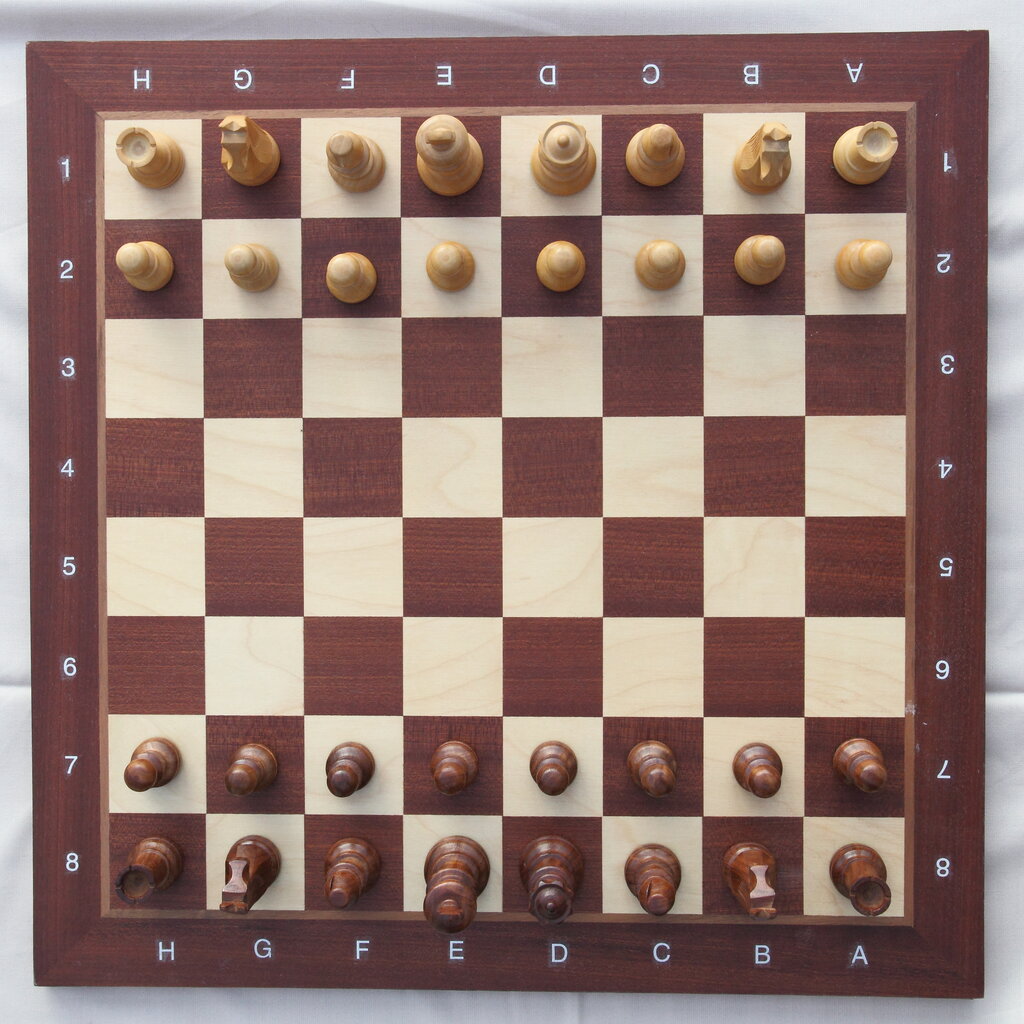
Here are the pieces that make up your army:
- The King: The most important piece, but not the most powerful. You have one king.
- The Queen: The most powerful piece. You have one queen.
- Rooks: These look like castle towers. You start with two.
- Bishops: You have two of these, one starting on a light square and one on a dark square.
- Knights: These are usually shaped like horse heads. You get two.
- Pawns: The frontline soldiers. You start with eight pawns.
White's pieces are set up on ranks 1 and 2, while Black's pieces occupy ranks 7 and 8.
| Piece | Quantity | Starting Squares (White) | Starting Squares (Black) |
|---|---|---|---|
| King | 1 | e1 | e8 |
| Queen | 1 | d1 | d8 |
| Rook | 2 | a1, h1 | a8, h8 |
| Bishop | 2 | c1, f1 | c8, f8 |
| Knight | 2 | b1, g1 | b8, g8 |
| Pawn | 8 | Rank 2 | Rank 7 |
The Objective
The goal of chess isn't to capture all of your opponent's pieces, though that often helps. The ultimate objective is to achieve checkmate.
This happens when you attack the opponent's king in such a way that it cannot escape. The king is under attack (in "check"), and there is no legal move to get it out of check. At that moment, the game is over, and the player who delivered the checkmate wins.
Checkmate
noun
A position in which a player's king is under threat of capture ('in check') and there is no legal move to escape the threat.
Everything you do in chess, every piece you move, should be guided by this single purpose: to checkmate your opponent's king while keeping your own king safe.
What is the ultimate objective in a game of chess?
According to modern chess conventions, what colour square should always be in the bottom-right corner from each player's perspective?
Now that you know the board, the pieces, and the goal, you have the foundation for every strategy and tactic to come.