Introduction to Chess
Chess Basics
The Board is Your Battlefield
The game of chess is played on a square board with 64 alternating light and dark squares, arranged in an 8x8 grid. The rows are called ranks and are numbered 1 to 8. The columns are called files and are lettered 'a' through 'h'. Each square has a unique name, like 'a1' or 'f7', which helps players describe their moves.
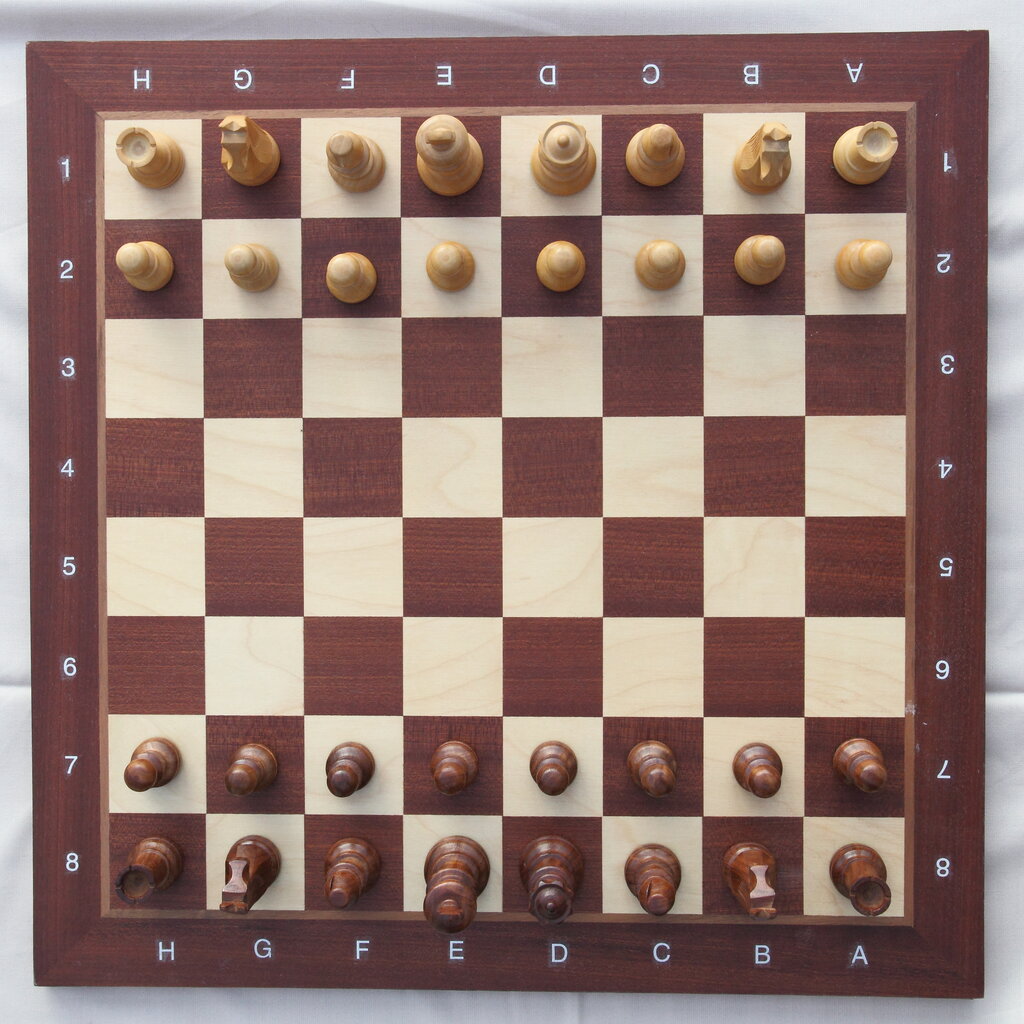
Before the game begins, the pieces are set up in a specific order. The player with the light-colored pieces (White) places their pieces on ranks 1 and 2. The player with the dark-colored pieces (Black) places theirs on ranks 7 and 8.
A helpful tip for setting up the board: the queen always starts on a square of her own color. The white queen goes on a light square (d1), and the black queen goes on a dark square (d8).
Meet Your Army
Each player starts with an army of 16 pieces: one king, one queen, two rooks, two bishops, two knights, and eight pawns. Each piece moves in a unique way.
The Pawn Pawns are the foot soldiers. On their first move, they can advance one or two squares forward. After that, they can only move one square forward at a time. Pawns capture enemy pieces by moving one square diagonally forward. They cannot move or capture backward. If a pawn reaches the opposite end of the board, it gets a promotion and can become any other piece (usually a queen).
Next up are the more powerful pieces.
The Rook The rook moves any number of squares horizontally or vertically, as long as its path is not blocked by another piece. Think of it moving in a straight line, like a plus sign.
Bishops and knights are known as the "minor pieces."
The Bishop The bishop moves any number of squares diagonally. Because of this, a bishop will always stay on squares of the same color it started on. You begin the game with one light-square bishop and one dark-square bishop.
The knight has the most unusual move in chess.
The Knight The knight moves in an 'L' shape: two squares in one direction (horizontally or vertically) and then one square at a 90-degree angle. The knight is the only piece that can jump over other pieces, making it very tricky.
And now for royalty.
The Queen The queen is the most powerful piece on the board. She combines the powers of the rook and the bishop, meaning she can move any number of squares in any straight line: horizontally, vertically, or diagonally.
Last, but certainly not least, is the king.
The King The king is the most important piece, but also one of the weakest. It can move one square in any direction: horizontally, vertically, or diagonally. The king can never move into a square that is attacked by an opponent's piece.
The Goal of the Game
The object of chess isn't just to capture your opponent's pieces. The ultimate goal is to win the game by achieving checkmate.
When a king is attacked by an opposing piece, it is in check. The player whose king is in check must immediately make a move to get out of check. There are three ways to do this:
- Move the king to a safe square.
- Block the attack with another piece.
- Capture the piece that is delivering the check.
If a king is in check and there are no legal moves to escape the attack, it's checkmate. The game is over, and the player who delivered the checkmate wins.
There's one other way a game can end without a winner: a draw. The most common type of draw is a stalemate. This happens when a player has no legal moves to make, but their king is not in check. In this situation, the game is a draw, and nobody wins.
In chess, what are the vertical columns on the board called?
According to the setup rule 'queen on her color', where does the black queen start the game?