Introduction to Chemistry
Atomic Structure
The Building Blocks of Everything
Everything you see, touch, and breathe is made of atoms. For centuries, we could only guess what they were. The ancient Greek philosopher Democritus imagined that if you kept cutting an object in half, you would eventually reach a tiny, uncuttable particle. He called it atomos, meaning 'indivisible.'
For a long time, this was just an idea. Then, in the early 1800s, John Dalton proposed that all matter was made of tiny, solid spheres. Each element, he thought, had its own unique type of sphere. This was a huge step forward, but the picture was still incomplete. The atom wasn't a simple solid ball.
The first major clue that atoms had smaller parts came in 1897. Physicist J.J. Thomson discovered the electron, a tiny, negatively charged particle. He imagined the atom was like a blob of positively charged 'pudding' with negative electrons stuck in it, like plums. This was known as the 'plum pudding model.'
Then came Ernest Rutherford. In 1909, he fired tiny, positively charged particles at a super-thin sheet of gold foil. According to the plum pudding model, they should have all passed right through. Most did, but a few bounced back dramatically. Rutherford was stunned, later saying, "It was almost as incredible as if you fired a 15-inch shell at a piece of tissue paper and it came back and hit you."
This surprising result meant the positive charge in an atom wasn't spread out like pudding. It had to be concentrated in a tiny, dense center, which he called the nucleus. The electrons, he proposed, orbited this nucleus like planets around the sun. The atom was mostly empty space.
Inside the Atom
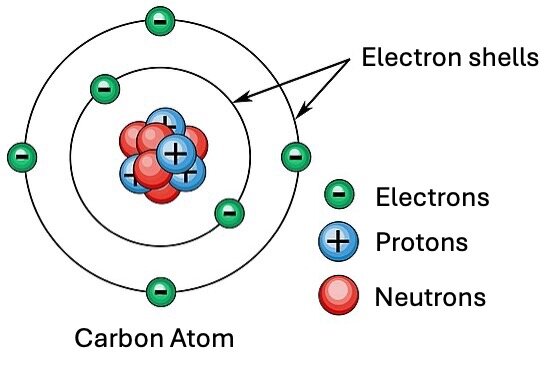
Rutherford’s model was close, but the picture was refined further. We now know that atoms are made of three main subatomic particles: protons, neutrons, and electrons.
| Particle | Charge | Relative Mass | Location in Atom |
|---|---|---|---|
| Proton | Positive (+1) | ~1 | Nucleus |
| Neutron | Neutral (0) | ~1 | Nucleus |
| Electron | Negative (-1) | ~1/1836 | Orbiting the nucleus |
The nucleus is the atom's tiny, heavy core. It contains all the protons and neutrons. The number of protons determines what element an atom is. An atom with one proton is always hydrogen. An atom with six protons is always carbon. This is the atom's atomic number.
Electrons are incredibly small and light, and they zip around the nucleus in specific energy levels or shells. Because opposite charges attract, the negatively charged electrons are held in orbit by the positively charged protons in the nucleus.
Same Element, Different Flavors
While the number of protons defines an element, the number of neutrons can vary. Atoms of the same element that have different numbers of neutrons are called isotopes.
Since neutrons add mass but have no charge, isotopes of an element have the same chemical properties but different masses. The total number of protons and neutrons in an atom's nucleus is called its mass number.
Isotopes are like different models of the same car. They're all the same make and behave similarly, but one might have a heavier engine, giving it a different overall weight.
Hydrogen is a perfect example. Most hydrogen atoms are just a single proton and an electron. This is the most common isotope, sometimes called protium. But there are other versions.
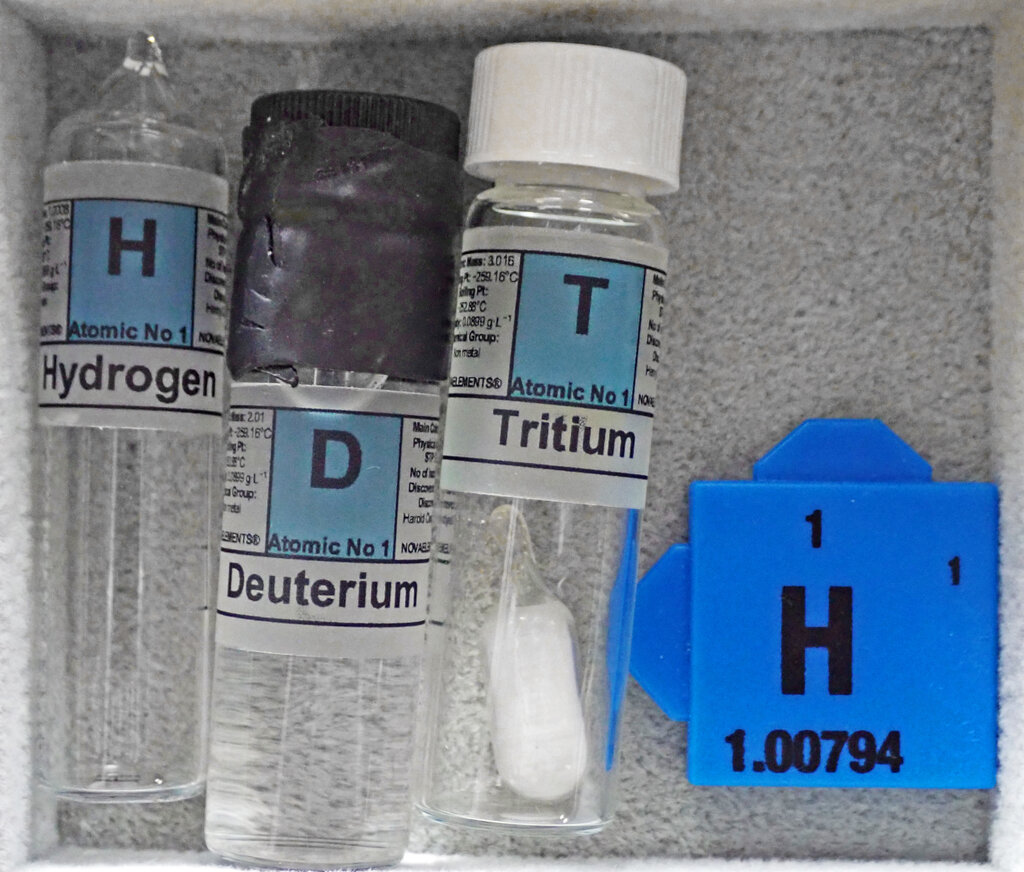
One isotope of hydrogen, called deuterium, has one proton and one neutron. Another, tritium, has one proton and two neutrons. All three are hydrogen atoms because they each have one proton, but they have different masses.
Isotopes are more than just a curiosity. Some, like tritium, are unstable and radioactive. This property is incredibly useful. For example, the radioactive isotope Carbon-14 is used by archaeologists to determine the age of ancient artifacts.
Let's review these core concepts.
Now, test your understanding of the atom.
What surprising result from Ernest Rutherford's gold foil experiment led him to conclude that the atom has a tiny, dense, positively charged nucleus?
Which subatomic particle defines an element's identity and is equal to its atomic number?
Understanding this basic structure is the first step toward seeing how atoms join together to form the molecules that make up our world.