Introduction to Calculus
Functions and Graphs
What Is a Function?
Think of a function as a simple machine. You put something in, the machine follows a specific rule, and something new comes out. In math, the “something in” is a number called the input, and the “something out” is a number called the output.
A function is a rule that assigns exactly one output to each input. We often use the notation , which you read as "f of x." Here, is the name of the function (the rule), and is the input.
For example, if our function's rule is "add 3 to the input," we can write it as . If you input the number 5, the function gives you an output of .
The most important part of this definition is the "exactly one output" rule. For any given input, a function can only produce a single output. An input of 5 can't give you both 8 and 10. That would break the rule.
We can visualize functions by graphing them on a coordinate plane. The input is the x-value, and the output is the y-value. A simple way to check if a graph represents a function is the vertical line test. If you can draw a vertical line anywhere on the graph and it only ever crosses the curve once, it's a function.
Domain and Range
Two key concepts for any function are its domain and range.
Domain
noun
The set of all possible input values (x-values) for a function.
Range
noun
The set of all possible output values (y-values) that a function can produce.
Let’s look at the function . You can square any number, so its domain is all real numbers. But when you square any number (positive or negative), the result is always positive or zero. So, its range is all real numbers greater than or equal to 0.
Now consider the function . You can't take the square root of a negative number (in the real number system), so the domain is restricted to all numbers greater than or equal to 0. The output, the square root, will also always be non-negative. Therefore, the range is also all real numbers greater than or equal to 0.
Common Types of Functions
Functions come in many varieties, but a few types are fundamental.
Linear Functions have the form . Their graph is always a straight line. The value '' represents the slope, which tells you how steep the line is, and '' is the y-intercept, the point where the line crosses the vertical y-axis.
Quadratic Functions have the form . Their graph is a U-shaped curve called a parabola. The parabola opens upwards if '' is positive and downwards if '' is negative.
Polynomial Functions are a broader category that includes linear and quadratic functions. They are built from variables raised to non-negative integer powers, like . Their graphs are smooth, continuous curves that can have various twists and turns.
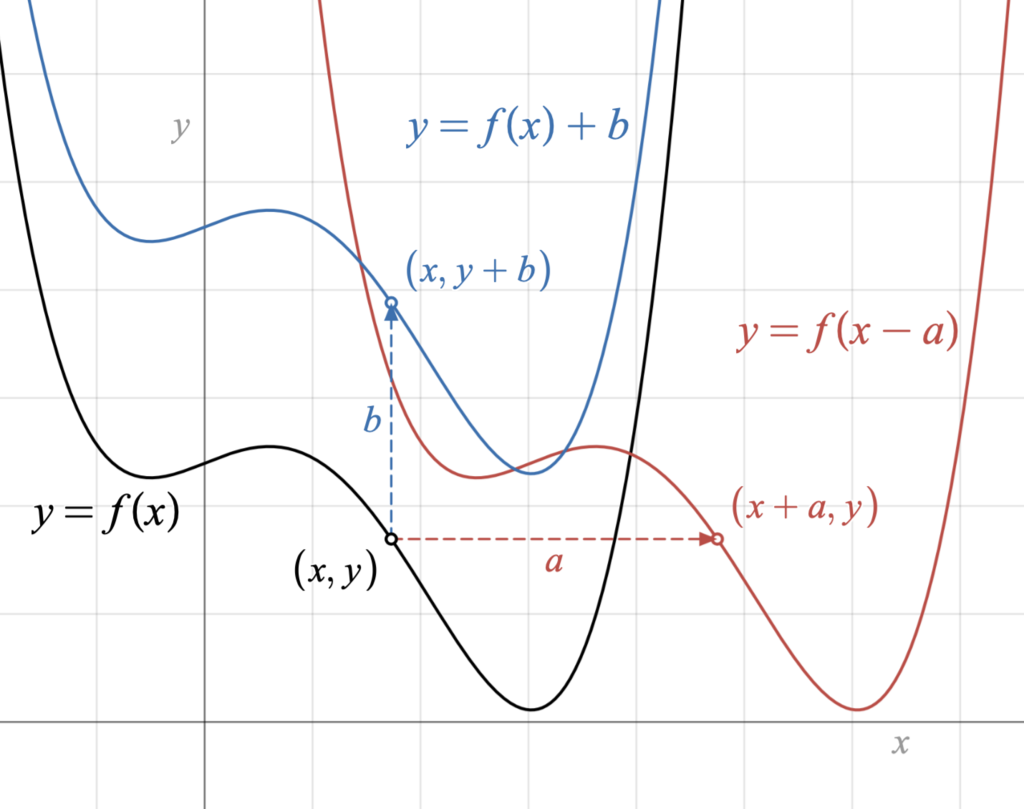
Understanding these basic function types is a building block for exploring more complex mathematical ideas. Their predictable shapes and properties allow us to model many real-world phenomena.
Reading a Graph
A function's graph is a picture of its behavior. Two of the most important features to look for are intercepts and slope.
Intercepts are the points where the graph crosses the axes.
- The y-intercept is where the graph crosses the y-axis. This happens when the input is zero, or .
- The x-intercept(s) are where the graph crosses the x-axis. This happens when the output is zero, or . These points are also called the roots or zeros of the function.
Slope describes the steepness and direction of a line. For a straight line, the slope is constant. It's the "rise over run" – how much the y-value changes for a one-unit change in the x-value. A positive slope means the line goes up from left to right, while a negative slope means it goes down.
For curved graphs, the steepness isn't constant. It changes from point to point. This idea of a changing slope is a central concept in calculus.
What is the fundamental rule that a relationship must follow to be considered a function?
The set of all possible input values for a function is known as its _________.
Grasping these core ideas—what a function is, its domain and range, and how to interpret its graph—provides the foundation for everything that comes next in calculus.