Introduction to C Programming
Introduction to C
The Foundation of Modern Coding
Before there was Python, Java, or JavaScript, there was C. Developed in the early 1970s by Dennis Ritchie at Bell Labs, C is one of the oldest and most influential programming languages. It was created to help build the Unix operating system, which itself became the backbone for many modern systems, including Linux and macOS.
Why learn a language that's over 50 years old? Because C is like the Latin of programming. Many modern languages, like C++, C#, and Objective-C, are direct descendants. Learning C teaches you how computers work on a deeper level, managing memory and interacting directly with hardware. It's known for being powerful and fast, making it the go-to choice for operating systems, embedded systems (like the software in your car or microwave), and performance-critical applications.
C is a fundamental programming language that forms the base for many modern languages like C++, Java, and Python.
Setting Up Your Workspace
To start writing C, you need two basic tools: a text editor and a compiler.
- Text Editor: This is where you'll write your code. It can be something simple like Notepad on Windows, TextEdit on Mac, or a more advanced code editor like VS Code or Sublime Text.
- Compiler: A compiler is a special program that translates your human-readable C code into machine code that the computer's processor can execute. A popular and free C compiler is GCC (GNU Compiler Collection).
Setting up these tools varies by operating system. On macOS and Linux, you can often install GCC through the command line terminal. On Windows, you might install a package like MinGW-w64. Many Integrated Development Environments (IDEs) like Code::Blocks or Visual Studio bundle a text editor and compiler together, simplifying the setup.
Your First Program
It's a long-standing tradition in programming to make your first program print the text "Hello, World!" to the screen. It's a simple way to confirm that your setup is working correctly.
The "Hello, World!" program is the first step toward learning any programming language. It's a simple victory that proves your tools are ready.
Open your text editor and type the following code exactly as it appears. Save the file as hello.c.
// This line includes the standard input/output library.
#include <stdio.h>

// The main function is the entry point of every C program.
int main() {
    // printf is a function that prints text to the console.
    printf("Hello, World!\n");

    // Return 0 to indicate the program ran successfully.
    return 0;
}
Let's quickly break down the key parts:
#include <stdio.h>: This line tells the compiler to include the "Standard Input/Output" library. This library contains functions for basic tasks, like printing text to the screen.int main(): This is the main function where program execution begins. Every C program must have amainfunction.printf("Hello, World!\n");: This is the line that does the work. It calls theprintffunction to print the text inside the quotation marks. The\nis a special character that represents a newline, moving the cursor to the next line after printing.return 0;: This line ends themainfunction and signals to the operating system that the program executed successfully.
Compiling and Running
Once you've saved your hello.c file, you need to compile it. Open your command line terminal, navigate to the directory where you saved your file, and run the following command:
gcc hello.c -o hello
This command tells the gcc compiler to take your source file (hello.c) and create an executable program named hello (the -o stands for output). If everything is correct, the command will run without any messages, and you'll see a new file named hello in your directory.
Now, to run your program, simply type:
./hello
The terminal should immediately print your message.
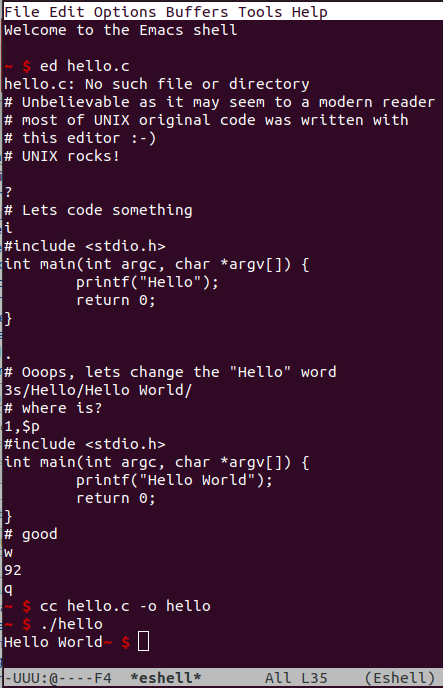
Congratulations! You've just written, compiled, and executed your first C program. You've taken the first step into a language that powers much of the technology we use every day.
What was the original purpose for the creation of the C programming language?
In C programming, what is the role of a compiler?
This process of writing, compiling, and running is the fundamental cycle of C development.