Introduction to BPMN
Introduction to BPMN
What is BPMN?
Think of a complex project, like fulfilling a customer order. It involves multiple steps and people: receiving the order, checking inventory, processing payment, and finally, shipping. How do you make sure everyone involved knows exactly what to do and when? You could write a long document, but that’s often hard to follow.
This is where Business Process Model and Notation (BPMN) comes in. It's a standardized graphical language used to create flowcharts of business processes. Essentially, it’s a way to draw a map of how work gets done.
BPMN provides a common language for everyone in an organization, from business analysts to IT developers to managers, to clearly communicate and understand workflows.
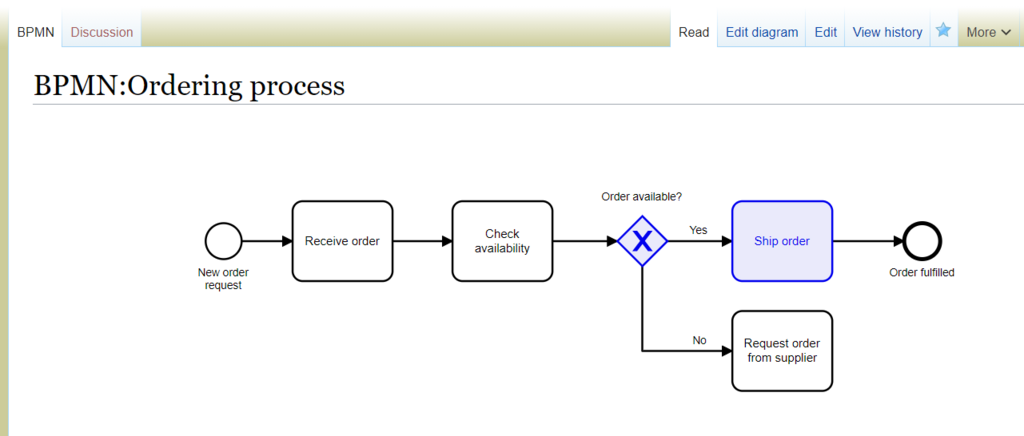
The goal is to visualize a process from start to finish. By mapping it out, teams can see exactly how a process works, identify bottlenecks or inefficiencies, and figure out how to improve it. It bridges the gap between designing a workflow and actually implementing it.
A Quick History
BPMN wasn't born overnight. It was developed by the Business Process Management Initiative (BPMI) and first released in 2004. The goal was to create a simple, easy-to-understand notation that could be used by both business and technical people.
In 2005, BPMI merged with the Object Management Group (OMG), an organization that maintains many important technical standards. This merger was significant because it placed BPMN alongside other widely accepted standards, like UML (Unified Modeling Language), giving it more authority and a path for future development.
The Business Process Modeling Notation (BPMN) is a widely used standard notation for defining intra- and inter-organizational workflows.
The most important evolution came in 2011 with the release of BPMN 2.0. This update was a game-changer. It wasn't just about standardizing how process diagrams look; it also standardized how they behave. BPMN 2.0 defined a format that allows these diagrams to be directly executed by a process engine. This means a visual model drawn by a business analyst could be turned into a running, automated process with less manual coding.
Why Use a Standard?
Using a standard notation like BPMN has several key advantages. Without one, different teams might create their own unique flowcharts, leading to confusion and misinterpretation. It would be like trying to build a house where every architect uses their own personal symbols for doors, windows, and walls.
First and foremost, BPMN creates clarity. It establishes a precise, unambiguous way to represent processes. When a manager, a software developer, and a quality assurance analyst all look at the same BPMN diagram, they all see the same process and understand their role within it.
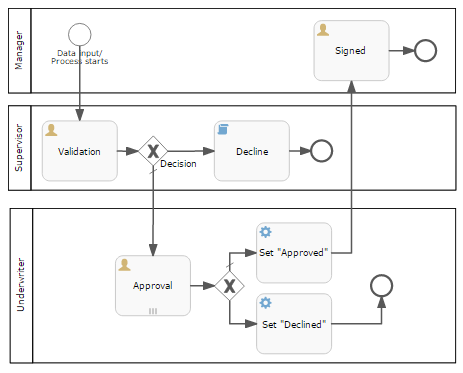
Second, it facilitates analysis and improvement. Once a process is mapped out in a standard way, it's much easier to spot problems. You can see where delays occur, where steps are redundant, or where handoffs between teams are failing. It's difficult to improve a process that you can't see clearly.
Finally, standardization supports automation. Because BPMN 2.0 is executable, businesses can move more quickly from process design to implementation. The model becomes more than just a picture; it becomes the blueprint for the actual automated workflow, ensuring the final process works exactly as designed.
Let's test your understanding of these core concepts.
What is the primary purpose of Business Process Model and Notation (BPMN)?
Which organization is currently responsible for maintaining the BPMN standard?