Introduction to Aviation
Principles of Flight
The Four Forces of Flight
Every object in the air, from a paper airplane to a passenger jet, is governed by four fundamental forces. For an aircraft to fly, these forces must be in balance. Think of it as a constant tug-of-war in the sky.
Four primary forces influence flight: lift, weight, thrust, and drag.
Here’s the lineup:
- Weight: This is the force of gravity pulling the aircraft down. It acts through the aircraft's center of gravity.
- Lift: This is the upward force created by the wings as they move through the air. Lift opposes weight.
- Thrust: This is the forward force produced by the engines, pushing the aircraft through the air. Thrust opposes drag.
- Drag: This is the force of air resistance that works against the aircraft's motion.
For an airplane to fly straight and level at a constant speed, lift must equal weight, and thrust must equal drag. If the pilot wants to climb, they need to generate more lift than weight. To speed up, thrust must be greater than drag.
Weight and thrust are fairly straightforward concepts. Gravity pulls things down, and engines push things forward. But how exactly does a wing, just a curved piece of metal, generate enough upward force to lift a massive airplane? It comes down to a combination of two key physics principles.
How Wings Create Lift
The shape of a wing, called an airfoil, is specially designed to manipulate air pressure. It's typically curved on top and flatter on the bottom. As the wing moves through the air, this shape forces the air to travel faster over the top surface than it does underneath.
This is where Bernoulli's Principle comes in. This principle states that as the speed of a fluid (like air) increases, its pressure decreases. The fast-moving air above the wing exerts less pressure than the slow-moving air below it. This pressure difference creates a net upward force: lift.
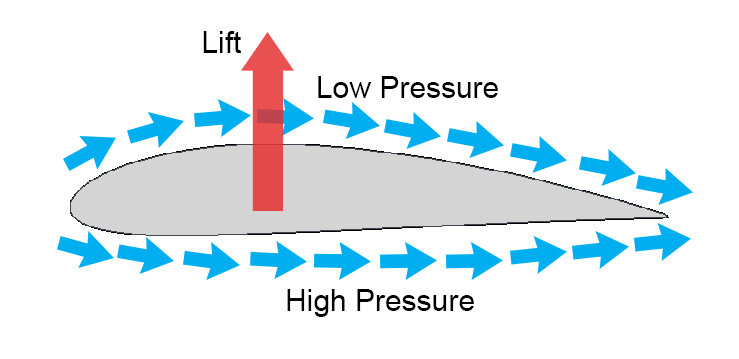
But that's not the whole story. Newton's Third Law of Motion also plays a crucial role. This law states that for every action, there is an equal and opposite reaction.
As a wing moves through the air, it's angled slightly upward. This angle forces air downwards, a phenomenon known as downwash. The "action" is the wing pushing the air down. The "reaction" is the air pushing the wing up. This upward push is another component of lift. Both Bernoulli's principle and Newton's third law work together to get an aircraft off the ground.
Angle of Attack and Stalls
Pilots can control the amount of lift a wing generates by changing its angle relative to the oncoming air. This is called the angle of attack.
Angle of Attack
noun
The angle between the wing's chord line (an imaginary line from the leading edge to the trailing edge) and the direction of the relative wind.
Increasing the angle of attack generally increases lift, but only up to a certain point. If the angle becomes too steep, the smooth flow of air over the top of the wing gets disrupted. The air separates from the wing's surface, becoming turbulent.
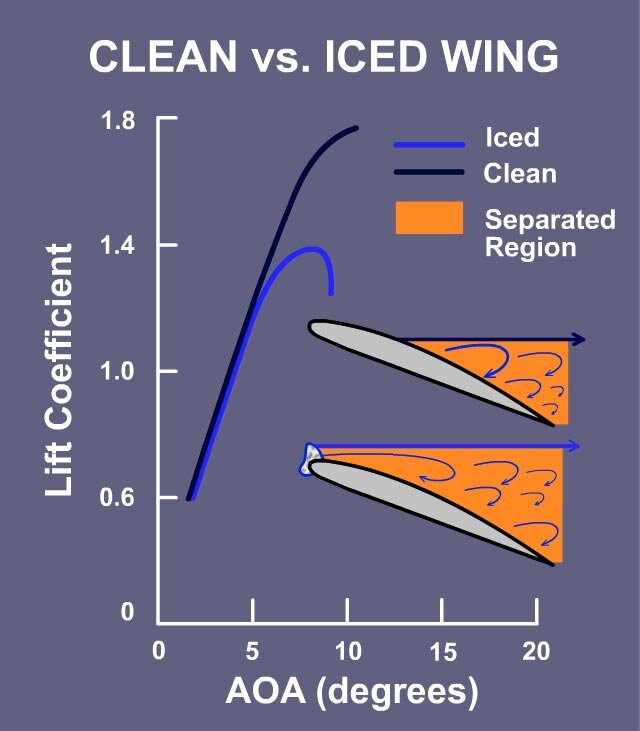
When this happens, lift decreases dramatically, and drag increases. This condition is called a stall. It's important to understand that a stall is not when the engine quits; it's an aerodynamic event caused by a loss of lift.
A stall is a loss of lift, not a loss of engine power.
Every aircraft has a specific "critical angle of attack" at which it will stall, regardless of its speed, weight, or altitude. The primary way to recover from a stall is for the pilot to reduce the angle of attack by pushing the nose of the plane down. This allows smooth airflow to reattach to the wing, restoring lift.
Which of the following are the four fundamental forces governing an aircraft in flight?
For an airplane to fly straight and level at a constant speed, which two conditions must be met?
Understanding these core principles—the four forces, the mechanics of lift, and the importance of the angle of attack—is the foundation of all aerodynamics.