Introduction to Aviation
Introduction to Aerodynamics
The Four Forces of Flight
For an aircraft to fly, it must manage four fundamental forces. These forces are constantly at play, pushing and pulling on the plane in different directions. Think of it as a tug of war in the sky.
These four forces are:
- Lift: The upward force that opposes weight and holds the aircraft in the air. It's generated primarily by the wings.
- Weight: The downward force of gravity acting on the aircraft.
- Thrust: The forward force produced by the engines, pushing the aircraft through the air.
- Drag: The backward force of air resistance that opposes thrust.
Flight is a continuous balancing act. For an aircraft to maintain a constant altitude and speed, lift must equal weight, and thrust must equal drag. If thrust is greater than drag, the plane accelerates. If lift is greater than weight, it climbs.
How Wings Create Lift
Lift isn't magic; it's a result of the wing's special shape and its interaction with the air. This shape is called an airfoil.
Airfoil
noun
A structure with curved surfaces, such as a wing or propeller blade, designed to give the most favorable ratio of lift to drag in flight.
An airfoil is typically curved on top and flatter on the bottom. As the wing moves through the air, it splits the airflow. The air traveling over the curved upper surface has a longer path to travel than the air moving along the flatter bottom surface. To meet up at the same time at the back of the wing, the air on top must move faster.
This is where a key principle of fluid dynamics comes into play.
Bernoulli's Principle states that an increase in the speed of a fluid occurs simultaneously with a decrease in pressure.
Because the air moves faster over the top of the wing, the pressure there is lower than the pressure of the slower-moving air underneath. This pressure difference creates a net upward force. That force is lift.
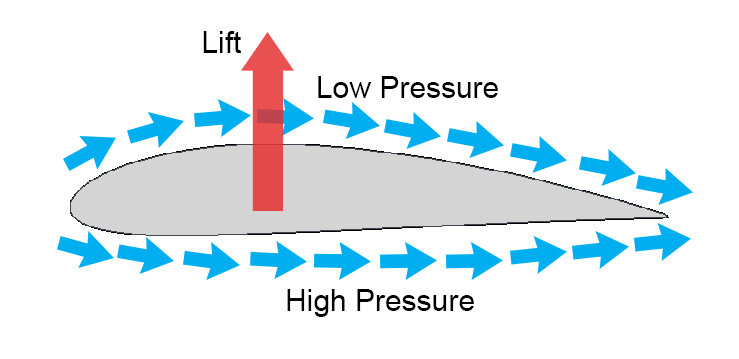
Newton's Third Law of Motion also provides an explanation. For every action, there is an equal and opposite reaction. As the wing moves through the air, it is angled to push air downward. This downward push of air is the 'action.' The 'reaction' is the air pushing the wing upward, contributing to lift.
Both Bernoulli's principle and Newton's laws are correct and complementary ways to understand the complex phenomenon of lift.
Controlling Lift and Drag
Pilots don't just rely on the wing's fixed shape. They can change the amount of lift a wing produces by adjusting its angle of attack. This is the angle between the wing and the oncoming air.
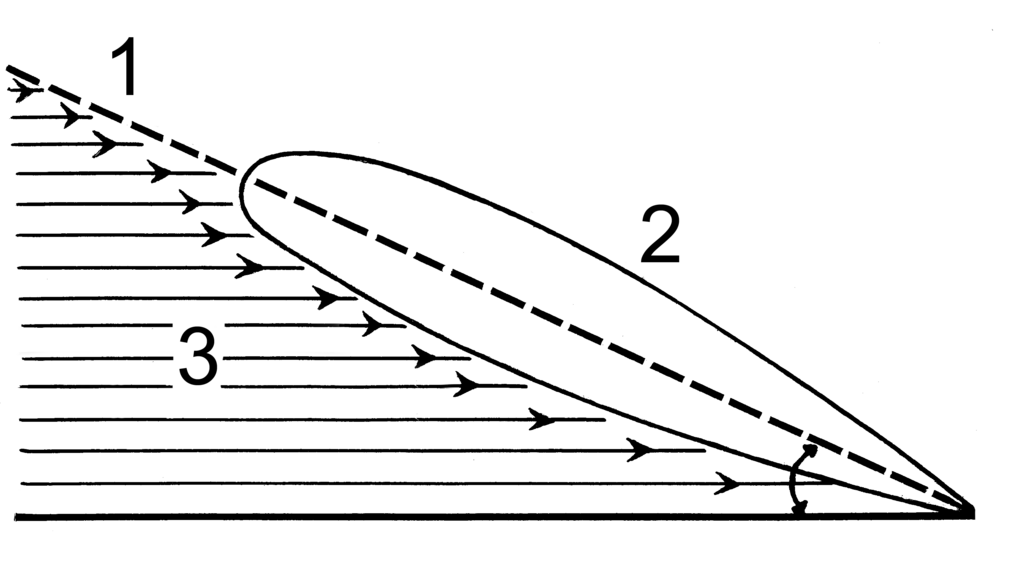
Increasing the angle of attack generally increases lift, but only up to a point. If the angle becomes too steep, the airflow over the top of the wing can separate and become turbulent. This causes a sudden loss of lift, a condition known as a stall.
Airflow patterns are critical. Smooth, or laminar, airflow over the wing is necessary for efficient lift generation. Turbulent flow increases drag and reduces lift.
Now let's review the key concepts we've covered.
Ready to test your understanding?
For an aircraft to maintain a constant altitude and speed, which of the following conditions must be met?
According to the principles described, lift is generated primarily due to a pressure difference. Where is the pressure lower?
Understanding these core principles is the first step to mastering the complexities of flight.