Introduction to Astrophysics
Introduction to Astrophysics
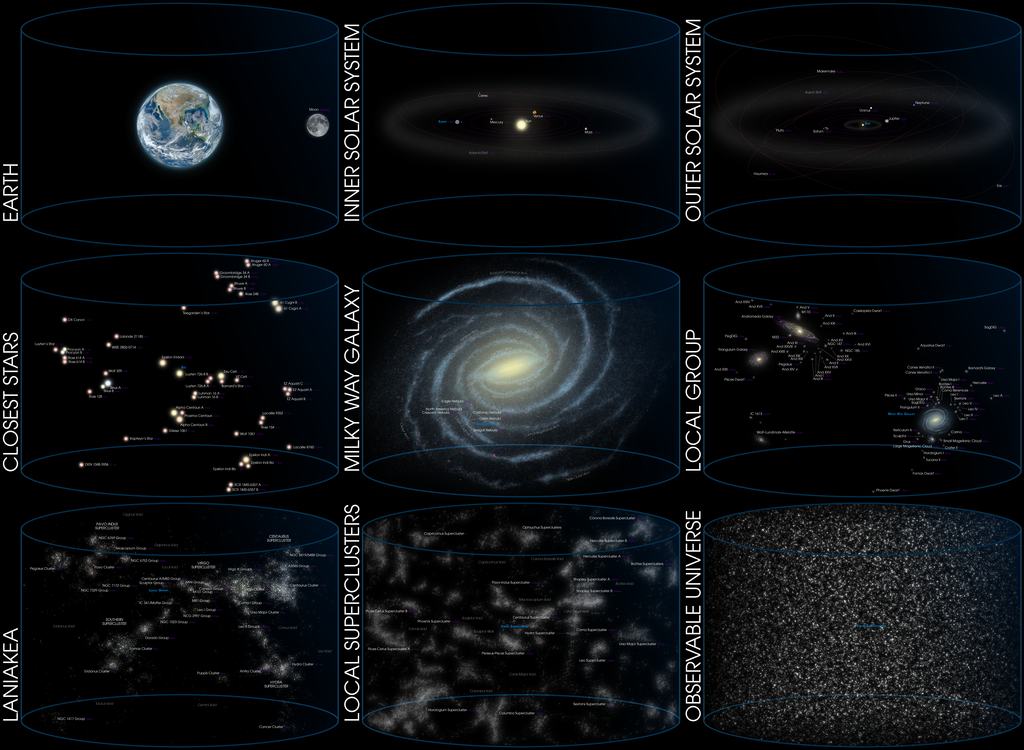
Sizing Up the Cosmos
The universe is unimaginably vast. The distances are so large that everyday units like miles or kilometers become completely impractical. To navigate this scale, astronomers use specialized units of measurement.
For distances within our solar system, we use the Astronomical Unit, or AU. One AU is the average distance from the Earth to the Sun, which is about 93 million miles (150 million kilometers). It’s a convenient yardstick for measuring the distance to Jupiter or Saturn without using unwieldy numbers.
1 AU ≈ 93 million miles / 150 million km
But once we look beyond our solar system, even the AU is too small. To measure the distances to other stars and galaxies, we use the light-year. This isn't a unit of time; it's the distance light travels in one year. Since light moves at about 186,282 miles per second (300,000 kilometers per second), a light-year is an enormous distance.
Light-Year
noun
The distance that light travels in a vacuum in one Julian year, equal to approximately 5.88 trillion miles or 9.46 trillion kilometers.
To put that in perspective, the Andromeda Galaxy, our closest major galactic neighbor, is about 2.5 million light-years away. When we look at it, we are seeing light that began its journey 2.5 million years ago. This scaling-up of distance helps us grasp our place in the cosmos, from our planetary neighborhood to the vast expanse of the observable universe.
A Universe of Light
Everything we know about distant stars and galaxies comes from the light they emit. But the visible light our eyes can see is just a tiny fraction of the full range of light, known as the electromagnetic spectrum. This spectrum includes everything from long-wavelength radio waves to short-wavelength gamma rays.
Different cosmic objects and events produce different types of light. Very hot, energetic phenomena, like exploding stars or the regions around black holes, emit high-energy X-rays and gamma rays. Cooler objects, like clouds of dust where new stars are forming, glow in infrared and microwave light. By observing across the entire spectrum, we get a complete picture of what's happening in the universe.
Astronomical Observation
So how do we capture this light? The primary tool of astronomy is the telescope. Telescopes work by collecting and focusing light from distant objects, making them appear brighter and closer.
There are two main types of telescopes:
- Refracting telescopes use lenses to bend light to a focus point. They were the first type of telescope invented.
- Reflecting telescopes use mirrors to reflect and focus light. Most modern professional telescopes are reflectors because mirrors can be made much larger than lenses, allowing them to collect more light and see fainter objects.
The light collected by a telescope can be analyzed with various instruments. A camera can take a picture, creating the stunning astronomical images we're familiar with. But astronomers often use an instrument called a spectrograph.
Spectrograph
noun
An instrument that separates incoming light into its constituent wavelengths or colors, forming a spectrum.
A spectrograph is like a prism. It spreads starlight out into a rainbow, revealing a pattern of dark or bright lines. These lines are chemical fingerprints. Each element, like hydrogen or helium, absorbs or emits light at specific, unique wavelengths. By studying the spectrum of a star or galaxy, astronomers can figure out what it's made of, how hot it is, and how it's moving.
By combining these tools—knowledge of scale, the full spectrum of light, and powerful telescopes—we can begin to piece together the story of the universe.
What is an Astronomical Unit (AU)?
A light-year is a unit of time.