Introduction to Astronomy
Introduction to Astronomy
A Look Back in Time
Long before telescopes, people looked to the sky. They saw the Sun's daily journey, the Moon's changing phases, and the steady march of stars. These celestial rhythms were the world's first clocks and calendars, telling our ancestors when to plant crops and when to expect the changing of seasons.
Ancient cultures wove stories into the stars, creating constellations that served as memory aids and cultural touchstones. Early astronomers in places like Babylonia, Egypt, and Greece meticulously recorded the movements of planets, which they noticed wandered against the backdrop of fixed stars. They built impressive structures, like Stonehenge, aligned with celestial events.
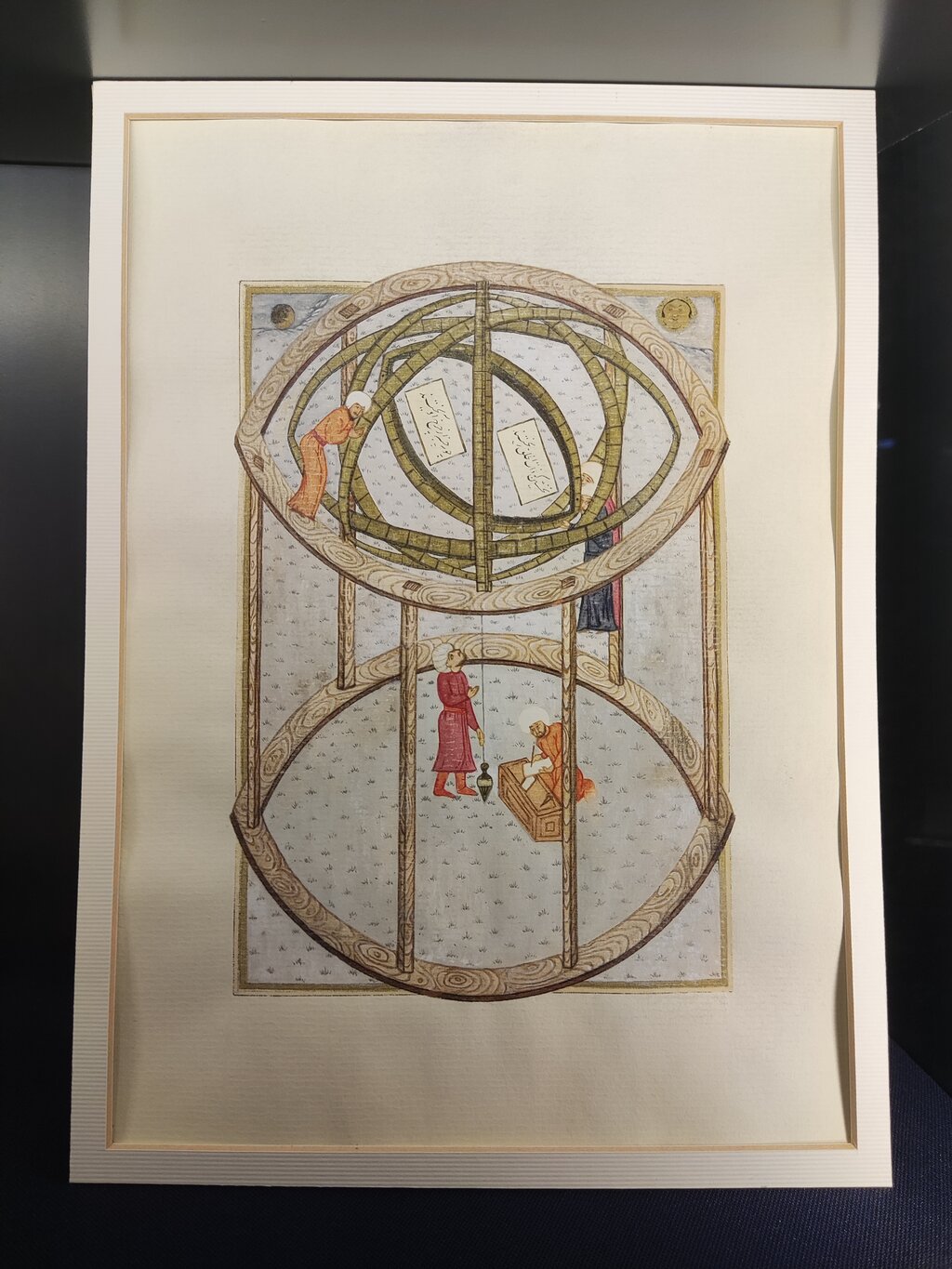
For nearly two thousand years, the prevailing view, championed by the Greek astronomer Ptolemy, was that Earth sat motionless at the center of the universe. This geocentric model seemed obvious. After all, we don't feel the Earth moving, and everything in the sky appears to revolve around us.
This perspective began to shift during the Renaissance. In the 16th century, Nicolaus Copernicus proposed a radical idea: the Sun, not the Earth, was the center of our system. This heliocentric model was simpler and explained the strange retrograde motion of planets more elegantly. Decades later, astronomers like Johannes Kepler figured out that planets move in ellipses, not perfect circles, and Galileo Galilei used his new telescope to discover moons orbiting Jupiter, proving that not everything orbited the Earth. A revolution in thinking was underway.
For millennia, we saw ourselves at the center of everything. Then, a few brave thinkers tilted our perspective, placing the Sun at the heart of our cosmic neighborhood.
Our Cosmic Address
Understanding our place in the universe is like learning a new address, one with an astronomical number of streets. We start on a small, rocky planet called Earth. Earth is one of eight planets orbiting a star we call the Sun. Together, these planets, along with their moons, asteroids, and comets, make up our Solar System.
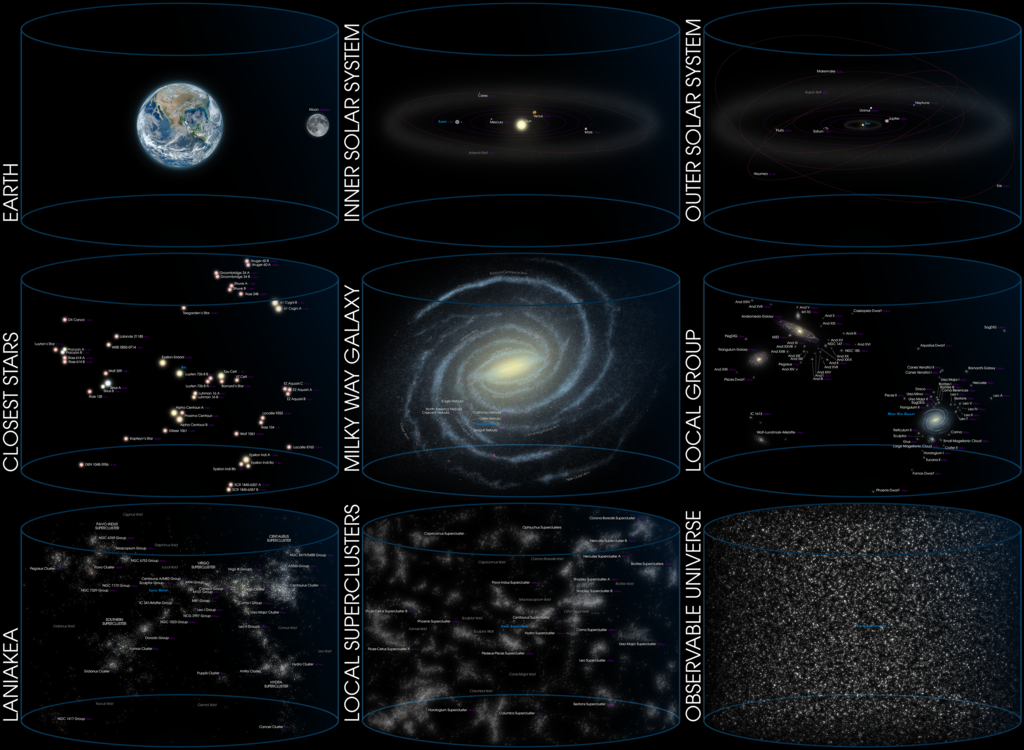
But our Solar System is just one of hundreds of billions in a vast, spinning collection of stars, gas, and dust called the Milky Way galaxy. And the Milky Way isn't alone. It's part of a small cluster of about 50 galaxies called the Local Group. This group, in turn, is a tiny piece of an enormous supercluster of galaxies known as Laniakea. Zoom out even further, and you see that superclusters form immense filaments and sheets, creating a cosmic web that stretches for billions of light-years.
galaxy
noun
A gravitationally bound system of stars, stellar remnants, interstellar gas, dust, and dark matter.
The distances involved are mind-boggling. To cope, astronomers use a special unit of measurement: the light-year. A light-year is the distance light travels in one year, which is about 9.5 trillion kilometers (or 5.9 trillion miles). It's a measure of distance, not time. The nearest star to our Sun, Proxima Centauri, is over four light-years away. The center of our own galaxy is 27,000 light-years away. When we look at distant objects, we are literally looking back in time, seeing them as they were when the light first left them.
Celestial Objects
The universe is filled with a zoo of fascinating objects. Here are a few of the main characters in our cosmic story:
| Object | Description |
|---|---|
| Stars | Giant, luminous spheres of plasma held together by their own gravity. They produce energy through nuclear fusion in their cores. Our Sun is a star. |
| Planets | Large celestial bodies that orbit a star. They don't produce their own light. They can be rocky, like Earth, or gassy, like Jupiter. |
| Moons | Natural satellites that orbit planets. Earth has one moon, while Jupiter has over 90. |
| Asteroids | Small, rocky objects that orbit the Sun, mostly found in the asteroid belt between Mars and Jupiter. |
| Comets | Icy bodies that release gas and dust as they near the Sun, forming a characteristic tail. |
| Nebulae | Enormous clouds of gas and dust in space. Some are stellar nurseries where new stars are born, while others are the remnants of dead stars. |
These objects aren't scattered randomly. Gravity pulls them together into the structures we see, from solar systems to galaxies. Each plays a role in the life cycle of the cosmos.
Mapping the Sky
Just as we use latitude and longitude to pinpoint locations on Earth, astronomers use a similar system to map the sky. This celestial coordinate system imagines the stars are fixed to the inside of a giant, spinning sphere with the Earth at its center. It's not how the universe actually is, but it's a useful model for locating objects from our perspective.
The two main coordinates are declination and right ascension.
Declination (Dec) is like celestial latitude. It measures how far north or south an object is from the celestial equator. It's measured in degrees, from +90° at the North Celestial Pole to -90° at the South Celestial Pole.
Right Ascension (RA) is like celestial longitude. It measures an object's east-west position. It's measured in hours, minutes, and seconds, from 0 to 24 hours, starting from a point called the vernal equinox.
This system allows any astronomer anywhere in the world to find the exact same star.
Time is also a bit different for astronomers. While we use a 24-hour day based on the Sun's position (solar time), astronomers often use sidereal time. A sidereal day is based on the Earth's rotation relative to the distant stars. It's about four minutes shorter than a solar day. This is because as the Earth orbits the Sun, it has to rotate a little extra each day to bring the Sun back to the same position in the sky.
Using sidereal time helps astronomers know when a particular star or galaxy will be in the best position for observation on any given night.
Now that you've been introduced to some of the core concepts, test your understanding.
For nearly two thousand years, what was the prevailing model of the universe, which placed the Earth at the center?
An astronomer tells you a distant galaxy is 50 million light-years away. What does this mean?
This is just the beginning of a journey. From our own cosmic backyard to the farthest reaches of space and time, the study of astronomy continually reshapes our understanding of the universe and our place within it.