Introduction to Artificial Intelligence
Introduction to Artificial Intelligence
What Is Artificial Intelligence?
Artificial intelligence is the science of making machines that can think like humans. It's a broad field aimed at creating systems that can perform tasks that typically require human intelligence, like learning from experience, solving problems, and understanding language.
Think of it this way: a regular computer program follows explicit instructions. An AI, on the other hand, can analyze new information and make decisions on its own, much like you do when you see a new kind of fruit and decide if you want to try it.
The goal isn't necessarily to replicate the human mind perfectly. Instead, it's about simulating intelligent behavior to tackle complex problems. This could be anything from recognizing a cat in a photo to navigating a car through city traffic.
The broad term “artificial intelligence” refers to the simulation of human-level intelligence and thinking through the use of machines.
A Brief History
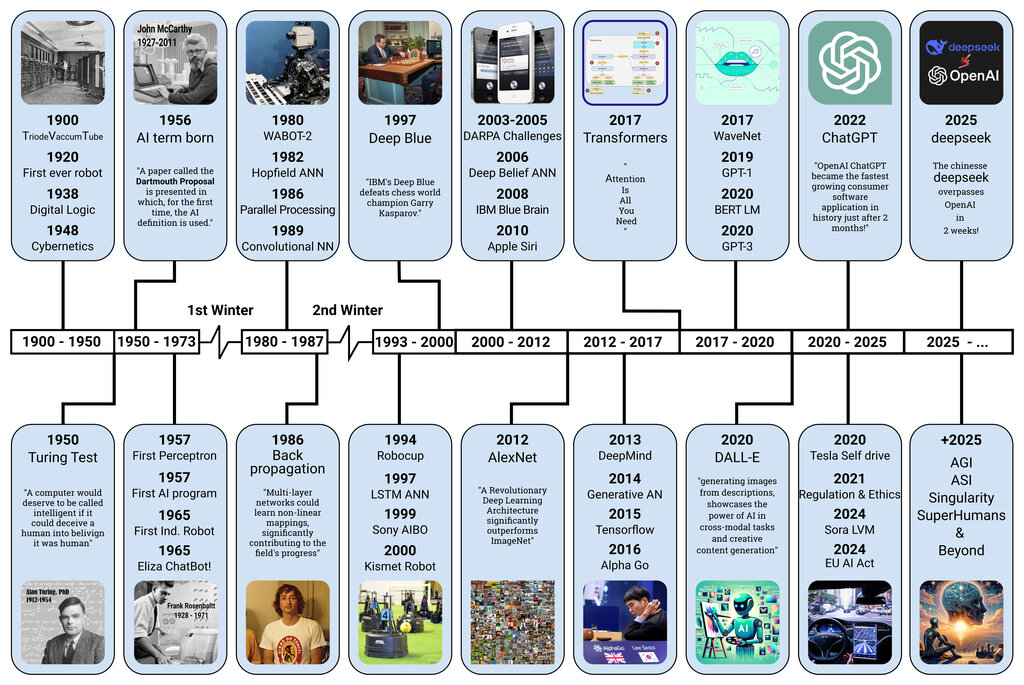
The dream of intelligent machines has been around for centuries, but the actual field of AI began in the 1950s. Early pioneers believed that a machine as intelligent as a human being was just a few decades away. This initial excitement led to a burst of research and funding.
However, the challenge proved much harder than anticipated. Progress slowed in the 1970s and 80s, leading to periods known as "AI winters" when funding and interest dried up. But the dream never died. Breakthroughs in computing power and the availability of massive amounts of data in the 2000s set the stage for a major comeback.
Now, AI is experiencing a golden age. Advances that were once science fiction are becoming part of our daily lives.
The Flavors of AI
AI isn't a single technology; it's an umbrella term for several related fields. Just as "sports" includes everything from swimming to basketball, "AI" covers a wide range of specializations. The most important ones to know are Machine Learning, Natural Language Processing, and Computer Vision.
Machine Learning (ML) is the most common type of AI. Instead of being programmed with specific rules, an ML system learns patterns directly from data. Your email's spam filter is a classic example. It wasn't told to look for specific words; it learned to recognize junk mail by analyzing thousands of examples of spam and legitimate emails.
Natural Language Processing (NLP) focuses on the interaction between computers and human language. When you ask a voice assistant for the weather or use a translation app, you're using NLP. This field gives machines the ability to read, understand, and generate human language.
Computer Vision is the subfield that teaches machines to see and interpret the visual world. It allows computers to identify objects in images and videos. This is the technology behind facial recognition on your phone and the systems that allow self-driving cars to identify pedestrians and traffic signs.
Let's check your understanding of these foundational AI concepts.
What is the primary goal of artificial intelligence?
The periods in AI history characterized by reduced funding and waning interest are known as 'AI winters'.
This foundation gives you the basic vocabulary to understand the world of AI. As you continue, you'll see how these different fields combine to create powerful and sophisticated tools.