Introduction to Artificial Intelligence
Introduction to Artificial Intelligence
What Is AI?
Artificial Intelligence is the science of making machines that can think and learn like humans. It's a broad field in computer science focused on building smart systems that can perform tasks that typically require human intelligence. This includes things like recognizing speech, making decisions, and translating languages.
Think of it this way: when you learn to ride a bike, you're not following a rigid set of instructions. You're adapting, learning from your mistakes, and developing a feel for balance. AI aims to give machines a similar ability to learn and adapt, not just execute pre-programmed commands.
Artificial Intelligence
noun
A field of computer science dedicated to creating systems capable of performing tasks that normally require human intelligence, such as visual perception, speech recognition, decision-making, and translation between languages.
The idea of creating intelligent machines has captivated thinkers for centuries, but the actual journey of AI as a scientific field is more recent. It’s a story of ambitious ideas, frustrating setbacks, and incredible breakthroughs.
A Brief History of AI
The term “artificial intelligence” was first officially used in 1956 at a conference at Dartmouth College. A group of scientists gathered for a summer workshop to explore the idea that every aspect of learning or any other feature of intelligence could, in principle, be so precisely described that a machine could be made to simulate it.
This was the first time the term "artificial intelligence" was used as the group spent almost two months discussing how machines might simulate learning and intelligence.
Early research was filled with optimism. Researchers developed programs that could solve algebra problems, prove theorems in logic, and speak simple English. But progress stalled. The complexity of creating true intelligence was far greater than anticipated, and the available computing power was limited. This led to periods known as “AI winters,” when funding and interest in the field declined sharply.
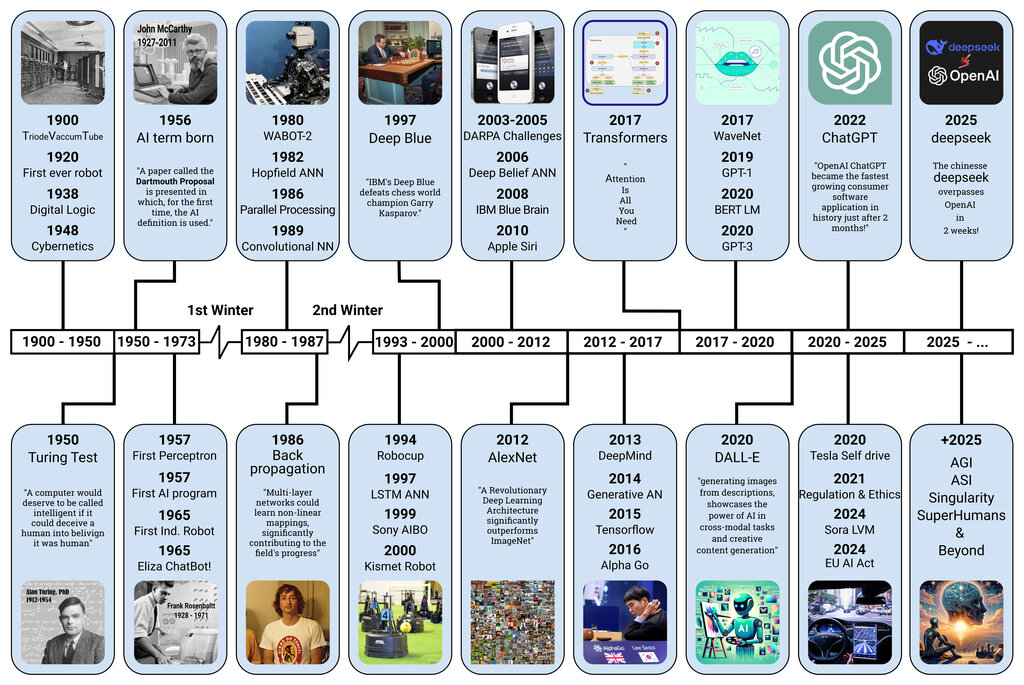
The winters didn't last forever. The dawn of the 21st century brought a resurgence, fueled by two key factors: the explosion of data from the internet and massive increases in computing power. Suddenly, AI researchers had the raw materials and the horsepower they needed to make significant progress. Milestones like IBM's Deep Blue defeating chess champion Garry Kasparov in 1997 signaled a new era where AI could tackle complex, strategic problems.
Why AI Matters Today
Today, AI is no longer just a subject of academic research; it's a powerful force reshaping our world. Its significance lies in its ability to process and understand vast amounts of information at a scale and speed that is beyond human capability. This allows us to find patterns, make predictions, and automate tasks in ways that were previously impossible.
From the algorithms that recommend what you should watch next to the systems that help doctors analyze medical images, AI is becoming a fundamental layer of modern technology. It's changing how we work, communicate, and solve some of the world's most complex challenges. Understanding its basic principles is becoming essential for navigating the contemporary world.
Now that you have a foundational understanding of AI, let's test your knowledge.
What is the primary goal of Artificial Intelligence as described in the text?
The periods of reduced funding and interest in AI research are known as:
That covers the basics of what AI is and where it came from. As the field continues to evolve, this historical context will remain a crucial reference point.