Introduction to Artificial Intelligence
Introduction to Artificial Intelligence
What Is Artificial Intelligence?
Artificial Intelligence, or AI, is the science of making machines that can think or act intelligently. At its core, it's about creating systems that can perceive their environment, reason, learn from data, and make decisions to achieve specific goals, much like a human does.
The main goal is to build machines that can perform tasks that would normally require human intelligence.
This doesn't mean creating conscious robots like in the movies. Most AI today is considered "narrow AI." It's designed to perform a specific task very well, like recommending a song, translating a sentence, or identifying a person in a photo. It can't perform tasks outside of its specific programming.
A Quick Trip Through Time
The idea of intelligent machines has been around for centuries, but the formal field of AI research began in the mid-20th century. Progress wasn't a straight line; it was marked by periods of great excitement followed by funding cuts, known as "AI winters." But recent breakthroughs in computing power and data availability have led to the incredible progress we see today.
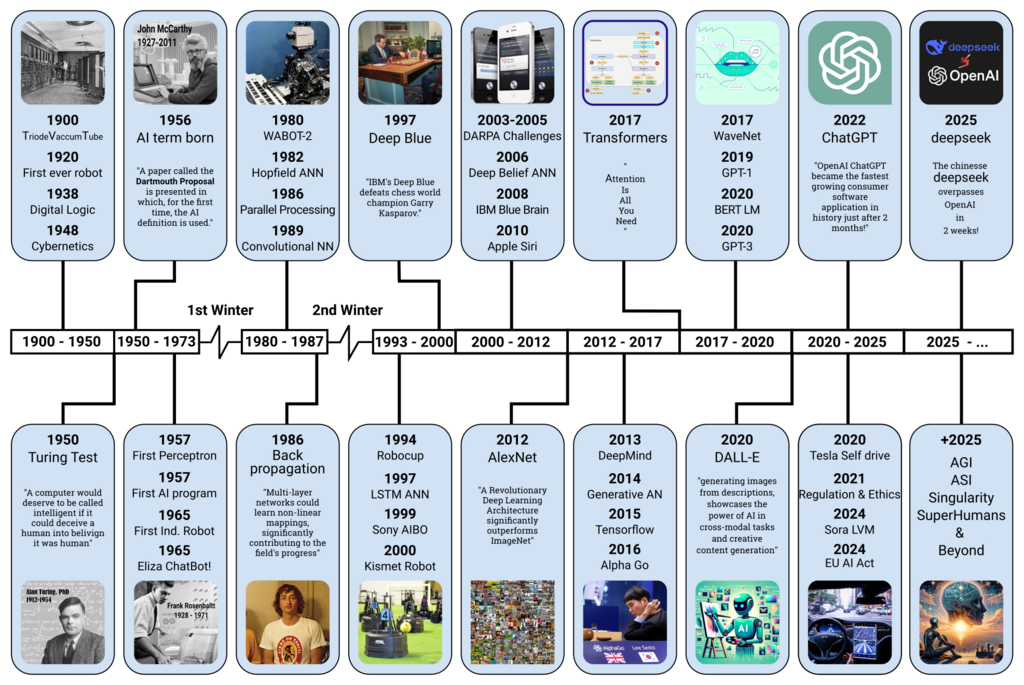
Here are a few key moments that shaped the field:
| Year | Milestone |
|---|---|
| 1950 | Alan Turing proposes the "Turing Test" to determine if a machine can exhibit intelligent behavior indistinguishable from a human. |
| 1956 | The term "Artificial Intelligence" is coined at the Dartmouth Workshop, marking the official birth of AI as a research field. |
| 1997 | IBM's Deep Blue chess computer defeats world champion Garry Kasparov, a major symbolic victory for AI. |
| 2012 | A deep learning model makes a massive leap in image recognition accuracy, kicking off the modern deep learning boom. |
The Flavors of AI
AI isn't just one thing. It’s a broad field with several specialized subfields, each focusing on a different aspect of intelligence. Some of the most important ones overlap and build on each other.
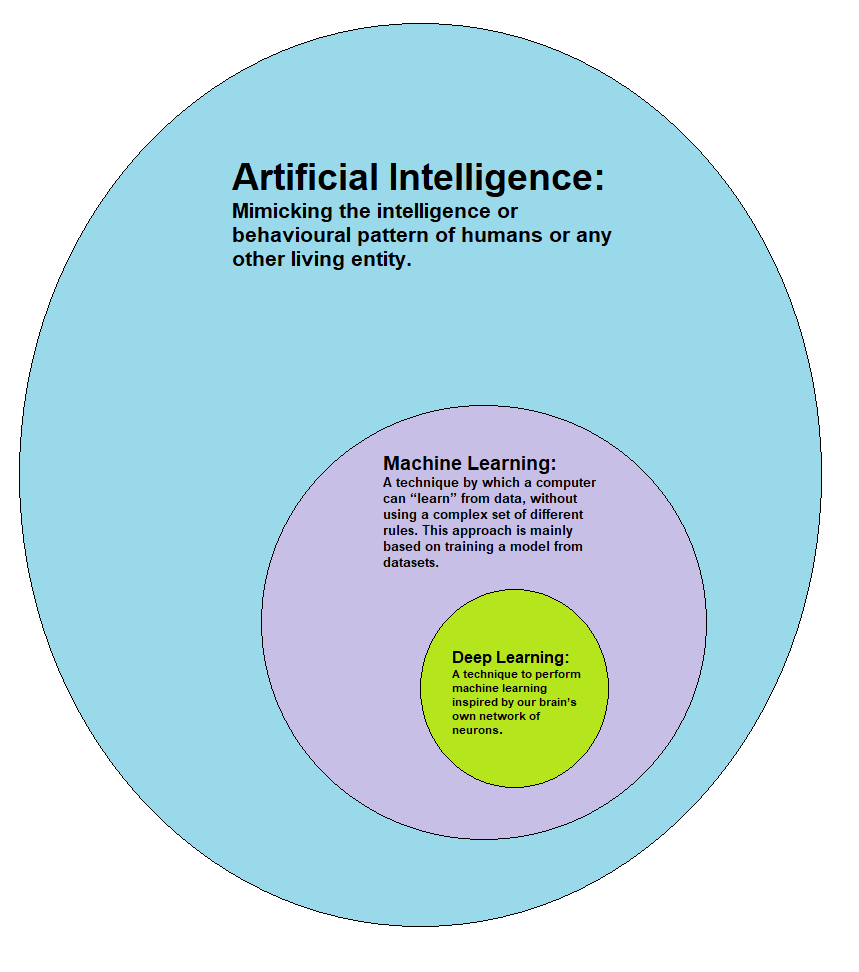
Machine Learning (ML) is a subset of AI where systems learn directly from data. Instead of being explicitly programmed with rules, a machine learning model identifies patterns in large datasets to make predictions or decisions. For example, your email's spam filter learns to identify junk mail by analyzing thousands of examples of spam and non-spam messages.
Deep Learning (DL) is a specialized type of machine learning. It uses complex structures called neural networks, which are inspired by the human brain. These networks have many layers, allowing them to learn intricate patterns from massive amounts of data. Deep learning is the engine behind many recent AI advances, like realistic image generation and advanced voice assistants.
Two other major areas focus on how AI interacts with the world:
Natural Language Processing (NLP) gives machines the ability to understand, interpret, and generate human language. It's what allows you to talk to your phone's digital assistant, use a translation app to read a menu in another language, or get a summary of a long article. NLP bridges the gap between human communication and computer understanding.
Computer Vision is the subfield that trains computers to see and interpret the visual world. Using images and videos, computer vision systems can identify and classify objects, faces, and even activities. This is the technology behind facial recognition on your phone, self-driving cars navigating roads, and medical systems that help doctors analyze X-rays.
Ready to check your understanding?
What is the core concept behind Machine Learning (ML), a major subset of AI?
Most AI today, like a GPS suggesting a route or a spam filter catching junk mail, is considered 'narrow AI'. What does this term signify?
These foundational concepts provide the building blocks for understanding the complex and rapidly evolving world of AI.