Introduction to Artificial Intelligence
Introduction to Artificial Intelligence
What Is Artificial Intelligence?
Artificial intelligence is the science of making machines that can think like humans. The goal is to create systems that can perform tasks that normally require human intelligence, like recognizing speech, making decisions, or translating languages.
Think of it this way: you can program a simple calculator to follow a strict set of rules. You tell it exactly what to do with numbers. But with AI, you don't just give it rules. You give it the ability to learn. Instead of programming a computer to recognize a cat by listing features like "pointy ears" and "whiskers," you show it thousands of cat pictures and let it figure out the patterns on its own. This ability to learn from data is at the heart of modern AI.
Artificial Intelligence
noun
A field of computer science dedicated to creating systems capable of performing tasks that typically require human intelligence, such as learning, reasoning, and problem-solving.
AI isn't a single technology, but a broad field with many different approaches. The core idea, however, remains the same: to build machines that can perceive their environment, reason about it, and take actions to achieve specific goals.
A Brief History
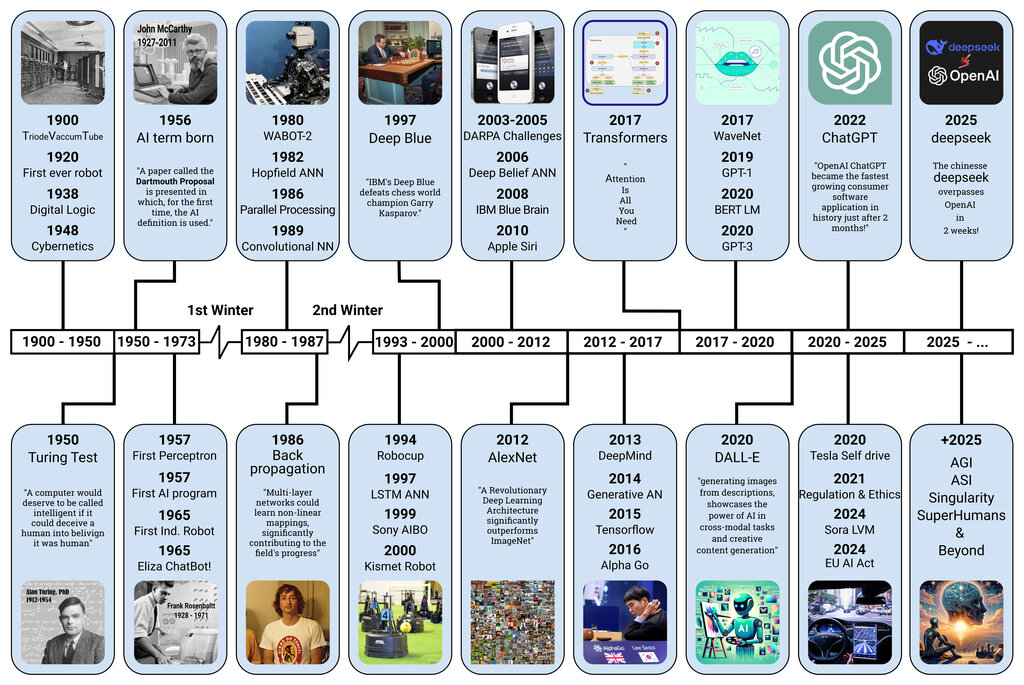
The dream of intelligent machines is ancient, but the scientific field of AI is relatively new. The journey began in the 1950s, a time of excitement and big ideas. One of the key moments was a workshop at Dartmouth College in 1956, where the term "artificial intelligence" was officially coined.
Early researchers were incredibly optimistic. They believed that a machine as intelligent as a human being was only a few decades away. This initial enthusiasm led to significant funding and groundbreaking work in problem-solving and game playing.
However, the progress wasn't as fast as they had hoped. The computers of the time were not powerful enough, and the problems were far more complex than anticipated. This led to periods known as "AI winters," when funding dried up and interest waned.
Things changed dramatically in the last couple of decades. The explosion of the internet provided massive amounts of data to train AI systems, and advances in computer hardware gave them the power they needed to process it all. This led to a resurgence in AI, bringing us the powerful tools we see today.
The Three Types of AI
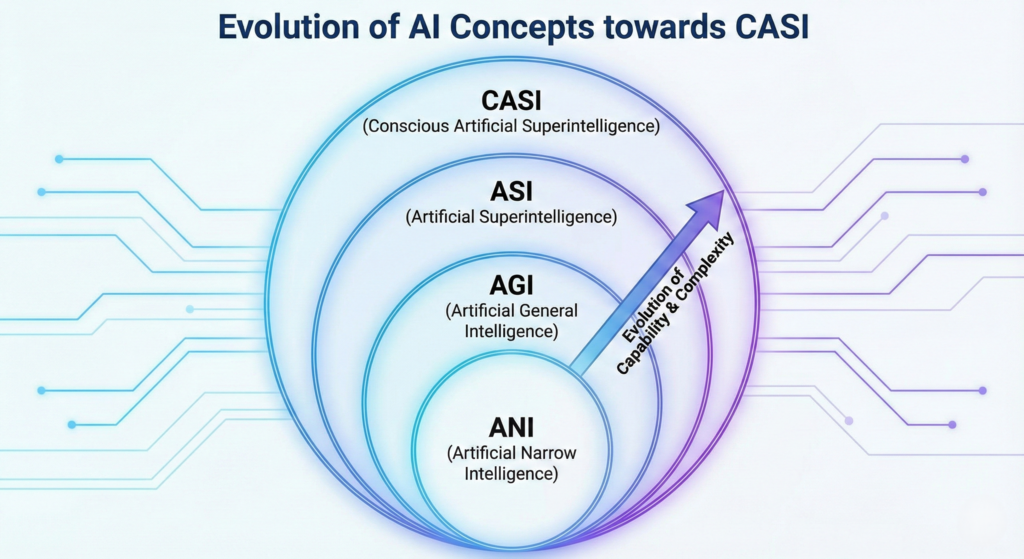
When people talk about AI, they might be referring to very different things. To understand the field, it's helpful to categorize AI based on its capabilities. There are three main types, though only one of them currently exists.
Artificial Narrow Intelligence (ANI)
This is sometimes called "Weak AI." It's the only type of artificial intelligence we have successfully created so far. ANI is designed and trained for one specific task. It can be incredibly good at that task, but it can't operate outside of its defined purpose.
Examples are all around us. The spam filter in your email, the recommendation engine on Netflix, and the voice assistant on your phone are all forms of ANI. They are experts in their narrow domains but have no general understanding or consciousness.
Your GPS is a perfect example of ANI. It can find the fastest route to your destination, but it can't tell you what to have for dinner.
Artificial General Intelligence (AGI)
Often called "Strong AI," AGI is the type of intelligence you see in science fiction movies. It refers to a machine with the ability to understand, learn, and apply its intelligence to solve any problem a human can. An AGI would possess consciousness and human-level cognitive abilities.
Creating AGI is the ultimate goal for many AI researchers, but it remains a massive challenge. We are not yet close to achieving it. An AGI system would be able to learn to paint a masterpiece, write a prize-winning novel, and make a scientific discovery, all without being specifically programmed for each task.
Artificial Superintelligence (ASI)
This is a hypothetical form of AI that would surpass human intelligence in every way. An ASI would not just mimic or understand human intelligence; it would be vastly more capable. It could solve problems that are currently unsolvable for the human mind, from curing diseases to ending poverty.
The concept of ASI raises profound ethical and safety questions. While it's still theoretical, it's a topic of serious discussion among scientists and philosophers who consider the long-term future of AI.
For now, every AI application you interact with is a form of Narrow AI. But the field is advancing quickly, and the lines between these categories help us understand where we are and where we might be heading.