Introduction to Artificial Intelligence
Introduction to Artificial Intelligence
What Is Artificial Intelligence?
Artificial Intelligence, or AI, is about creating machines that can think, learn, and solve problems like humans do. It's a broad field in computer science focused on building smart systems capable of performing tasks that typically require human intelligence. This could be anything from understanding language to recognizing objects in a photo.
Artificial Intelligence
noun
The theory and development of computer systems able to perform tasks that normally require human intelligence, such as visual perception, speech recognition, decision-making, and translation between languages.
Think of it this way: when you learn to ride a bike, you observe, you try, you fall, and you adjust until you get it right. AI systems are built to do something similar, but with data. They process vast amounts of information, identify patterns, and make decisions or predictions based on what they've learned.
The core idea of AI isn't to replace human intelligence, but to augment it, helping us tackle complex problems more efficiently.
A Brief History of AI
The concept of intelligent machines has been around for centuries in myths and stories, but the actual scientific pursuit of AI began in the mid-20th century. The field was formally born at a workshop at Dartmouth College in 1956, where the term "artificial intelligence" was coined. Early researchers were incredibly optimistic, believing that a machine as intelligent as a human being was only a few decades away.
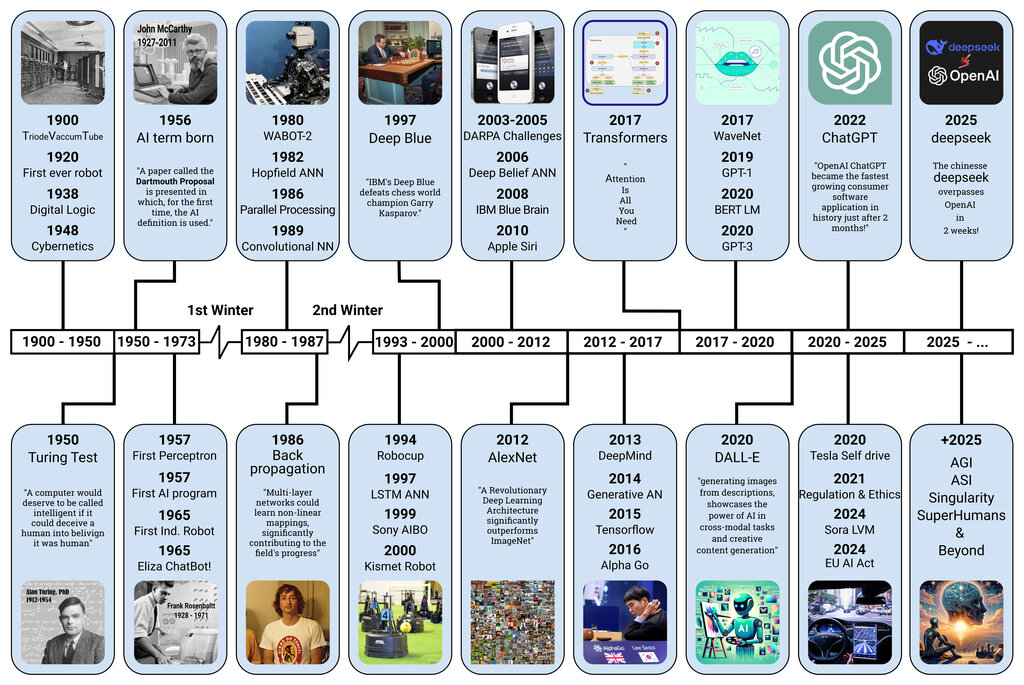
Progress came in waves. The early years saw breakthroughs in problem-solving and symbolic reasoning. Then came a period known as the "AI winter," when funding dried up due to slow progress and unfulfilled promises.
Things picked up again in the 1980s and have accelerated dramatically since the 2000s, thanks to more powerful computers and the availability of massive amounts of data. Milestones like IBM's Deep Blue defeating a world chess champion in 1997 and the rise of systems like ChatGPT have brought AI into the public eye.
The history of Artificial Intelligence (AI) is a narrative of waves -- rising optimism followed by crashing disappointments.
Core Concepts and Applications
At its heart, AI involves a few key concepts. One is representation, which is how the system stores knowledge about the world. For example, a navigation app needs a way to represent roads, traffic, and destinations.
Another is reasoning, the ability to use that knowledge to make decisions. When your app suggests a new route to avoid a traffic jam, it's using a form of logical reasoning. Finally, there's learning, where the system improves its performance over time by analyzing new data. That same app learns about typical traffic patterns by observing data from thousands of drivers.
These concepts fuel a wide range of applications that we interact with daily.
| Industry | Example Application |
|---|---|
| Healthcare | Analyzing medical images to detect diseases earlier. |
| Finance | Detecting fraudulent credit card transactions. |
| Retail | Recommending products based on your shopping history. |
| Entertainment | Powering the content suggestions on streaming services. |
| Transportation | Optimizing delivery routes for shipping companies. |
From the smart assistant on your phone to the systems that manage power grids, AI is becoming a fundamental part of our technological landscape. It helps businesses operate more efficiently and opens up new possibilities for scientific discovery.
Now that you have a foundational understanding of what AI is and where it came from, let's test your knowledge.
What is the primary goal of artificial intelligence?
The term 'artificial intelligence' was first coined at a workshop held at which institution in 1956?
Understanding the definition, history, and applications of AI is the first step in appreciating its impact on our world.