Introduction to Artificial Intelligence
Introduction to Artificial Intelligence
What Is Artificial Intelligence?
Artificial intelligence is the science of making machines that can think, learn, and solve problems like humans. At its core, AI aims to replicate or simulate human intelligence in machines, enabling them to perform tasks that would otherwise require our own cognitive abilities.
Artificial Intelligence
noun
A field of computer science dedicated to creating systems capable of performing tasks that normally require human intelligence, such as visual perception, speech recognition, decision-making, and translation between languages.
The main goals of AI research are broad. They include reasoning, knowledge representation, planning, learning, natural language processing (understanding and generating human language), and perception. A long-term goal for some researchers is creating systems with general intelligence, which we'll explore shortly.
A Brief History of AI
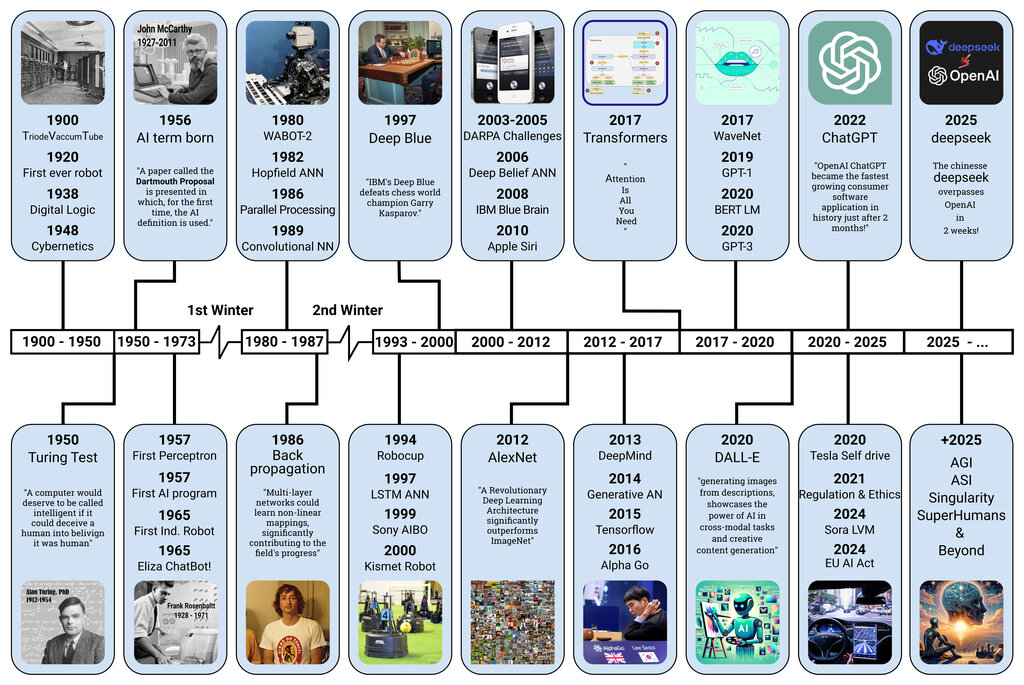
The idea of intelligent machines has been around for centuries in myths and stories, but the formal field of AI research is relatively new. It officially began in the summer of 1956 at a workshop at Dartmouth College, where the term "artificial intelligence" was first used.
Early AI, often called symbolic AI, was based on rules. Researchers believed they could create intelligence by writing down a long list of explicit rules for a machine to follow. This approach was great for solving clearly defined problems, like playing chess or solving logic puzzles. However, it struggled with the messiness of the real world, where rules aren't always so clear.
This early, rule-based approach is known as GOFAI, or "Good Old-Fashioned AI."
Progress was slower than expected, leading to periods called "AI winters" when funding and interest dwindled. A major shift occurred with the rise of machine learning. Instead of being programmed with rules, systems could now learn patterns directly from data. This was a huge leap forward.
More recently, a subset of machine learning called deep learning, powered by massive amounts of data and more powerful computers, has led to the breakthroughs we see today, from voice assistants to self-driving cars.
The Three Types of AI
AI systems are often categorized into three types based on their capabilities. Understanding these distinctions is key to understanding what AI can—and can't—do today.
| Type | Description | Example |
|---|---|---|
| Artificial Narrow Intelligence (ANI) | Specializes in one specific task. | A chess-playing AI, a spam filter, or a language translation app. |
| Artificial General Intelligence (AGI) | Can understand, learn, and apply knowledge across a wide range of tasks at a human level. | This is the type of AI often seen in science fiction, like HAL 9000 or Data from Star Trek. |
| Artificial Superintelligence (ASI) | An intellect that is much smarter than the best human brains in virtually every field. | This is a hypothetical future form of AI. |
Right now, all the AI we interact with is ANI, or narrow AI. These systems can be incredibly powerful and outperform humans at their specific tasks, but they operate within a limited, pre-defined range. For example, an AI that's an expert at recommending movies has no idea how to drive a car or diagnose a disease.
AGI remains a theoretical goal for researchers. Creating a machine with the flexible, common-sense reasoning of a human is an incredibly complex challenge that we have not yet solved. ASI is even further off, existing only in speculation about the future.
So, while today's AI is transformative, it is highly specialized. The dream of a truly general artificial intelligence is still on the horizon.
Let's check your understanding of these fundamental concepts.
What is a primary goal of artificial intelligence research?
The term "artificial intelligence" was first coined at a 1956 workshop held at which institution?
This introduction covers the basic definition, history, and types of AI. These concepts provide a foundation for understanding the more complex topics that follow.