Introduction to Artificial Intelligence
Introduction to Artificial Intelligence
What Is Artificial Intelligence?
At its core, artificial intelligence (AI) is about building machines that can think and learn like humans. It's a field of computer science dedicated to simulating human intelligence processes. These processes include learning from information, reasoning to draw conclusions, and solving problems.
Think of it this way: we teach a child by showing them examples. AI works similarly, but with data. The goal is to create systems that can perform tasks that normally require human intellect.
Artificial Intelligence
noun
The theory and development of computer systems able to perform tasks that normally require human intelligence, such as visual perception, speech recognition, decision-making, and translation between languages.
A Journey Through Time
The idea of intelligent machines has been around for centuries, but the formal field of AI research began in the 1950s. The term itself was coined in 1956 at a conference at Dartmouth College. A group of scientists gathered to explore the possibility of creating machines that could think.
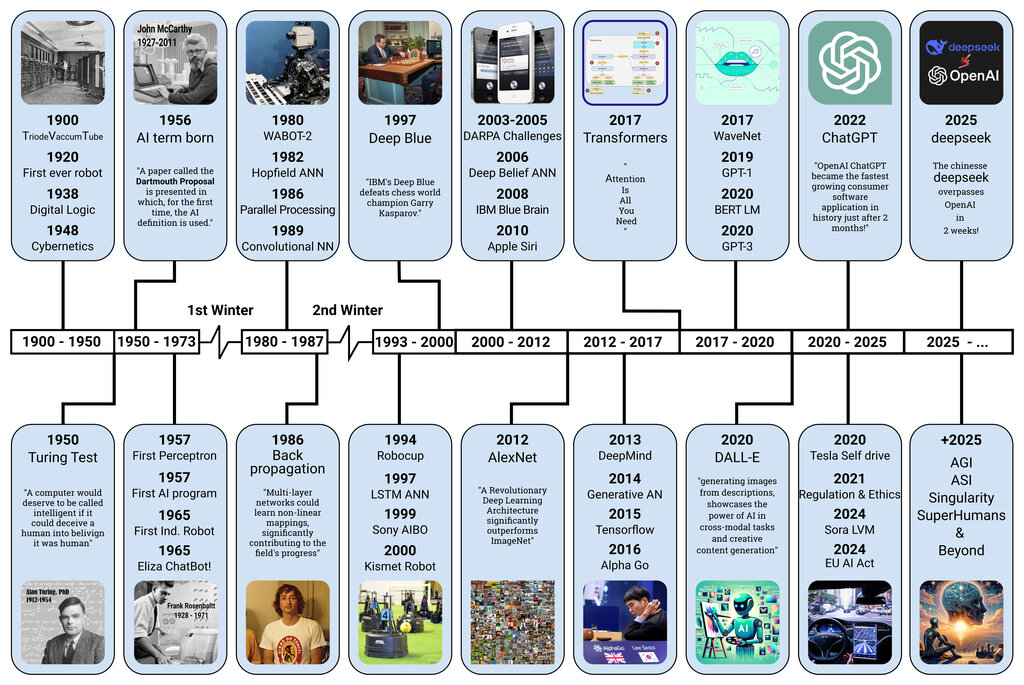
Early research was filled with optimism. Researchers developed programs that could solve algebra problems, prove logical theorems, and speak simple English. However, the complexity of creating true intelligence was underestimated. The limited computing power of the time couldn't handle the vast amount of knowledge and processing required for more difficult tasks.
This led to periods known as "AI winters," when funding and interest in the field dwindled. But progress didn't stop. Advances in computing power and the availability of massive datasets in the 21st century sparked a resurgence. Today, AI is one of the most active and exciting areas of technology.
The Core Goals
The ultimate ambition of AI is to create machines that can perform intelligent tasks as well as, or even better than, humans. This broad goal can be broken down into a few key areas.
Reasoning: This involves applying logic to draw inferences. For example, if we tell an AI system that "All birds can fly" and "A robin is a bird," a reasoning system should be able to conclude that "A robin can fly."
Learning: This is the ability to improve at a task over time without being explicitly programmed for every scenario. Instead of writing rules for every possible situation, an AI learns patterns from data. This is how a spam filter gets better at identifying junk email by learning from the messages you mark as spam.
Problem-Solving: This goal focuses on finding the best solution from many possibilities. Think of a GPS navigation app finding the fastest route to your destination. It analyzes traffic, road closures, and different paths to solve the problem of getting you there quickly.
These foundational goals have driven AI research for decades, pushing the boundaries of what machines can do. Understanding them is the first step to grasping the power and potential of artificial intelligence.
The term "Artificial Intelligence" was first coined at a conference held at which institution in 1956?
An email service that automatically gets better at identifying junk mail by analyzing messages you mark as spam is primarily demonstrating which AI capability?