Introduction to Artificial Intelligence
Introduction to Artificial Intelligence
What Is Artificial Intelligence?
At its core, artificial intelligence is about making computers smart. The goal is to create machines that can perform tasks that typically require human intelligence, like learning, reasoning, problem-solving, and understanding language.
Think of it this way: instead of programming a computer with a rigid set of instructions for every single task, AI allows a computer to learn from experience and adapt to new situations on its own.
Artificial Intelligence
noun
The theory and development of computer systems able to perform tasks that normally require human intelligence, such as visual perception, speech recognition, decision-making, and translation between languages.
This isn't a new idea. For centuries, humans have imagined creating intelligent, non-human beings. But it wasn't until the mid-20th century that we had the technology to start turning that fiction into a reality.
The Journey of AI
The term "artificial intelligence" was officially coined in 1956 at a conference at Dartmouth College. This event brought together the first generation of AI researchers who were optimistic about creating thinking machines in just a few years.
Progress was slower than expected. The field went through several cycles of excitement followed by disappointment, often called "AI winters," when funding and interest dried up due to the immense challenges. But breakthroughs continued, and with the rise of powerful computers and vast amounts of data in the 21st century, AI experienced a renaissance.
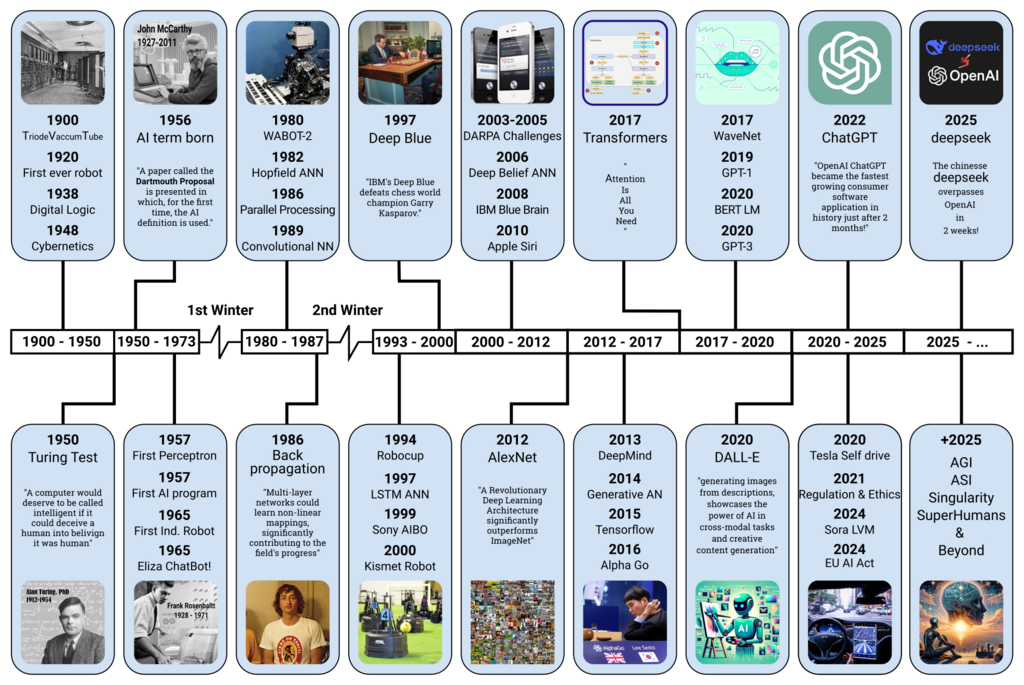
A few key moments pushed AI forward. In 1997, IBM's Deep Blue computer defeated world chess champion Garry Kasparov, a landmark achievement. In 2011, another IBM system, Watson, won the game show Jeopardy! by understanding and responding to natural language clues. These events showed that AI could tackle complex problems once thought to be exclusively in the human domain.
The Language of AI
To understand AI, it helps to know a few basic terms. These concepts are the building blocks of most modern AI systems.
Machine Learning
noun
A subset of AI where systems learn and improve from experience without being explicitly programmed. It involves feeding data to an algorithm and allowing it to identify patterns.
Machine learning is a bit like how a child learns to recognize a dog. You don't give the child a long list of rules about what makes a dog. Instead, you show them many pictures of dogs. Over time, they start to recognize the patterns on their own: four legs, a tail, fur, and a wagging tail.
Neural Network
noun
A computational model inspired by the structure and function of the human brain. It consists of interconnected nodes, or 'neurons,' that process information and learn to recognize patterns.
Neural networks take the learning process a step further. They are a key part of an even more advanced subset of machine learning called deep learning. These networks have many layers of 'neurons' that work together, allowing them to learn much more complex patterns from data, like understanding the nuances of human speech or identifying objects in a busy photograph.
What is the fundamental goal of artificial intelligence?
The term "artificial intelligence" was officially coined at a 1956 conference held at which institution?
This foundation gives you the basics of what AI is and where it came from. As you continue, you'll see how these core ideas power the incredible range of AI applications we see today.