Introduction to Artificial Intelligence
Introduction to AI
What Is AI, Really?
At its heart, artificial intelligence isn't about creating a thinking, feeling robot like you see in movies. It's much simpler and more practical than that. AI is the science of making computers do things that normally require human intelligence. This includes tasks like understanding language, recognizing images, making decisions, and solving problems.
Think of it this way: AI gives a computer the ability to learn from data and experience, rather than just following a rigid set of pre-programmed instructions.
Artificial Intelligence
noun
The theory and development of computer systems able to perform tasks that normally require human intelligence, such as visual perception, speech recognition, decision-making, and translation between languages.
AI is already a part of your daily life, often working quietly in the background. When your navigation app reroutes you to avoid traffic, that's AI. When a streaming service recommends a movie you might like, that's AI. It powers spam filters in your email, helps doctors diagnose diseases, and allows your phone's camera to recognize faces. Its impact is enormous because it helps us find patterns and make predictions on a scale far beyond human capability.

The Two Main Flavors of AI
Not all AI is created equal. Right now, we can sort AI into two main categories: Narrow AI and General AI. Understanding the difference is key to understanding where the technology is today and where it might go.
Artificial Narrow Intelligence (ANI), or Weak AI, is designed and trained for one specific task. It's a master of its domain, but it can't operate outside of it. The AI that plays chess can't write an email or drive a car. This is the only type of AI we have successfully built so far.
Artificial General Intelligence (AGI), or Strong AI, is the stuff of science fiction. This is a type of AI that could understand, learn, and apply its intelligence to solve any problem, much like a human being. AGI doesn't exist yet, and creating it remains one of the most challenging goals in computer science.
| Feature | Narrow AI (ANI) | General AI (AGI) |
|---|---|---|
| Scope | Performs a single, specific task | Can handle any intellectual task |
| Capability | Superhuman at its one task | Human-like, flexible intelligence |
| Examples | Chess programs, Siri, self-driving cars | None currently exist |
A Quick Trip Through Time
The idea of intelligent machines has been around for centuries, but the modern field of AI officially began in the mid-20th century. The term "artificial intelligence" was coined at a workshop at Dartmouth College in 1956. Early researchers were optimistic, believing that a machine as intelligent as a human would exist in just a few decades.
Progress wasn't that simple. The field went through periods of high funding and excitement, followed by "AI winters" where progress stalled and funding dried up. But in recent years, two key factors have fueled an explosion in AI development: the availability of massive amounts of data and the development of powerful computers that can process it all.
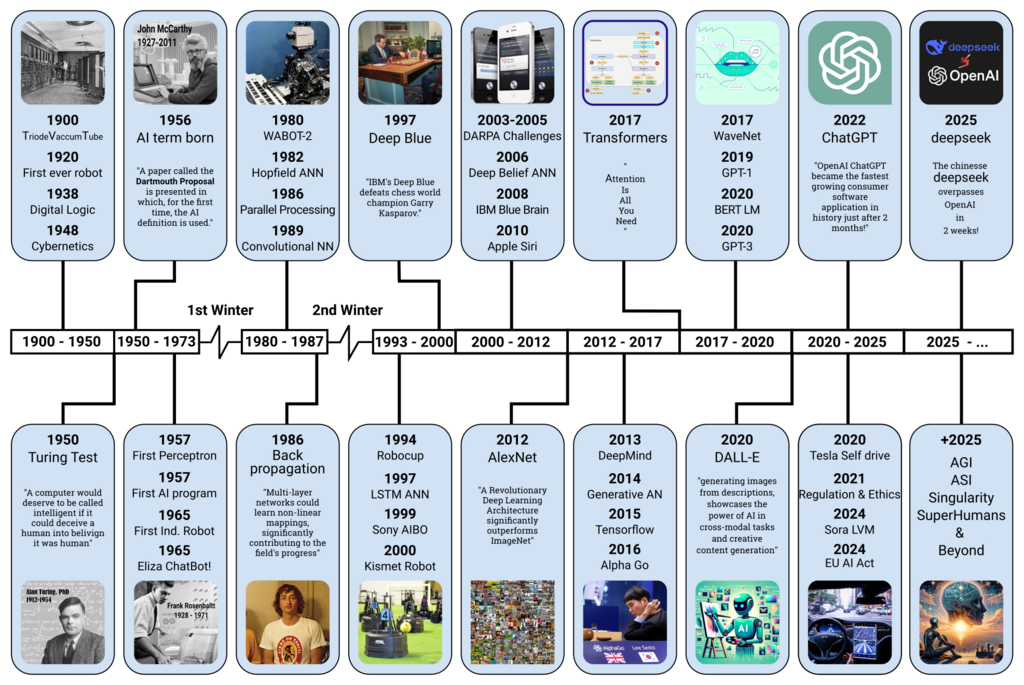
This combination has led to breakthroughs in a subfield of AI called machine learning, allowing computers to learn from examples and achieve remarkable results. Now that you have a basic grasp of what AI is, it's time to check your understanding.
What is the primary goal of artificial intelligence as it exists today?
The type of AI that can understand, learn, and apply its intelligence to solve any problem, much like a human, is known as: