Introduction to Artificial Intelligence
Introduction to AI
What Is Artificial Intelligence?
Artificial intelligence, or AI, is the science of making machines that can think like humans. It's about creating computer systems that can perform tasks that normally require human intelligence. This includes things like learning from experience, understanding language, recognizing objects, solving problems, and making decisions.
artificial intelligence
noun
A field of computer science dedicated to creating systems capable of performing tasks that typically require human intelligence.
Think about how you learn. You observe, you try things, you make mistakes, and you get better over time. AI aims to replicate this process in machines. It's not about creating robots with human emotions, like in the movies. Instead, it's about building tools that can analyze information and perform complex tasks, often much faster and more accurately than a person could.
The goal of AI is to create systems that can reason, learn, and act autonomously.
A Brief History
The dream of creating intelligent machines is ancient, but the formal field of AI began in the mid-20th century. The term "artificial intelligence" was first coined at a workshop at Dartmouth College in 1956. Early researchers were optimistic, believing that a machine as intelligent as a human being would exist in just a few decades.
Progress was slower than expected. The complexity of creating true intelligence led to periods of reduced funding and interest, sometimes called "AI winters." However, breakthroughs continued. In 1997, IBM's Deep Blue computer defeated world chess champion Garry Kasparov, a major milestone. This demonstrated that a machine could master a complex, strategic game once thought to be the exclusive domain of human intellect.
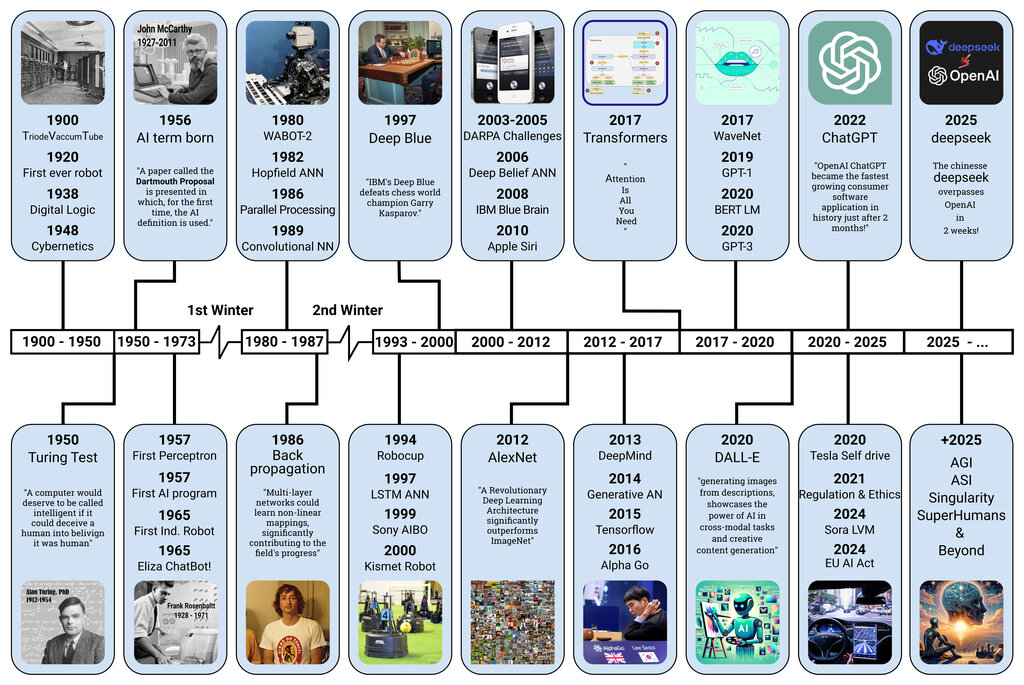
In recent decades, the growth of computing power and the availability of massive amounts of data have fueled an AI renaissance. We've seen the development of AI that can translate languages in real time, identify diseases from medical scans, and even create original art and music. These advances have brought AI out of the research lab and into our daily lives.
The Branches of AI
Artificial intelligence isn't a single technology. It's a broad field with many specialized subfields, each focused on a different aspect of intelligence.
Here are some of the most important branches:
- Machine Learning (ML): This is the engine behind most modern AI. Instead of being explicitly programmed, ML systems learn patterns directly from data. Your email's spam filter and the recommendation engine on a streaming service are both powered by machine learning.
- Natural Language Processing (NLP): This subfield gives machines the ability to understand, interpret, and generate human language. Digital assistants like Siri and Alexa, as well as language translation apps, rely on NLP.
- Computer Vision: This area focuses on enabling computers to see and interpret the visual world. Computer vision is used in everything from facial recognition on your phone to self-driving cars navigating the road.
- Robotics: This branch involves designing and building robots. While it includes physical hardware, robotics also heavily involves AI to give robots the ability to perceive their environment and make intelligent decisions.
A Meeting of Minds
AI is not just about programming. It's a deeply interdisciplinary field that draws on knowledge from many different areas of study.
- Computer Science provides the fundamental tools for building AI, including algorithms, data structures, and the raw power of computation.
- Mathematics, especially statistics and probability, is crucial for machine learning. It provides the framework for understanding data and quantifying uncertainty.
- Cognitive Science is the study of the human mind and intelligence. By studying how we think and learn, AI researchers can gain insights into how to build intelligent machines. This includes fields like psychology, neuroscience, and linguistics.
This blend of disciplines is what makes AI so powerful and dynamic. It's the intersection of technical skill, mathematical rigor, and the study of intelligence itself.
Time to test your knowledge of these fundamental concepts.
What is the fundamental goal of Artificial Intelligence (AI)?
The term "artificial intelligence" was first formally used at which event?
That's a quick look at the foundations of artificial intelligence. We've defined what it is, traced its history, and explored its main branches and the fields it draws upon.