Introduction to Artificial Intelligence
Introduction to Artificial Intelligence
What Is Artificial Intelligence?
Artificial intelligence, or AI, is about building machines that can think, learn, and solve problems like humans. It's not about creating conscious robots from science fiction. Instead, it’s about making software smart enough to perform specific tasks that normally require human intelligence.
This introduction to this special issue discusses artificial intelligence (AI), commonly defined as “a system’s ability to interpret external data correctly, to learn from such data, and to use those learnings to achieve specific goals and tasks through flexible adaptation.”
Think about how you recognize a friend's face in a photo. You process visual information, compare it to your memories, and make a connection. AI aims to give computers similar abilities, whether that’s recognizing faces, understanding spoken words, or even driving a car.
A Quick Trip Through Time
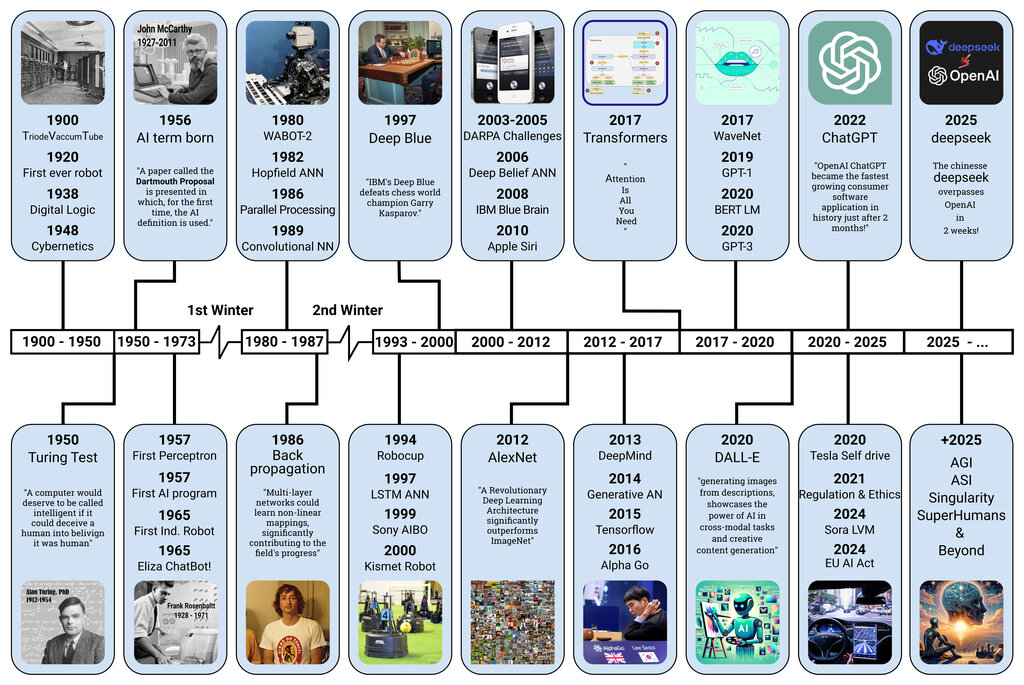
The dream of intelligent machines is ancient, but the actual field of AI is relatively young. The term "artificial intelligence" was first coined in 1956 at a conference at Dartmouth College. Early researchers were incredibly optimistic, believing that a machine as intelligent as a human was just a few decades away.
Progress wasn't a straight line. The field went through several “AI winters,” periods when funding dried up and public interest faded because the technology couldn’t live up to the hype. But breakthroughs kept happening. In 1997, a chess-playing computer called Deep Blue defeated the world champion, Garry Kasparov. This was a huge milestone, proving that a machine could strategize better than the best human player in one of the world's most complex games.
The last couple of decades have seen an explosion in AI. This is largely thanks to two things: the availability of massive amounts of data (the internet is a giant library for AIs to learn from) and the development of much more powerful computers.
The Branches of AI
AI isn't a single thing. It’s a broad field with many specialized branches, like different departments in a university. Each branch focuses on a particular aspect of intelligence.
Here are three of the most important branches:
-
Machine Learning (ML): This is the most common type of AI today. Instead of programming a computer with explicit rules for a task, machine learning lets the computer learn from data. You show it thousands of examples, and it starts to figure out the patterns on its own. Spam filters, recommendation engines, and stock market predictions all use machine learning.
-
Natural Language Processing (NLP): This branch focuses on the interaction between computers and human language. When you talk to a smart assistant like Siri or Alexa, or use a translation app, you're using NLP. The goal is to enable computers to understand, interpret, and generate human language in a way that is both meaningful and useful.
-
Computer Vision: This is the science of teaching computers to see. It involves processing and understanding information from images and videos. Computer vision powers everything from facial recognition on your phone to the systems that allow self-driving cars to navigate roads and avoid obstacles.
These subfields often overlap. For instance, an AI that describes the contents of a photo uses both computer vision (to see the photo) and natural language processing (to create the description).
These foundational areas are the building blocks of the AI applications we see all around us. Understanding them is the first step to understanding AI itself.