Introduction to Artificial Intelligence
Introduction to AI
What Is Artificial Intelligence?
Artificial Intelligence, or AI, is about creating systems that can think, learn, and adapt. Think of it less like a single technology and more like a broad field of science, much like biology or physics. The goal is to build machines that can perform tasks that typically require human intelligence.
Artificial intelligence (AI), commonly defined as “a system’s ability to interpret external data correctly, to learn from such data, and to use those learnings to achieve specific goals and tasks through flexible adaptation.”
Why does this matter? AI is the engine behind many tools you use every day. When your navigation app reroutes you around traffic, that's AI. When a streaming service recommends a movie you end up loving, that's also AI. It's quietly reshaping industries from healthcare to finance by finding patterns and making predictions on a scale far beyond human capability.
The Flavors of AI
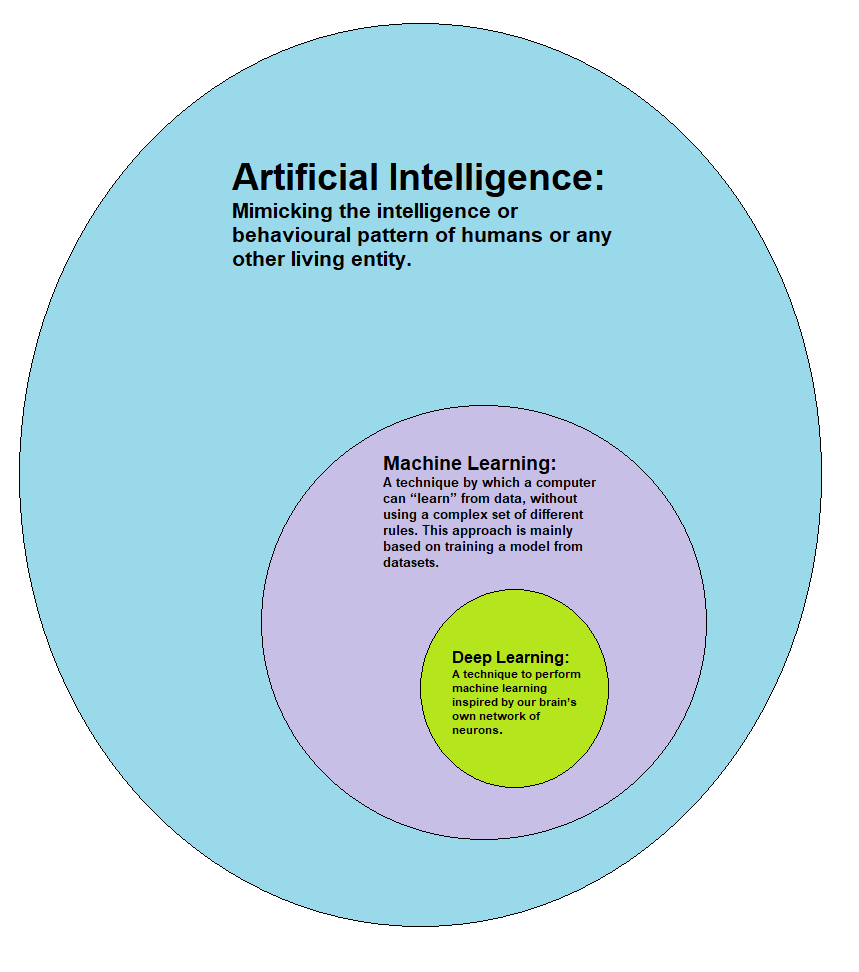
AI isn't a single entity. It's an umbrella term for several specialized subfields. Understanding these branches is the key to understanding AI itself. Let's look at the most prominent ones.
Machine Learning
noun
A subset of AI where systems learn and improve from experience without being explicitly programmed. Instead of following a strict set of rules, a machine learning model is trained on a large dataset to recognize patterns.
Imagine teaching a child to recognize a cat. You wouldn't list rules like "must have pointy ears, whiskers, and a tail." Instead, you'd show them pictures of many different cats. Eventually, they learn to identify a cat on their own. Machine Learning (ML) works in a similar way, by feeding an algorithm vast amounts of data until it learns to perform a task.
Another major area is Natural Language Processing, or NLP. This is all about the interaction between computers and human language. The goal of NLP is to enable computers to understand, interpret, and generate human language in a way that is both meaningful and useful.
Think about the digital assistants on your phone or smart speaker. When you ask a question, NLP is what allows the device to understand what you said, find the answer, and reply in a way that makes sense. It's also at the heart of language translation apps and chatbots.
Finally, there's Computer Vision. This field trains computers to see and interpret the visual world. Using digital images from cameras and videos, computer vision models can identify and classify objects, and then react to what they "see."
This technology powers everything from the facial recognition that unlocks your phone to the systems that allow self-driving cars to navigate roads and avoid obstacles. It's also used in medical imaging to help doctors spot signs of disease that might be missed by the human eye.
These subfields—Machine Learning, NLP, and Computer Vision—are the building blocks of modern AI. They often work together to create the powerful applications we use every day.
Time to review what you've just learned.
Now, let's test your understanding.
What is the primary goal of Artificial Intelligence as described in the text?
Which subfield of AI is most concerned with enabling computers to understand and interpret the visual world?
By understanding these core concepts, you've taken the first step toward grasping the power and potential of Artificial Intelligence.