Introduction to Artificial Intelligence
Introduction to Artificial Intelligence
What Is Artificial Intelligence?
Artificial intelligence is the science of making machines that can think and learn like humans. The goal is to create systems that can reason, solve problems, perceive the world, and understand language without being explicitly programmed for every single task. Instead of just following a strict set of instructions, an AI system learns from experience, just like we do.
Think of it this way: you can teach a dog to fetch a ball by repeating commands and rewarding it. AI works on a similar principle, but with data and algorithms instead of treats.
Algorithm
noun
A process or set of rules to be followed in calculations or other problem-solving operations, especially by a computer.
At its core, AI is about creating models that can make predictions or decisions based on patterns found in data. The more data the model sees, the better it gets at its job.
The Early Years
The idea of intelligent machines has been around for centuries, but the modern field of AI officially began in the summer of 1956. A group of scientists gathered for a workshop at Dartmouth College to explore the possibility of creating machines that could think. It was here that the term "artificial intelligence" was first used.
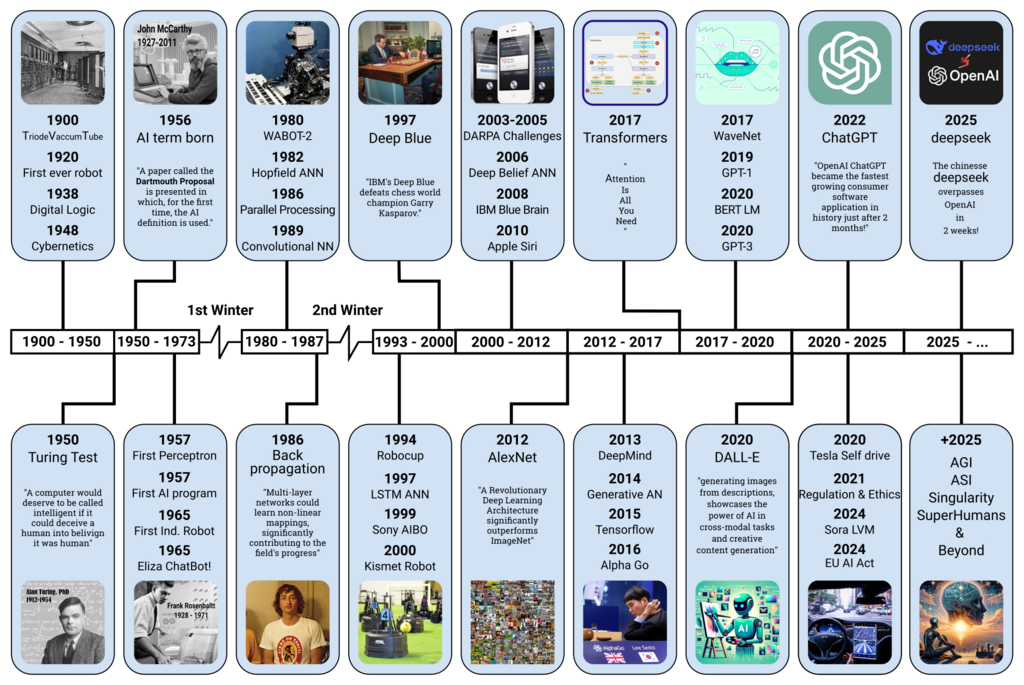
Early AI research focused on an approach called Symbolic AI, sometimes nicknamed "Good Old-Fashioned AI" or GOFAI. The idea was to program computers with human knowledge in the form of logical rules. For example, to build an AI that could identify a cat, researchers would write explicit rules like:
IFit has fur,THENit might be a cat.IFit has whiskers,THENit might be a cat.IFit meows,THENit is a cat.
This approach worked well for clearly defined problems, like playing chess or solving logic puzzles. The computer knew all the rules of the game and could calculate the best move based on that logic.
From Rules to Learning
Symbolic AI had its limits. The real world is messy and full of exceptions. What if a cat doesn't meow? What about a cat breed with no fur? Writing a rule for every single possibility is impossible. The systems were brittle; they couldn't handle new information or situations they weren't programmed for.
This led to a new approach: machine learning. Instead of giving the computer rules, scientists started giving it data. They would show the system thousands of pictures labeled "cat" and thousands labeled "not a cat." The algorithm would then learn the patterns on its own, figuring out what features (like pointy ears or a certain eye shape) are most associated with a cat.
A key milestone was Arthur Samuel's checkers program in 1959. It learned to play by playing thousands of games against itself, eventually becoming better than Samuel himself. It demonstrated that a machine could learn from experience without being explicitly taught every move.
The Deep Learning Revolution
In recent decades, a powerful subfield of machine learning called deep learning has driven many of the biggest breakthroughs in AI. Deep learning uses structures called artificial neural networks, which are inspired by the interconnected web of neurons in the human brain.
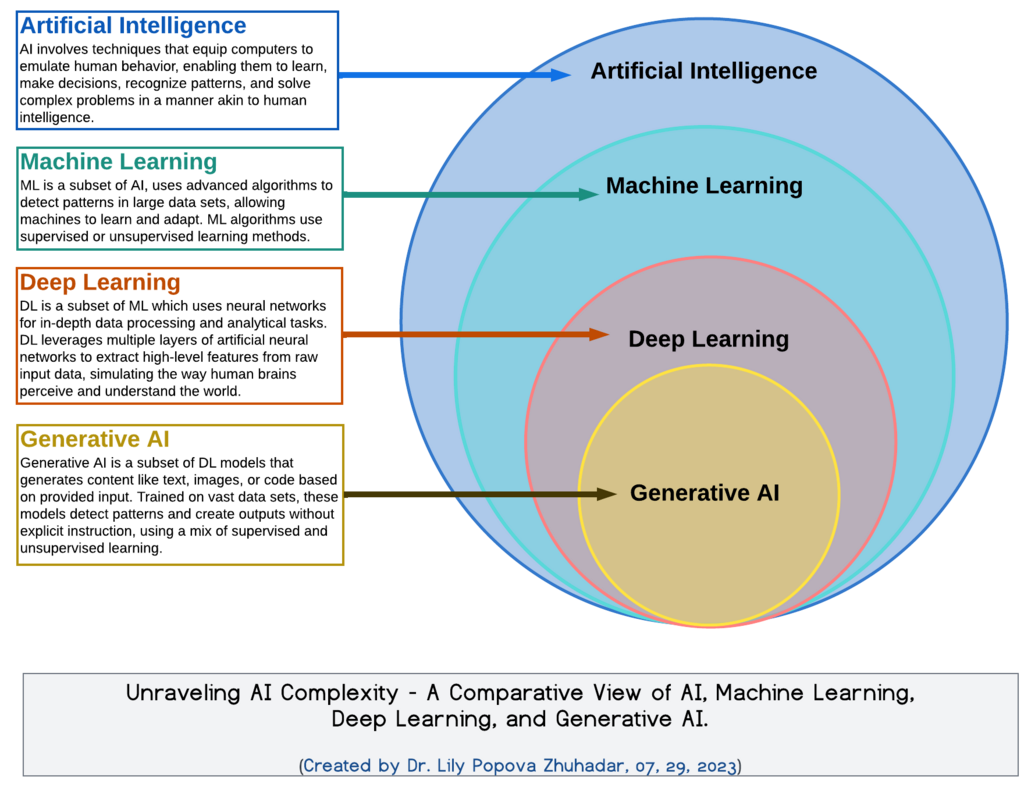
These networks consist of many layers of artificial neurons. When you feed data into the first layer, each neuron processes it and passes its output to the next layer. Each layer learns to recognize increasingly complex features. For our cat example, the first layer might learn to spot simple edges and colors. The next might combine those edges into shapes like ears or whiskers. The final layers would combine those shapes to identify a complete cat.
This layered approach allows the AI to learn very complex, abstract patterns from vast amounts of data. The rise of powerful computers and the availability of massive datasets (thanks to the internet) made deep learning practical and fueled the AI boom we see today.
This journey—from hard-coded rules to learning from data, and finally to deep, layered learning—is the story of AI's evolution. It's a shift from programming intelligence to growing it.