Introduction to Artificial Intelligence
Introduction to AI
What Is Artificial Intelligence?
At its core, artificial intelligence is the science of making machines that can think or act intelligently. The goal is to create systems that can perform tasks that normally require human intelligence, like understanding language, recognizing patterns, solving problems, and learning from experience.
Artificial Intelligence
noun
A field of computer science dedicated to creating systems capable of performing tasks that typically require human intelligence.
AI research is driven by several key objectives. Scientists aim to build systems that can:
- Reason and problem-solve: Look at a problem, consider different options, and choose the best path forward.
- Represent knowledge: Store what they know or learn in a way that's useful for future tasks.
- Learn: Improve their performance over time by analyzing data and outcomes.
- Process language: Understand and generate human language, both spoken and written.
- Perceive the world: Interpret information from sensors, like cameras and microphones, to understand their surroundings.
The ultimate goal is to build a machine with a flexible intelligence that mirrors our own, but the journey involves tackling these capabilities one by one.
More Than Just Code
Creating intelligence requires more than just programming. AI is a truly interdisciplinary field, drawing insights and techniques from many different areas of study. To build a thinking machine, you first have to understand what thinking is.
Each of these fields provides a crucial piece of the puzzle:
- Computer Science offers the programming languages, algorithms, and computing power to build AI systems.
- Cognitive Psychology studies how humans think, learn, and perceive, providing models for AI to emulate.
- Neuroscience investigates the physical structure of the brain, inspiring the design of artificial neural networks.
- Linguistics is the study of language, essential for developing AI that can understand and communicate with us.
- Philosophy tackles fundamental questions about the nature of intelligence, consciousness, and ethics.
- Mathematics provides the formal logic and statistical tools that underpin nearly all AI algorithms.
A Quick Trip Through Time
While the dream of creating artificial beings is ancient, the scientific pursuit of AI is much younger. The field officially began in the mid-20th century, and its history has been a rollercoaster of breakthroughs, excitement, and periods of doubt.
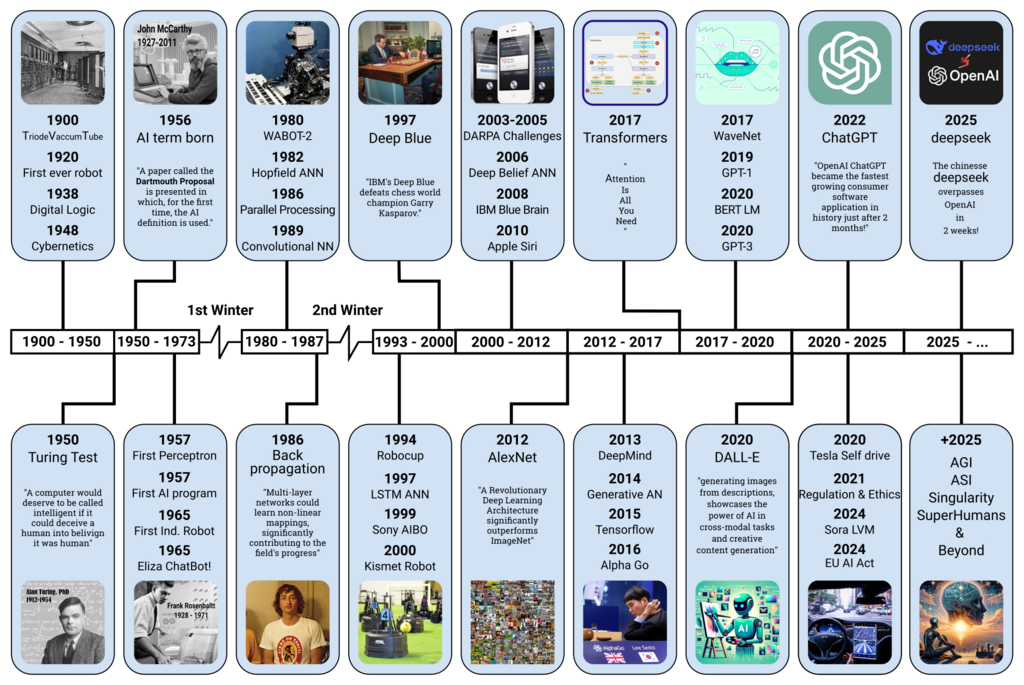
A pivotal moment came in 1956 at the Dartmouth Workshop, where the term "Artificial Intelligence" was first coined. This gathering of researchers sparked decades of work. Early AI research saw some quick successes in solving puzzles and playing games, leading to a wave of optimism.
However, researchers soon discovered that creating true intelligence was much harder than they anticipated. The complexity of real-world problems led to the so-called "AI winters" in the 1970s and late 1980s, when funding dried up and progress slowed.
The field was revived by the rise of machine learning, a new approach where systems learn patterns directly from data rather than being explicitly programmed. This led to more robust and practical applications. In the 2010s, a subfield of machine learning called deep learning, powered by massive datasets and powerful computers, triggered the AI boom we are experiencing today.
Let's test your understanding of these foundational ideas.
What is the core goal of artificial intelligence?
Which academic discipline provides the formal logic and statistical tools that are foundational to most AI algorithms?
Understanding AI's roots helps us appreciate how far the field has come and provides context for where it might go next.