Introduction to Artificial Intelligence
Introduction to Artificial Intelligence
What Is Artificial Intelligence?
At its core, artificial intelligence is the science of making machines smart. It's a field of computer science dedicated to creating systems that can perform tasks that normally require human intelligence. This includes things like learning from experience, understanding language, recognizing objects and sounds, and solving problems.
Think of it this way: You can easily tell the difference between a cat and a dog. But for a computer, this is a complex task. AI gives a computer the ability to "learn" what a cat and a dog look like, so it can make that distinction on its own.
The main goal of AI is to create tools that can reason, learn, and adapt. Some AI is designed for very specific tasks, like playing chess or recommending movies. This is often called Narrow AI. The bigger, more futuristic goal is to create Artificial General Intelligence (AGI), a type of AI that could perform any intellectual task a human can.
Artificial Intelligence
noun
A branch of computer science dealing with the simulation of intelligent behavior in computers.
The AI Family Tree
Artificial Intelligence isn't just one single thing; it's a broad field with many specialized branches. The most important branches to know are Machine Learning, Deep Learning, and Natural Language Processing. Understanding how they relate to each other is key.
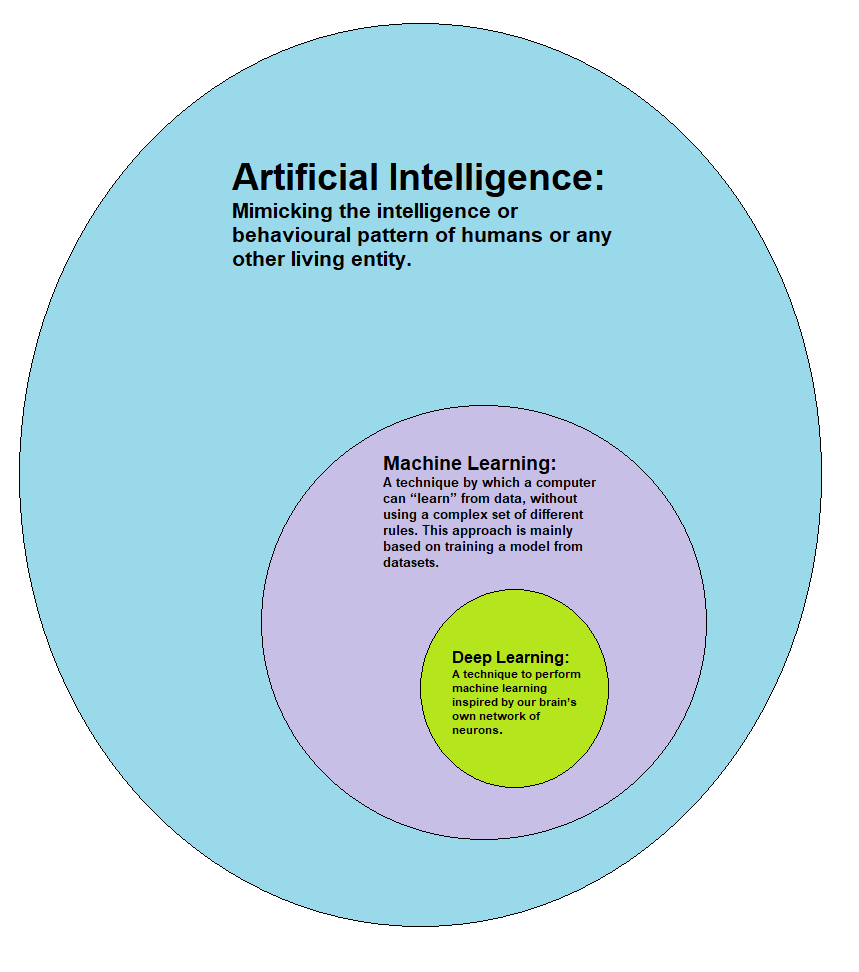
Machine Learning (ML) is a subset of AI. Instead of programming a computer with explicit rules for a task, you give it lots of data and let it learn the rules for itself. For example, a spam filter in your email learns to identify junk mail by analyzing millions of emails that users have marked as spam.
Deep Learning (DL) is a specialized type of machine learning. It uses structures called neural networks, which are inspired by the human brain. Deep learning is especially powerful for finding complex patterns in huge amounts of data, like images, sound, and text. It's the technology that powers facial recognition and enables voice assistants to understand what you're saying.
Natural Language Processing (NLP) is another branch of AI focused on the interaction between computers and human language. Its goal is to enable machines to read, understand, interpret, and generate human language. Every time you use a translation app or ask a chatbot a question, you're interacting with NLP.
| Subfield | What It Does | Real-World Example |
|---|---|---|
| Machine Learning | Learns patterns from data without explicit instructions. | A streaming service recommending movies you might like. |
| Deep Learning | A type of ML using brain-like neural networks for complex patterns. | A self-driving car identifying a pedestrian. |
| Natural Language Processing | Enables computers to understand and use human language. | A smart speaker like Alexa or Siri responding to your commands. |
Why AI Matters
AI is no longer just a concept from science fiction. It's a fundamental part of modern technology, working behind the scenes in many of the tools we use every day. It's changing how we work, live, and interact with the world.
In healthcare, AI helps doctors diagnose diseases earlier and more accurately by analyzing medical images like X-rays and MRIs. In finance, it detects fraudulent transactions in real-time, protecting consumers and banks. For shoppers, AI powers the recommendation engines that help you discover new products on sites like Amazon.
By automating complex and repetitive tasks, AI allows us to solve problems that were previously too difficult or time-consuming for humans alone. It's a tool for augmenting human capabilities, helping us make better sense of a world that is increasingly filled with data.
Time to check what you've learned.
What is the primary goal of Artificial Intelligence?
Which of the following statements accurately describes the relationship between AI, Machine Learning (ML), and Deep Learning (DL)?
Now that you have a foundational understanding of AI and its key subfields, you're ready to explore how these powerful technologies are put into practice.