Introduction to Artificial Intelligence
Introduction to Artificial Intelligence
What Is Artificial Intelligence?
Artificial Intelligence is the science and engineering of making intelligent machines. The goal is to create systems that can perform tasks that typically require human intelligence, like learning from experience, solving problems, understanding language, and recognizing objects.
Think of it this way: AI gives a computer a mind of its own, allowing it to think and learn in a way that mimics a human brain.
Artificial Intelligence
noun
The theory and development of computer systems able to perform tasks that normally require human intelligence, such as visual perception, speech recognition, decision-making, and translation between languages.
AI, Machine Learning, and Deep Learning
People often use the terms Artificial Intelligence, Machine Learning, and Deep Learning interchangeably, but they have distinct meanings. The relationship between them is like a set of Russian nesting dolls.
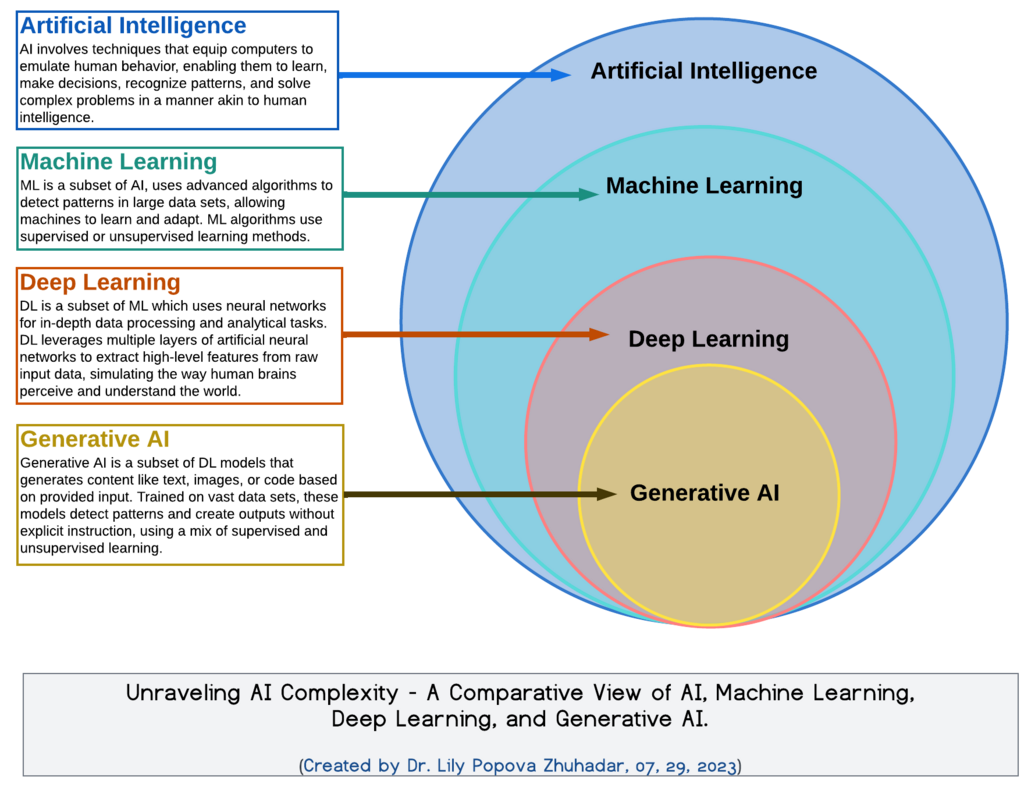
- Artificial Intelligence (AI) is the all-encompassing concept of creating intelligent machines.
- Machine Learning (ML) is a subset of AI. It's an approach where we give machines access to data and let them learn for themselves without being explicitly programmed for every task. Instead of writing step-by-step instructions, developers create algorithms that allow the computer to find patterns in data.
- Deep Learning (DL) is a subset of machine learning. It uses complex, multi-layered neural networks—inspired by the structure of the human brain—to process data and make decisions. This is the technology behind many of today's most advanced AI applications, like self-driving cars and advanced image recognition.
A Brief History
The idea of artificial beings with intelligence has been around for centuries, but the scientific field of AI is much younger. The term "Artificial Intelligence" was first coined in 1956 at a conference at Dartmouth College. This event brought together the founding fathers of the field and kicked off decades of research.
Early AI research was full of optimism. Pioneers believed that a machine as intelligent as a human being would exist in no more than a generation.
Progress came in waves. The early years saw breakthroughs in problem-solving and symbolic reasoning. But the excitement was followed by periods of reduced funding and interest, often called "AI winters," when the technology couldn't live up to the hype.
The 21st century has seen a massive resurgence. This revival is driven by two key factors: the availability of vast amounts of data (thanks to the internet) and the development of powerful, affordable computing hardware. These ingredients allowed deep learning techniques to flourish, leading to the rapid advancements we see today.

From theoretical beginnings to powerful, real-world systems, the journey of AI has been one of ambition, setbacks, and incredible breakthroughs. Understanding this foundation is the first step to grasping where this technology is headed.