Introduction to Artificial Intelligence
Introduction to AI
What Is AI Anyway?
At its core, artificial intelligence is the science of making machines that can think like humans. It's a broad field in computer science focused on creating systems that can perform tasks that typically require human intelligence. This includes things like learning from experience, understanding language, recognizing objects, and solving problems.
Artificial Intelligence
noun
A field of computer science dedicated to creating systems capable of performing tasks that normally require human intelligence.
Think of it like teaching a computer. Instead of giving it a rigid set of instructions for every single possibility, you give it the ability to learn and adapt on its own. Just as a child learns to identify a dog by seeing many different dogs, an AI system learns by analyzing vast amounts of data.
A Journey Through Time
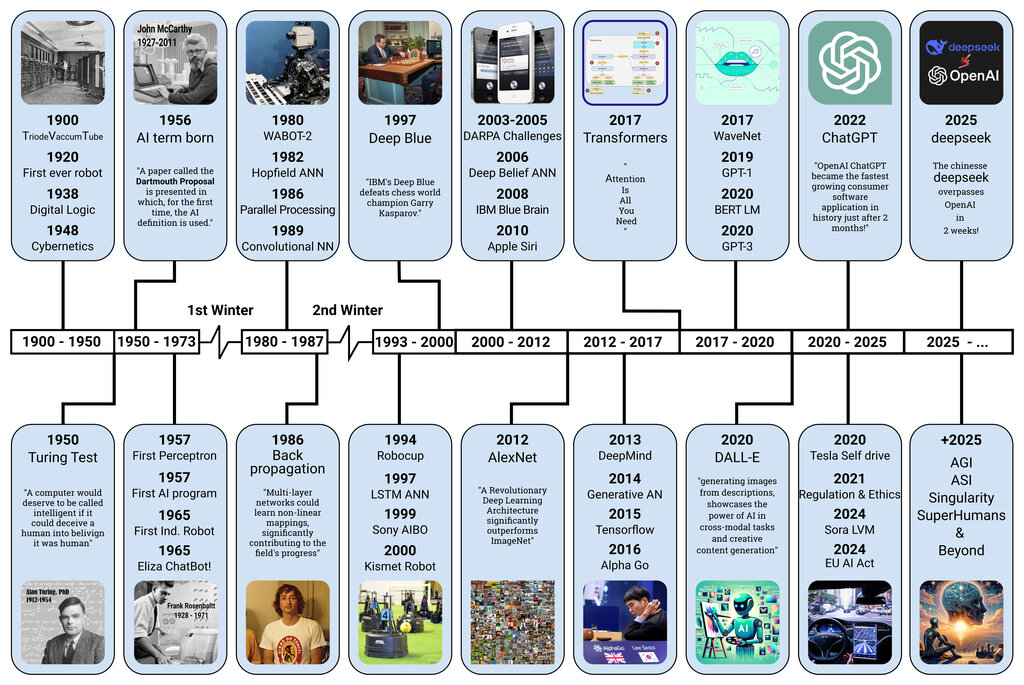
The idea of intelligent machines has been around for centuries, but the formal field of AI research is relatively new. It all started with foundational ideas in the mid-20th century.
In 1950, computer scientist Alan Turing proposed the "Turing Test," a test of a machine's ability to exhibit intelligent behavior equivalent to, or indistinguishable from, that of a human. A few years later, in 1956, the term "artificial intelligence" was officially coined at the Dartmouth Workshop. This event brought together the founding fathers of AI and marked the birth of the field.
The early years were filled with excitement and bold predictions. Researchers developed programs that could solve algebra problems and play checkers. However, progress slowed in the 1970s and 80s, leading to periods known as "AI winters," when funding and interest dried up due to the technology's limitations.
Things picked up again in the 1990s. A major milestone occurred in 1997 when IBM's Deep Blue chess computer defeated world champion Garry Kasparov. This event showed that machines could tackle complex, strategic tasks once thought to be exclusively human. The rise of the internet and the explosion of digital data in the 2000s provided the fuel needed for the next big leap: machine learning and deep learning.
The Basic Principles
So, how do AI technologies actually work? While the details can get complex, the basic principle is about learning from data. AI systems are trained on massive datasets to recognize patterns, make predictions, and decide on actions.
At the heart of AI are algorithms, which are sets of rules or instructions that a computer follows to achieve a goal. In AI, these algorithms are designed to allow the machine to learn from data without being explicitly programmed for every scenario. This is the core idea behind machine learning, a major subfield of AI.
Think of a spam filter for your email. It wasn't programmed with a list of every possible spam email. Instead, it learned to identify spam by analyzing millions of emails labeled as either "spam" or "not spam." It identified common patterns in spam messages—like certain keywords or sender addresses—and uses that knowledge to filter your inbox.
Deep learning is a more advanced type of machine learning inspired by the structure of the human brain. It uses layers of interconnected "neurons" to process information and discover incredibly complex patterns in data. This is the technology behind self-driving cars recognizing pedestrians and voice assistants understanding your speech.
AI isn't about magic. It's about using data and clever algorithms to enable computers to learn, reason, and act.
Now that you've got the basics down, let's test your knowledge.
What is the fundamental principle behind how most modern AI systems, like email spam filters, operate?
What was the significance of the 1956 Dartmouth Workshop in the history of AI?
Understanding these foundational ideas is the first step in appreciating the power and potential of artificial intelligence.