Introduction to Artificial Intelligence
Introduction to AI
What Is Artificial Intelligence?
Artificial Intelligence, or AI, is the science of making machines that can think and act like humans. The goal is to create systems that can perform tasks that typically require human intelligence, like understanding language, recognizing patterns, and making decisions.
Artificial Intelligence
noun
A field of computer science dedicated to creating systems that can perform tasks that normally require human intelligence. This includes abilities like learning, reasoning, problem-solving, perception, and language understanding.
Think about how you learn. You observe, you try things, you get feedback, and you adapt. A key objective of AI is to build machines that can do the same. This involves several distinct capabilities:
- Learning: Acquiring knowledge and rules for using that knowledge.
- Reasoning: Using rules to reach approximate or definite conclusions.
- Problem-solving: Figuring out solutions to specific challenges.
- Perception: Understanding the world through senses like sight and sound.
- Language: Understanding and generating human language.
At its core, AI is about creating tools that can augment and extend our own intelligence.
A Brief History
The dream of creating intelligent machines has been around for centuries, but the formal field of AI research began in the 1950s. The journey has been one of incredible optimism, frustrating setbacks, and breathtaking breakthroughs.
Understanding AI's historical development provides essential context for navigating its future.
The 1956 Dartmouth Workshop is often cited as the birthplace of AI as an academic field. Early research was full of promise, with pioneers creating programs that could solve algebra problems and play checkers. But the initial excitement was followed by periods known as "AI winters," when funding dried up due to slow progress and overblown promises.
Things began to heat up again in the 1980s with the rise of machine learning. The pace has only accelerated since, with major milestones marking AI's growing power.
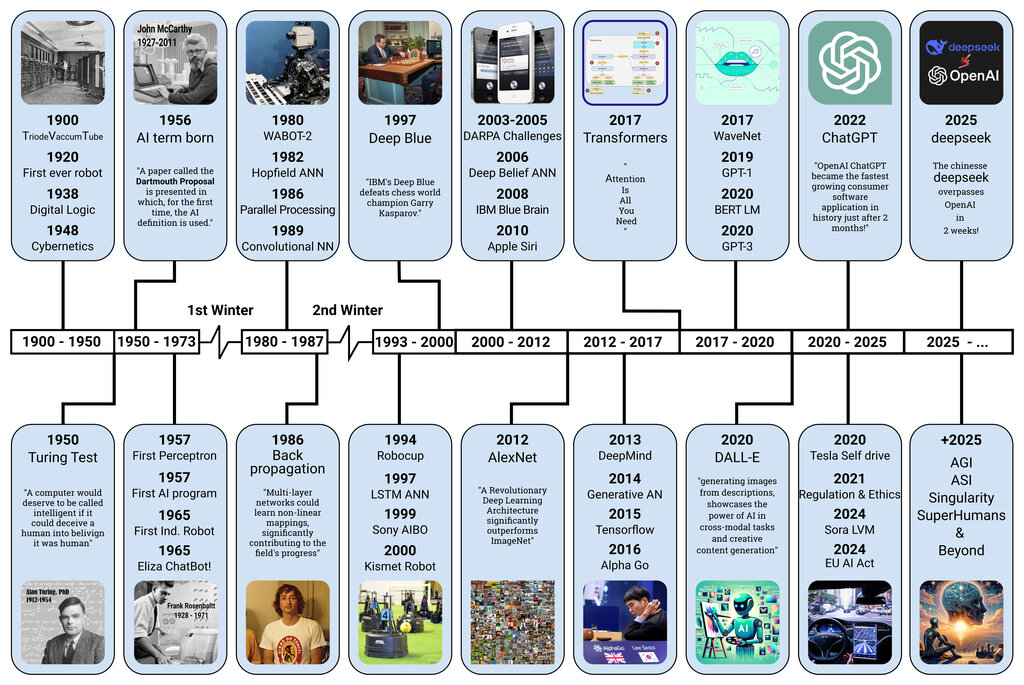
From Deep Blue defeating chess grandmaster Garry Kasparov in 1997 to the rise of large language models like ChatGPT, each step has built on the last, bringing us closer to the sophisticated AI we see today.
Two Kinds of AI
When people talk about AI, they are usually referring to one of two broad categories. The distinction between them is crucial for understanding what AI can and can't do right now.
Artificial Narrow Intelligence (ANI), sometimes called Weak AI, is what we have today. ANI is designed to perform a single, specific task exceptionally well. The AI that recommends movies on Netflix, the voice assistant on your phone, and the software that detects spam in your email are all examples of narrow AI. They are experts in their one domain but cannot operate outside of it. The AI that plays chess can't write a poem or diagnose a disease.
Artificial General Intelligence (AGI), or Strong AI, is the kind of AI you often see in science fiction. AGI would possess the ability to understand, learn, and apply its intelligence to solve any problem, much like a human being. It would have consciousness, self-awareness, and the flexibility to handle unfamiliar tasks. Creating AGI is the ultimate goal for many AI researchers, but it remains a theoretical and distant concept.
AI in the Real World
Even without AGI, narrow AI is already transforming our world. It's not just about smart speakers and streaming services. AI is a powerful tool being applied across nearly every industry to solve complex problems and improve efficiency.
| Industry | Application of AI |
|---|---|
| Healthcare | Analyzing medical images to detect diseases like cancer earlier and more accurately. |
| Finance | Detecting fraudulent transactions in real-time and automating trading strategies. |
| Transportation | Powering self-driving cars and optimizing traffic flow in smart cities. |
| Retail | Personalizing shopping experiences and managing inventory with predictive analytics. |
| Entertainment | Creating special effects in movies and generating personalized content recommendations. |
| Agriculture | Monitoring crop health with drones and predicting yields to improve food production. |
These applications show how AI is already a fundamental part of modern technology. From small conveniences to life-saving innovations, its impact is widespread and growing every day.
What is the primary goal of Artificial Intelligence?
The type of AI that can perform a wide variety of tasks at a human level of intelligence, similar to what's often depicted in science fiction, is known as ______.
As you continue to learn, you'll see how these foundational ideas connect to the more complex technologies that power the AI systems we use.